
The world is witnessing a coup taking place in the USA as Trump and Musk set about dismantling the US government, ignoring all congressional legislation and fiscal authority. The Constitution has effectively been suspended. Trump and Musk are leading extra-governmental operatives (young white male engineers employed by Musk) who have seized control of the Treasury payment system, and IT systems in other agencies such as USAID. They are starting to eliminate agencies created by Congress, the first being USAID. They are suspending payments authorized by law, re-interpreting the Constitution, and ignoring the judiciary. Already, several judges have made orders suspending various of their activities. They are being ignored. Ultimately, much later, such orders may end up in the Supreme Court who have already ruled that Trump has immunity for official actions.
What has led to this? How did the world’s richest man and a deeply ignorant psychopathic criminal get to seize control of government in the USA?
Timothy Snyder, a leading historian of fascism, wrote a few days ago on Substack:
“The people who now dominate the executive branch of the government deny all of this, and are acting, quite deliberately, to destroy the nation. For them, only a few people, the very wealthy with a certain worldview, have rights, and the first among these is to dominate.
“For them, there is no such thing as an America, or Americans, or democracy, or citizens, and they act accordingly. Now that the oligarchs and their clients are inside the federal government, they are moving, illegally and unconstitutionally, to take over its institutions.”
They have allied with the MAGA supporters of Trump, who also seek to overturn US government institutions and to implement laws based on pre-modern values, and who seem will to allow the oligarchs to seize power as long as the serfs can re-enslave women and either get rid of the non-whites or force them into “black jobs” (a term actually used by Trump in his campaign).
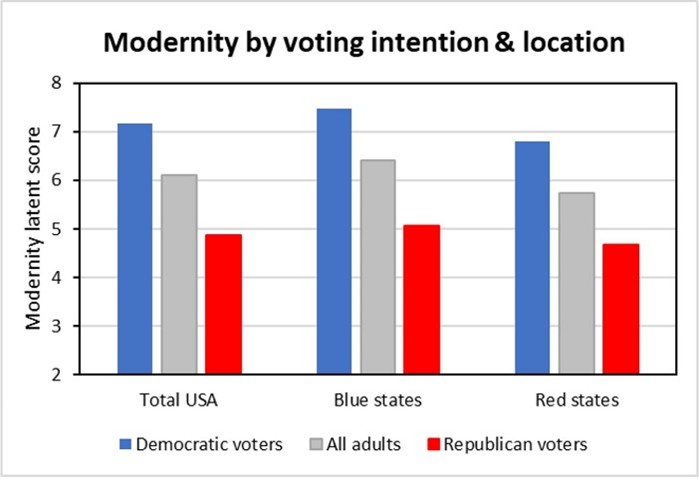
In an earlier post, I examined levels of modern and pre-modern beliefs in red states and blue states using US data from the World Values Survey spanning the period 1981 to 2021. States were classified as red or blue based on State votes in Presidential elections from 2000 to 2020 as reported by Wikipedia. I used the survey data to estimate an underlying latent variable “modernity” based on responses to 11 selected questions on values (see here for details).
The following graph shows the average modernity scores for Democrat and Republican voters in blue and red states for the broad period 2005-2020. The modernity score has been scaled so the average values for countries ranges from just above zero to just below 10.
The following graph summarizes trends over time for the average modernity of Democrat voters in blue states and Republican voters in red states. The graph also shows selected groups of 3 to 4 comparison countries with similar values to the two US subgroups. I also included a group of the three countries with the most modern values and three countries with very pre-modern values to provide a global context for the range and trends in modernity. Averages for the country groups are arithmetic averages of their modernity scores, not population-weighted averages.
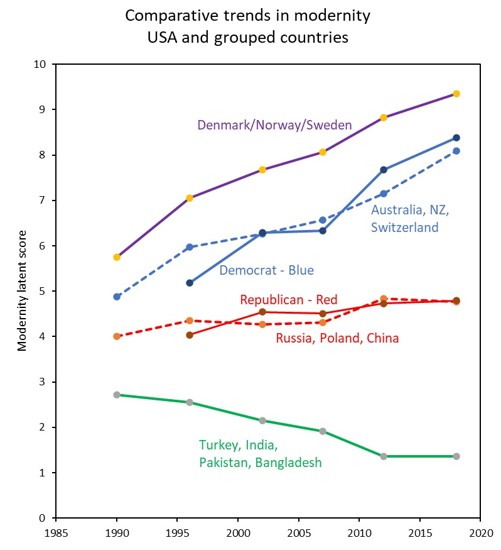
It is immediately clear that modernity of values has been increasing at a substantial rate for Democrat voters in blue States. And modernity of values has increased only slightly in red states over the same period, leading to a widening values gulf. A gulf that has almost certainly widened further in subsequent years.
Blue-Democrats have followed a very similar trajectory to the average of Australia, New Zealand and Switzerland over the last three decades, with relatively rapidly rising levels of modernity. This puts them very much in the company of modern Western secular states. In contrast, the red-Republicans level of modernity tracks closely the average for Russia, Poland, and China, and currently falls about halfway between that of China and Russia. This probably is a factor in explaining why they are quite happy for their cult leader Trump to openly admire and support Putin and other dictators and despise and attack the leaders of the democratic countries of Europe.
A US economist has calculated a US state-level version of the UN Human Development Index, which combines summary indicators for income, education, and health (see here). The average AHDI for red states is much lower than that for blue states. The blue state ADHI is similar to that for the Australia and New Zealand, Switzerland’s is a little higher. The red state ADHI is very similar to that for Russia. This tells a story remarkably similar to that of my modernity index. In another post, I examined the differences in life expectancy between blue and red states, which widened in 2021 when covid vaccines became available and were taken up to a greater extent in blue states than red./i
The latest US survey was carried out in 2017 and it’s entirely possible that data from 2018 onwards would also reflect increasing anti-modernism given the dramatic increase in moral panic about gays and trans people among Republican supporters, the rising censorship of books and speech in the south, and the reproductive re-enslavement of women that is underway.
The higher levels of pre-modern values in red states go hand-in-hand with greater involvement in religion, particularly in Christian fundamentalism. Its not really possible to disentangle causal relationships here. People with pre-modern values will seek out pre-modern forms of religion, and equally, pre-modern religious leaders will promote and enforce pre-modern values, not only on their followers, but also to the extent possible, on laws and governance of their states.
I estimated not only the prevalence of atheism (people who did not say “Yes” to the question “Do you believe in God”) but also the prevalence of the non-religious, those people who say they believe in God but do not practice a religion and rates the importance of God as any of the three points at the not important end of a 10-point scale. In most countries, the prevalence of the non-religious is at most one or two percentage points. The USA stands out with 6% in the non-religious category. I suspect this is because atheism is stigmatized in the USA, unlike in most other high-income countries.
I have projected the prevalence of the irreligious (non-religious plus atheists) forward from the most recent surveys in the Integrated Values Survey (WVS plus EVS). The projection to 2025 is based on the recent country-specific trends over the last two waves of the surveys.
In an earlier analysis of WVS survey data, I found that the prevalence of atheism was rising faster in the USA than in other developed countries apart from South Korea. I opted for a more conservative projection rate for the USA, based on my earlier estimates of the rate at which the modernity index has been changing in red and blue states. This results in projected prevalences of irreligion in 2025 of 33% overall, 39% for blue states and 27% for red states.
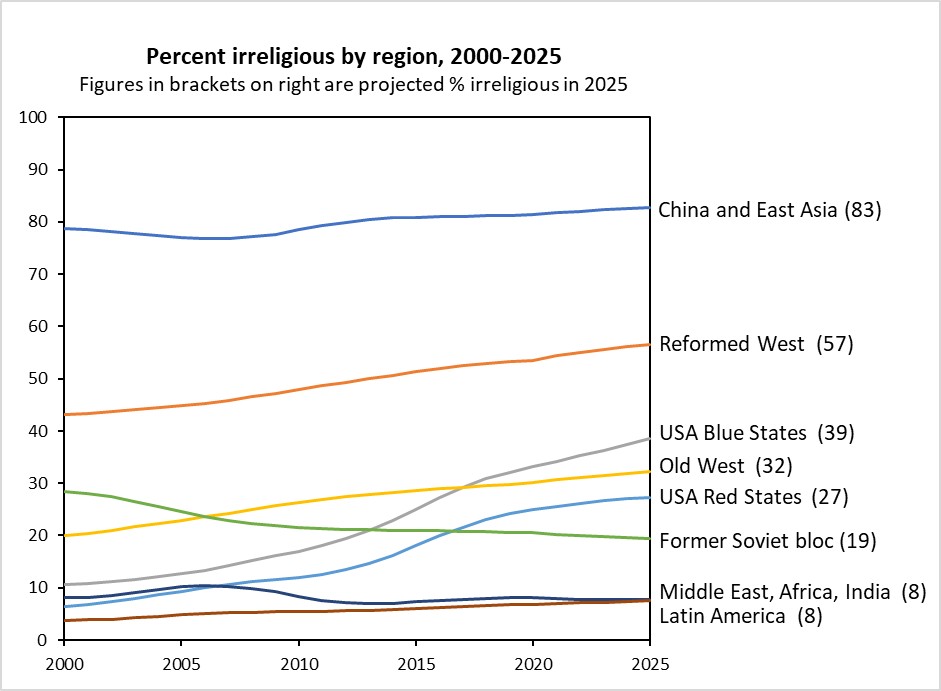
China and East Asia have the highest levels of irreligion (83% in 2025) reflecting the dominance of non-theistic religions in the past and the current religious repression by authoritarian regimes in China and North Korea. Throughout the first decades of the 21st century, the prevalence of irreligion has grown substantially in the USA, the Reformed West and the Old West. The Reformed West includes the countries of western and northern Europe substantially influenced by the Reformation, as well as Canada, Australia and New Zealand. The Old West includes the countries of eastern and southern Europe much less influenced by the Reformation. Irreligion has declined in most former Soviet bloc countries. Latin America, the Middle East and India have levels of irreligion below 10%.
It is noteworthy that a majority are now irreligious in the Reformed West. Actively religious people are a distinct minority with less than 14% of the population attending religious services once a month or more often. Is it a coincidence that these countries have the most comprehensive social safety nets, highest levels of education and gender equality, and generally come at the top of any international rankings of happiness or quality of life?
It is also notable that the more democratic countries have higher levels of irreligion, China and East Asia aside. The Economist Intelligence Unit has been publishing the Economist Democracy Index every year since 2006. This index measures the quality of democracy in 167 countries across the world. The Index ranges between 0 and 10, and is also used to group countries into four categories:
Full democracy. Civil liberties and fundamental political freedoms are respected and enforced. Governments function adequately, there are valid checks and balances, an independent judiciary and an independent media.
Flawed democracies. Democracies with problems such as limitations on judicial independence, or media freedom, some suppression of political opponents, low levels of participation in politics, or limitations in government functioning.
Hybrid regimes. Countries with regular electoral fraud, non-independent judiciary and/or media, widespread corruption and issues with functioning.
Authoritarian regimes. Political opposition is nonexistent, abuses of civil liberties common. Elections are not fair, often sham, criticism is suppressed. The countries are often absolute monarchies, dictatorships or one-party states.
The latest Index for 2023 classifies only 24 countries as full democracies, 50 as flawed democracies, 34 hybrid regimes and 59 authoritarian regimes. The USA has been classified as a flawed democracy since 2016 and I suspect it will likely be downgraded to a hybrid regime in 2025. How do levels of irreligion vary across regime type. I used the 2023 index to calculate average percent irreligious in 2023 using my projections from the IVS surveys. These are shown in the Table below.
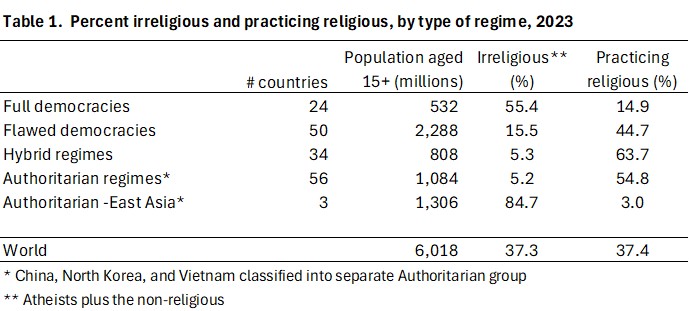
Full democracies have high levels of irreligion, atheists are generally more than 50% of the population and practicing religious are distinct minority. All 13 of the Reformed West countries fall into the Full Democracy category. Flawed democracies and undemocratic regimes are characterised by low levels of atheism and high levels of religious practice, apart from East Asia. This is not surprising, as pre-modern forms of organized religion are generally authoritarian in nature.
Believers in pre-modern forms of religion are either in developing countries whose culture has not generally evolved towards modern values or are in modern countries and essentially rebelling against modernity. Both groups are characterised by generally poor levels of education, their literal interpretation of selected parts of their sacred books, acceptance of a primitive theology which posits their god or gods operating through punishment and reward, and acceptance of authoritarian leaders. In the case of the USA, racism and religious fundamentalism have become fused as white Christian nationalism, a form of “Christianity” which bears little resemblance to any teachings of Jesus.
The white supremacists now in control of the US government are busy hunting down and sacking government employees who are not loyal, the wrong colour or gender, or have the misfortune to have a disability. They are were elected and supported by MAGA and their fellow travellers who would rather burn down the country than let minorities, women, and the non-religious flourish in it. The tech billionaires have allied with these Trumpers, as they see the opportunity to remove all barriers to the re-feudalisation of the workforce and accelerate their own enrichment and power. Its not looking good for humanity or modern freedoms.
 Mountains and rivers
This is an excellent breakdown, concisely presented and in strong command of the relevant facts and sociology.
This new reality, though, grows out of earlier “pre-modern” movements in US life, in particular the business ideology under the former Hollywood actor, and the 50s Christian nationalist hysteria under the McCarthy/Eisenhauer/Birchite wing. Business morons have allied with fascism and nazism for decades now in the US, so this is not so much a “coup” as a demented radicalization of long-established trends.
I cannot see how “democracy” can be applied to socio-political conditions under the Citizens United opening of the gates for the WWE-style corporate media. The voting populace is enfranchised in xenophobic nationalist religious ignorance and illiteracy stoked by the shifting of huge amounts of corporate advertising and thought control between the two established parties, and we are supposed to see “democracy” in that?
Of course, I should also say that I am not presenting the case for direct democracy. Jason Brennan, an otherwise deluded libertarian, makes an excellent case in “Against Democracy” for removing the very important and consequential outcomes of voting from the rule of stupidity. Plumbers should be rigorously certified as competent; so should voters.
The courts can erect momentary bulwarks despite their business ideology corruption to this madness, but collapse in various sectors from degovernmentalization will be the far more potent, yet completely tragic, opposing force. I agree: not good.
After Citizens United, the corporations have essentially bought both parties. The silence of the Democrats and the surrender of the mainstream media are testament to that.