Christmas skiing in the Swiss Alps

A couple of days before Christmas, my younger son invited me to join him for a day skiing in the Swiss Alps.  Champéry lies in a side valley of the Rhone valley under the Dents du Midi (“Teeth of Noon”) mountain range. I’d last skied there years ago (see earlier post). At less than a day’s notice, I rang the hotel he was staying at and booked a room for the night. The hotels and the ski slopes were half empty because of the Covid travel bans, particularly for the many British who had planned ski holidays in Switzerland and nearby France.

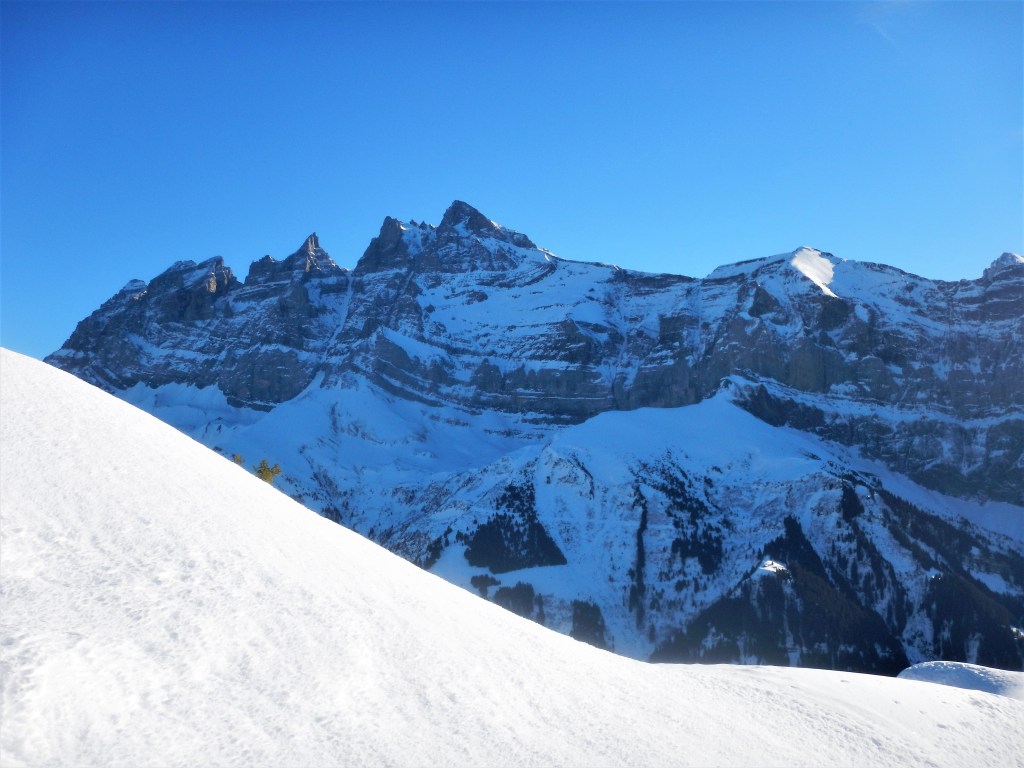
Les Dents du Midi (Teeth of the Noon)
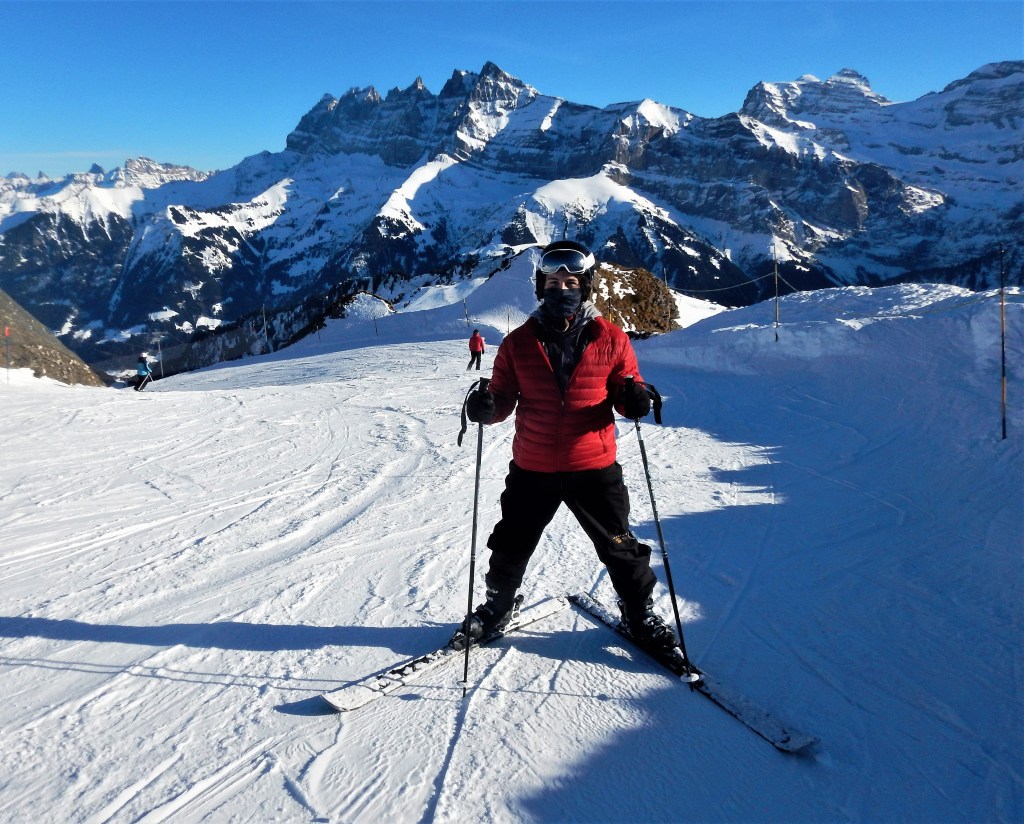
My son at around 2000 m with the Dents du Midi behind him.
Continue reading

Modern and pre-modern religious values: an update

In a recent post, I presented revised estimates for trends in the prevalence of atheism and religiosity for 110 countries over the last 40 years. This was based on a new analysis of the 2021 release of combined data for the WVS and EVS in the Integrated Values Surveys (IVS) 1981-2021 [1, 2]. The main revision to the dataset was to correct an error in the data for the USA. This post summarizes my updated analysis of modern and pre-modern religious values and for the first time  I have also carried out an analysis of time trends from 1980 to 2020. See here for full details of the construction of a revised latent variable for modern values and the analysis of time trends.

My earlier post discusses in some detail the conceptualization and operationalization of modern and pre-modern religious values. I here give a very brief overview of this in terms Kohlberg’s three stages of moral development. Stage 1 moral values focus on absolute rules, obedience and punishment and an individual is good in order to avoid being punished. In stage 2, the individual internalizes the moral standards of the culture and is good in order to be seen as a good person by oneself and others. Moral reasoning is based on the culture’s standards, individual rights and justice. In stage 3, the individual becomes aware that while rules and laws may exist for the greater good, they may not be applicable in specific circumstances. Issues are not black and white, and the individual develops their own set of moral standards based in universal rights and responsibilities. As moral values evolve through the three broad stages, the size of the in-group (“us”) with which an individual identifies typically expands from tribe to ethnic group or nation to all humanity.

Continue reading

Vaccination is highly protective against Covid-19

As in Europe, the US is currently experiencing a surge in Covid-19 cases and hospitalizations driven by transmission among the unvaccinated.  Two days ago, health officials in Vermont noted that 90% of Covid cases in Intensive Care Units are unvaccinated. Currently 74% of the Vermont population is fully vaccinated. This information allows us to do a simple calculation using only high school algebra to estimate the difference in risk of severe Covid infection among vaccinated compared to unvaccinated.

Continue reading

Global, regional and country-level trends in religiosity and atheism: an update

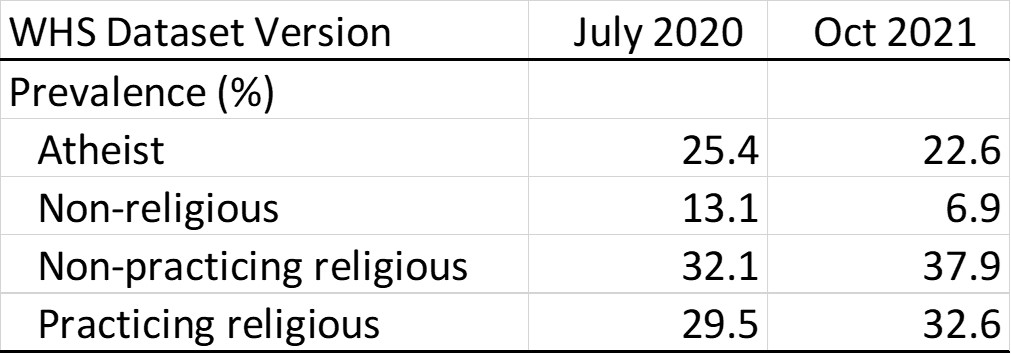
In two earlier posts (here and here), I examined global, regional and country-level trends in religious belief and practice, and the prevalence of atheism. The analysis was based on data from the  World Values Survey (WVS) and the European Values Study (EVS), covering the period 1981 to 2020. Earlier this year, I discovered that the World Values Survey dataset has been updated. Some data collected using a mobile phone app in the most recent US survey was incorrectly coded and this mainly affected the religiosity categories.  Comparison of the US prevalences for religiosity show that the coding errors resulted in an overestimate of the atheist and non-religious categories as shown in the following table:

Comparison of religiosity prevalence estimates
 for USA in year 2020

I have now updated the previous analyses using the 2021 release of the combined data for the WVS and EVS in the Integrated Values Surveys (IVS) 1981-2021 [1-3]. In carrying out these updates, I also addressed some definitional issues which have resulted in mostly slight changes to estimates for other countries. The details of the updated analysis are described elsewhere.

Continue reading