Like most people, it seemed obvious to me that we have free will and up until about three years ago, I had not thought about it much or questioned it. Then I read Sam Harris’ small book Free Will (2012, Free Press) which made the case that we do not have free will. In my previous posts on consciousness, I noted that Annaka Harris, David Chalmers and Anil Seth all had some discussion of free will in their books. So I re-read Sam Harris’s book, now with a much deeper understanding of its relationship to consciousness, and came away largely convinced that he is right in seeing free will as an illusion.
Free Will is a very short book, 66 pages of main text amounting to around 15,000 words. It is very well written and jargon-free and makes a very strong case that free will is an illusion. Thoughts and intentions emerge from background causes of which we are unaware and over which we exert no conscious control. Well worth reading, whatever your views on free will.
For most people, consciousness not only involves a sense of self but also the feeling of being in control of your actions, of being the author of your thoughts. In other words, you have free will, the ability to consciously choose among potential decisions or actions. I refer to this as free will in the ordinary sense. This idea of free will emerges from a felt experience, and most people do not question it. That included me until relatively recently.
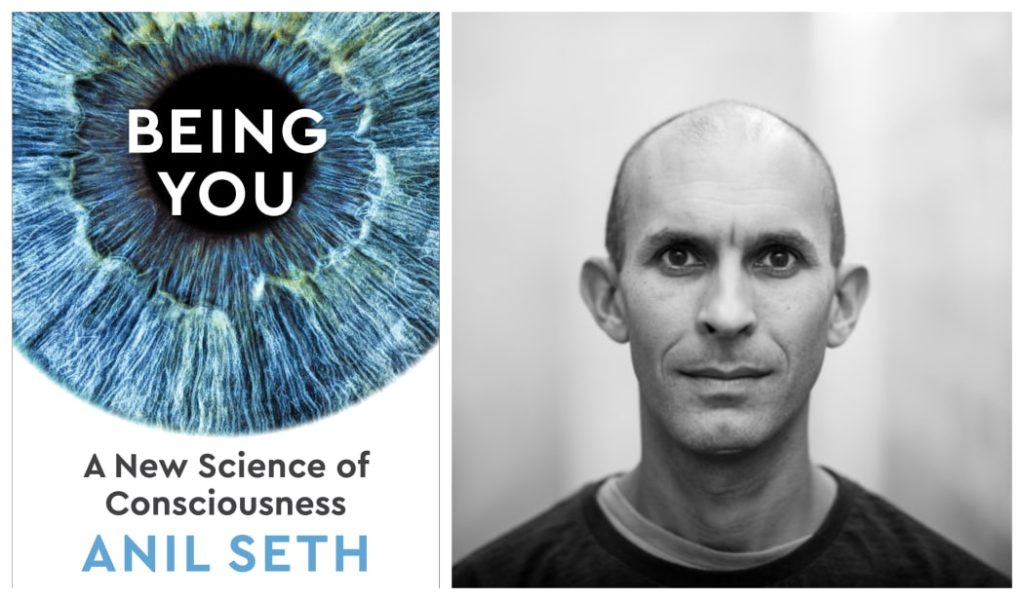
In my fifth post in this series, I review Anil Seth’s 2021 book Being You. See here, here, here, and here for the previous posts. I read a Guardian review of this book in August 2021 which raved about it, as did various other reviewers. So, I went out and bought it, and when it came, I started to read it. It annoyed me so much (see below) that I put the book aside until recently. Seth is a Professor of Neuroscience at the University of Surrey, highly cited for his publications, and also a prolific popularizer of his views on consciousness (New Scientist, Scientific American, TED talks etc).
Seth starts well in the Prologue, with the comment that “consciousness is a mystery that matters. For each of us, our conscious experience is all there is. Without it there is nothing at all: no world, no self, no interior and no exterior.” But he continues with “For me, a source of consciousness should explain how the various properties of consciousness depend on, and relate to, the operations of the neuronal wetware inside our heads. The goal of consciousness science should not be ‑‑ at least not primarily ‑‑ to explain why consciousness happens to be part of the universe in the first place.”
In my fourth post in this series, I review David Chalmer’s 1996 book The Conscious Mind: In Search of a Fundamental Theory. See here, here and here for the previous posts. This is a long and often technical book (about 395 pages) though Chalmers has kindly flagged the Chapters and Sections that he recommends non-philosophers read and has asterisked the headings of Sections that he considers technical details likely of interest only to philosophers. I read some but not all asterisked sections, and I have to say that it is indeed the most technical and “academic” work of philosophy I have read in decades. But let’s dive into it.
The hard problem of consciousness
It was like a breath of fresh air to read the introductory chapter. Instead of dismissing consciousness as an illusion, Chalmers sees it as the largest outstanding obstacle in our quest for a scientific understanding of the universe. He coined the phrase “the hard problem” around 1994 and it caught on. In contrast to the hard problem of why we have first-person experience, issues such as how the brain processes environmental stimuli, or how it integrates information into a coherent whole, might be called “easy” problems, and many books about consciousness, such as Dennett’s, are largely about the easy problems. Consciousness remains a big, deep mystery about which science has almost nothing to say, and where there is no agreement even in the broad about how consciousness occurs.
Chalmers says he has found that around one-third of people think that solving the easy problems explains everything that needs to be explained about consciousness, and around two thirds hold that there is a further “hard” problem. This ratio is fairly constant across academics and students in a variety of fields. He sets out explicitly to address the hard problem and to develop at least a basis for a scientific theory of consciousness though he recognizes that it is not open to investigation by the usual scientific methods.
He outlines a set of constraints within which attempts to obey in this quest. First, to take consciousness seriously and not redefine it as something else (as per Dennett). Second, to take science seriously in the domains where it has authority. Third, to take consciousness to be a natural phenomenon.
Two fundamental questions about consciousness
In the Introduction and Chapter 1, Chalmers clarifies what he means by consciousness. It’s the way we experience the world, the way it feels to us subjectively. Using the phrase Nagel made famous in 1974, Chalmers says “We can say that a being is consciousness if there is something it is like to be that being …”
Chalmers identifies two fundamental questions about consciousness that we currently cannot answer. (1) Why does conscious experience exist and how does it arise in physical systems, and (2) why do conscious experiences have their particular nature? Why does the experience of red differ from the experience of blue?
First, Chalmers draws our attention to the range of conscious experiences by presenting a set of examples ranging from visual experiences, through mental imagery, to emotions, and to our sense of self. It seems odd that he completely ignores non-ordinary states of consciousness though he touches on changes in consciousness with a discussion of how his visual experience dramatically changed as a child when he was fitted with glasses.
This leads into an important distinction that he makes between the psychological concept of mind and the phenomenal concept of mind. The phenomenal aspect of mind is conscious experience. The psychological aspect of mind refers to the mental states construed as the (ultimately physical) states relevant to the causation and explanation of behavior. It matters little or not at all whether these mental states are conscious or not. The materialist hopes that the phenomenal and psychological minds turn out to be the same thing, Chalmers argues that they are different things, a form of dualism.
Chalmers approaches the study of consciousness from a completely nonspiritual, nonreligious perspective. The dualism he advocates is governed by natural laws, it is just that these natural laws extend beyond the laws of our current sciences. He is not a mysterian, someone who throws their hands up and say that consciousness is a fundamental mystery outside the reach of human understanding. Rather he wants to understand and explain consciousness as a natural phenomenon.
Zombies and other arguments against a reductive materialist explanation
Chalmers argument against a materialist explanation of consciousness relies heavily on two things: supervenience and logically possible worlds. The definition of logical supervenience is as follows: B facts/properties logically supervene on A facts if no two logically possible worlds are identical with respect to their A facts while differing in their B facts. A phenomenon is reductively explainable in terms of low level physical facts if and only if it logically supervenes on those properties.
These issues are dealt with in detail in a long and philosophically technical chapter 2. Its worth reading to get a grasp of Chalmers’ arguments in following chapters, but it is a heavy read with technical terms such as “intension” and “instantiation” much used.
Chalmers then argues that everything in our world logically supervenes on the low-level physical facts except for consciousness. He actually gives five arguments in Chapter 3 for this conclusion. The first and third, which I find the most compelling, are the zombie argument and the epistemic asymmetry argument.
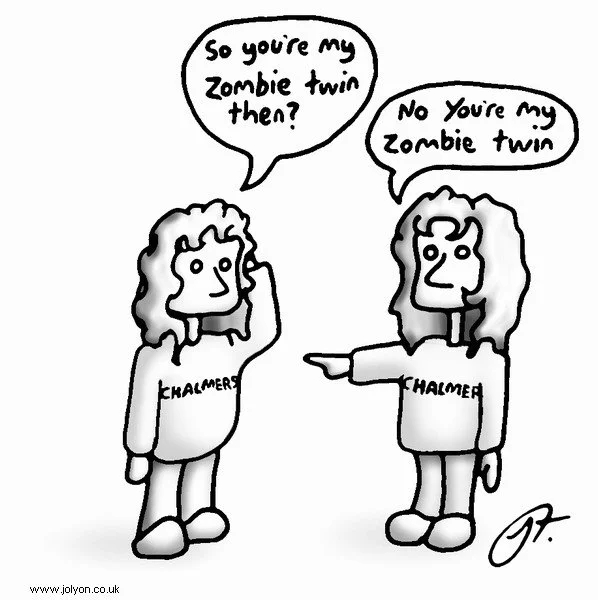
The zombie argument is that it is logically possible to imagine zombies who are just like us, fuctionally, psychologically and behaviourally, but yet have no phenomenal mind, no experiences, nothing that it is like to be them. These are often referred to as philosophical zombies, as opposed to the Hollywood zombies who are functionally impaired. It is logically possible to imagine a world physically identical to ours inhabited by philosophical zombies. Therefore consciousness does not supervene on the physical facts. So consciousness cannot be reductively explained in terms of the physical and materialism is false.
The epistemic asymmetry argument stems from the fact that we know about it only through our own experience. Even if we had a completed theory of cognition (and biochemistry, chemistry, and physics) that information would not lead us to postulate consciousness. There is also the problem of other minds. Even if we know everything physical about other creatures, we do not know for certain if they are conscious. There is no problem with physical things like “other lives”, or other “economies” or “other heights”. Chalmers argues there is no epistemic asymmetry in these cases precisely because they are logically supervenient on the physical.
Chalmers concludes that consciousness cannot be logically supervenient “because a logically supervenient property can be detected straightforwardly on the basis of external evidence, and there is no special role for the first-person case.” This is as close as Chalmers comes in the whole book to saying in straightforward jargon-free terms why consciousness cannot be reduced to the physical. The physical is objective, third-person, the “outside”. Consciousness is subjective, first-person, the “inside”. It seems quite obvious to me that the subjective cannot derive from the objective, the first-person from the third-person, the inside from the outside.
Chalmers’ five arguments are all “intuition” pumps to help the skeptical see that consciousness does not logically supervene. Briefly, his other three arguments are:
2. The inverted spectrum. Imagine someone physically identical to you, but with different conscious experiences. For example, their experience of the colour spectrum is inverted relative to yours.
4. Someone raised in a black and white room could have complete knowledge of neuroscience but still have no idea what it is like to see green or any other colour.
5. The lack of any remotely plausible analysis of consciousness that can explain even in outline how it arises from non-conscious processes.
In the rest of Chapter 3, Chalmers examines in detail and refutes all the various objections that he thinks might be raised against his arguments and conclusion. As Dennett, caustically but wittily has said, “Chalmers never leaps to conclusions; he oozes to conclusions, checking off all the caveats and pitfalls and possible sources of error along the way with exemplary caution.” Dennett has concluded that nothing can shake Chalmers intuition that consciousness is not reductive to the physical, because he has presented excellent versions himself of every one of Dennett’s objections and failed to convince himself. Dennett in quite an entertaining attack then suggests a number of reasons Chalmers may “cling like a limpet” to dualism. These include that it is a parody of academic philosophic scholarship, or that it is a philosopher performing (I am a philosopher and this is what philosophers do). See Dennett’s 2012 article “The mystery of David Chalmers” for these and other entertaining observations.
I am quite sure that Chalmers is largely correct in his conclusions, but rather than writing in clear language for a general intelligent reader as Anaka Harris does, Chalmers is indeed “doing what philosophers do” and doing it in excruciating detail.
Naturalistic dualism
In Chapter 4, Chalmers examines the implications of his conclusion that consciousness is a feature of the world over and above the physical, and not reducible to it. However, consciousness is systematically associated with physical structures and functions. Chalmers develops this into the concept of “natural supervenience”, that there is an as yet unknown lawful association between the phenomenal mind and the psychological mind, between consciousness and physical processes. Again, a very technical and jargon-filled set of arguments. To my mind, its completely obvious that the inside (the first-person) is systematically associated with the outside (the third person).
Chalmers then suggests that a theory of consciousness could go one of two ways. First, that consciousness is a fundamental property alongside things such as charge, spin, etc. Second, that consciousness derives from some other class of more fundamental properties, which cannot be physical properties since consciousness is not supervenient on the physical.
Chalmers calls this position “naturalistic dualism” because it posits that everything is a result of basic properties and laws and is compatible with existing “physical” science. There need be nothing transcendental about consciousness, it is just another natural phenomenon. He then examines a range of possible objections to naturalistic dualism, particularly the concept of emergence of consciousness from complex systems, probably the dominant view among neuroscientists. Like Annaka Harris, Chalmers rejects emergence on the grounds that consciousness is not supervenient on the physical and so cannot be emergent from it. The first-person subjective cannot emerge from sufficiently complex arrangements of third-person objective things.
Annaka Harris says this much more clearly than Chalmers does: “when scientists assume they have bypassed the hard problem by describing consciousness as an emergent property — that is, a complex phenomenon not predicted by the constituent parts — they are changing the subject. All emergent phenomena — like ant colonies, snowflakes, and waves — are still descriptions of matter and how it behaves as witnessed from the outside. What a collection of matter is like from the inside and whether or not there is an experience associated with it is something the term “emergence” doesn’t cover. Calling consciousness an emergent phenomenon doesn’t actually explain anything, because to the observer, matter is behaving as it always does.”
Can consciousness play a causal role in events?
Next, Chalmers tackles the issue of whether consciousness is epiphenomenal. If all physical events are caused by physical causes, then consciousness cannot play a causal role in physical events, it is an epiphenomenon. Chalmers examines a number of potential strategies for avoiding epiphenomenalism but concludes that none of them justify rejecting the conclusion that consciousness is mostly epiphenomenal, perhaps with some subtle exceptions. This clearly is fundamental to the issue of whether or not we have free will, and I find it odd that Chalmers does not discuss free will directly. He is on record as saying he does not have strong feelings about free will. In any case, I will leave the issue of free will for a following post to examine.
In Chapter 7, Chalmers examines the issue of phenomenological judgements. This refers to when we use our cognition (thinking functions) to make judgements about the experience of consciousness. Chalmers argues that phenomenal judgements are themselves cognitive acts, and so fall within the domain of psychology and thus are not mysterious, potentially explicable scientifically, unlike consciousness. This leads to a paradox since our claims about consciousness should be reductively explicable in terms of cognitive science whereas consciousness is not.
Chalmers then argues that our judgements (and the things we say about the experience of consciousness) would be the same whether or not we actually experience consciousness. In other words, the zombie will describe experiences of consciousness exactly in the way that we do, although he does not experience consciousness. This simply makes no sense at all to me and seems like a convincing argument that the complete philosophical zombie is actually not a logical possibility. A zombie cannot report his experiences of consciousness in the same way that I do. In other words, there is an area where consciousness plays a causal role in behaviour.
Annaka Harris makes exactly the same point: “consciousness seems to play a role in behaviour when we think and talk about the mystery of consciousness. When I contemplate “what it’s like” to be something, that experience of consciousness presumably affects the subsequent processing taking place in my brain. And almost nothing I think or say when contemplating consciousness would make any sense coming from a system without it. How could an unconscious robot (or a philosophical zombie) contemplate conscious experience itself without having it in the first place?”
Why does Chalmers ignore the evidence from meditation?
Most people who have had sufficient training in meditation realize that an experience of consciousness needn’t be accompanied by thoughts—or any input to the senses, for that matter. I have experienced what it is like to be acutely aware of my subjective awareness in the absence of any content such as thought, sights, sounds, or other perceptions. I have practiced for many hours to become aware of my awareness as an observer of thoughts and sensory perception, that is separate from them. And then to take that awareness and turn it back on itself, letting thoughts and sensory perceptions fall away. While I might have difficulty finding words that can convey a sense of that experience, there are many such descriptions in the Zen literature, for example. I really don’t see how a zombie could carry out such a program, or report the experiences that result, let alone in similar terms to what I might report.
Chalmers’ explanation for how a zombie is still conceivable in theory is that the language and concepts of consciousness could be built into the program of a zombie. The unstated implication is that we could also have the same language and concepts of consciousness built into us. And the implication of that is that we also are not actually conscious, but our sense of the inexplicable wonder of consciousness is actually an illusion built into us somehow by evolutionary processes. This totally destroys Chalmers claim that consciousness is not reducible. The idea that its logically possible for zombies to replicate the outcomes of a long-term meditation practice seems nonsensical to me.
Chalmers would seem to have no real experience of meditation. In a 2017 interview with Chalmers, John Horgan reported that Chalmers has “never had the patience” for meditation, and he has doubts about basic Buddhist claims, such as anatta, the doctrine that the self does not really exist.
I find this astonishing. Chalmers has made the nature of consciousness his life’s work and understands intellectually that consciousness cannot be investigated using the third-person objective methods of science. But he apparently does not have the patience to investigate the very sophisticated first-person methods that have been developed over thousands of years to exactly investigate the nature of consciousness. While Chalmers is of course entirely free to doubt that the self does not really exist, it seems enormously arrogant to do this while dismissing the no-self experiences of many people, including myself, through meditation or through exploration with psychedelics.
Does functional organization fully determine conscious experience?
In chapters 6 and 7, Chalmers starts to outline a possible approach to developing a naturalistic dualist theory of consciousness. He argues for a general principle that consciousness is an organizational invariant, i.e., that “functional organization fully determines conscious experience. In other words, if a silicon brain is organized identically to a human brain, it will also be conscious. He did not present any evidence for this claim that I could see, and I don’t find it plausible. In another review, Eric Dietrich comments that this principle is unintuitive and not widely believed among philosophers.
Chalmers gives some thought experiments to argue for this principle: his examples show that, without it, humans could be massively mistaken about their experience of qualia (whether absent, fading or dancing). I found all these thought experiments unconvincing, not least because once Chalmers has decided that zombies can be programmed to think they are conscious even when they are not, then humans can also be massively mistaken about their actual experiences and his arguments self-implode.
Panpsychism: maybe not as silly as people tend to assume
Chapter 8 is even more speculative. Chalmers proposes that the basic stuff of the universe is information and that has two aspects: a phenomenal and a physical aspect. He largely lost me here. I did not find it at all compelling. But this leads him to consider panpsychism, since even simple systems containing information must then have associated experience. Of course, the experience of a simple system will not be associated with a mental life, a sense of self, or memory.
I discussed panpsychism in my previous post about Annaka Harris’s book, and that it is largely dismissed as ridiculous by scientists, who imagine it implies rocks must have human-like consciousness. Chalmers makes all the same points, very clearly, and also notes that panpsychism avoids the need to have consciousness wink-in or switch-on at some particular level of complexity. Rather it may be a universal property, with very simple systems having very simple phenomenology and very complex systems having very complex phenomenology.
Chalmers also discusses the possibility that we have various information-processing systems in the brain with associated consciousness, to which we do not have access. This indeed is what has been found in some split-brain patients. Chalmers concludes that his theory results in a variant of “outrageous” panpsychism, but it is a view that can grow surprisingly satisfying with reflection. I am inclined to agree with him.
In conclusion
The two final chapters deal with conscious machines and strong artificial intelligence (chapter 9) and quantum mechanics and consciousness (chapter 10). I will leave these subjects for later discussion.
While Chalmers does indeed take consciousness seriously and recognize that it is fundamentally different to physical functions and cannot be reductively explained, most of his philosophic machinery and some of the principles he argued for in the second half of the books I found unconvincing. Consciousness exists in the real world, it is our primary experience and in fact ALL our experiences of physical systems are mediated through consciousness. So consciousness must be explored using evidence, not by using thought experiments of what is guessed to be logically possible. And the primary evidence is direct personal exploration of consciousness through tools like meditation, breathwork, psychedelics. None of which Chalmers appears to have any interest in or experience with. Sure, these first-person experiences are much more difficult to work with than the objective observational tools of current science, but philosophical thought experiments about “logically possible” worlds are even less adequate for understanding such an important aspect of our reality.
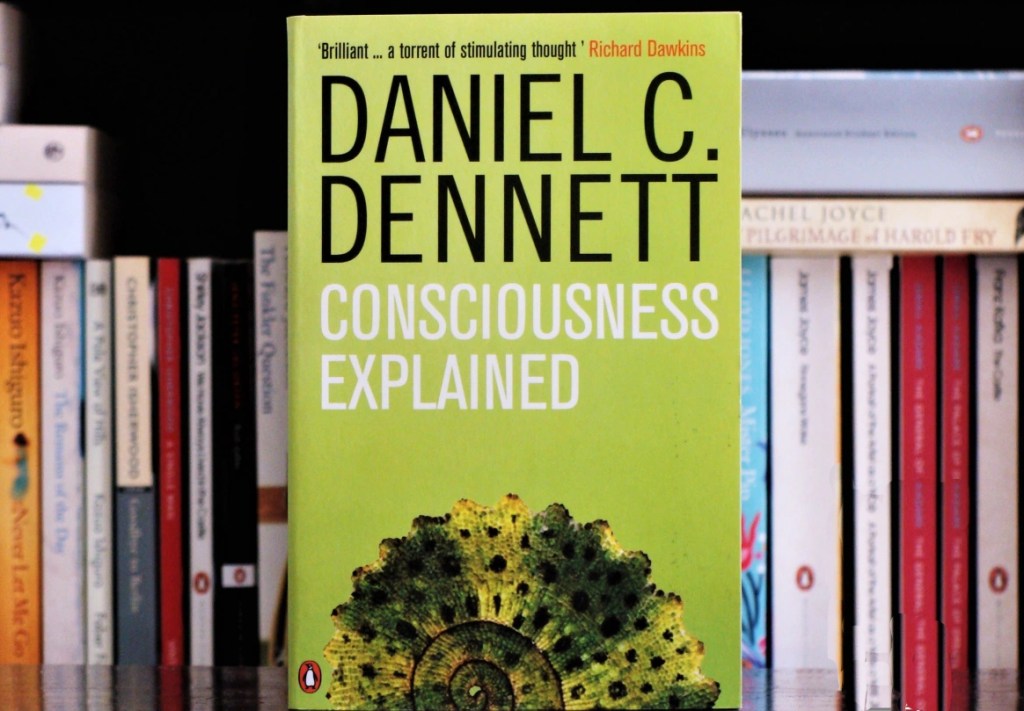
In my third post on consciousness, I review Daniel Dennett’s 1991 book Consciousness Explained. My preliminary reading suggested this was an important contribution to the debate on the nature of consciousness.
His first chapter starts with the brain in the vat. He argues that the creation of all the inputs needed to fool the brain in the vat they were having real experiences is simply computationally impossible, due to the massive number of scenarios requiring inputs. And also claims that hallucinations are rarely “deep” in the sense of being solidly realized hallucinations that the person can interact with, walk around, view from different angles etc.
He seems to have a very limited understanding of the range of hallucinogenic experiences that people have, or for that matter, lucid dreams in which they can have detailed interactions, conversations etc with other dream characters and interact in detail with their dreamscape, including changing and influencing it. He does have some interesting thoughts on how dreams can be randomly generated in a way which means they reflect the concerns of the dreamer, but have no “internal author”.
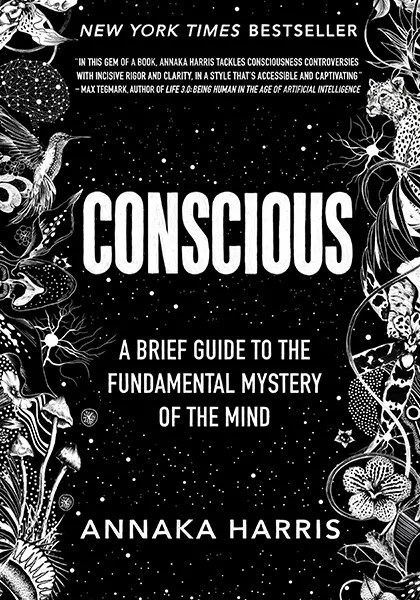
In my previous post on consciousness, I noted that the 2019 book Conscious: a guide to the fundamental mystery of the mind, by Annaka Harris, was a superb discussion of the various issues, evidence and theories about consciousness. Of the seven books on consciousness I listed in the previous post, hers is the only one to take into account insights derived from meditation, use of psychedelics, and of altered states of consciousness more generally. It is also the only one to review, fairly honestly as far as I can tell, most of the major approaches to understanding and explaining consciousness and to discuss their pros and cons rather than making a partisan case for one approach.
Harris starts by explaining what she means by the word “consciousness”. She basically takes the philosopher Thomas Nagel’s definition in his famous essay “What is it like to be a Bat?” and posits that an organism is conscious if there is something that it is like to be that organism. She says:
“Consciousness is experience itself , and it is therefore easy to miss the profound question staring us in the face in each moment : Why would any collection of matter in the universe be conscious ? We look right past the mystery as if the existence of consciousness were obvious or an inevitable result of complex life , but when we look more closely , we find that it is one of the strangest aspects of reality.”
Over the last couple of years, I’ve been thinking more and more about the nature of consciousness. My Zen meditation practice basically involves letting go of thoughts, letting go of the self, and simply experiencing consciousness without content. I have direct experiences from my meditation practice, as well as a reasonably wide reading of Zen and Buddhist masters and their experiences and understanding of consciousness, self and reality. At times, I feel like I have had openings to experiences which have “enlightened” me about the nature of self, consciousness etc, but I have not really integrated these tastes of non-self into any sort of stable or mature understanding of reality.
I had read a few articles by philosophers who have explored the nature of consciousness, particularly the so-called hard problem of consciousness and last year read a review of a new book by Anil Seth which led me to think he had made advances from the neuroscience perspective.
Apart from my direct explorations through Zen meditation, breathwork and psychedelics, I also have worked with several Zen teachers and read extensively on consciousness in Buddhist literature and in the works of Ken Wilber, who has explored and mapped states and stages of consciousness in his writings. More recently, I read and reviewed Sam Harris’s book Waking Up, which also discusses the nature of consciousness and self.
So I decided I would read some of the key books and articles on consciousness from the philosophers and neuroscientists, to complement my experience and understanding gained from meditation and psychedelic explorations.
Anil Seth is a neurologist, Peter Godfrey-Smith a biologist and philosopher of science. Annaka Harris is a science writer (fun fact: also the wife of Sam Harris). Lewis-Williams and Pearce are both archaeologists. The final three are all philosophers. I guess the other relevant discipline I am missing is artificial intelligence research. I’ve read a little in this area and have found it mostly irrelevant to the issues relating to consciousness that I am interested in, and tedious reading to boot.
I browsed Chalmers book on consciousness and discovered the entire book ignores the entire knowledge base on states of consciousness, meditation, nondual states, etc. As if it’s irrelevant. So I quickly browsed the books by the other two philosophers, and the book by Anil Seth the neurologist. Not a single mention of meditation, altered states, psychedelics. I had bigger problems with Seth’s ideas, but will leave that to a separate review.
My initial reaction was to dismiss the philosophers as inhabiting a limited sterile corner of academia ignoring large parts of human experience. But then realized if I did that, I would be no better than them.
Ken Wilber has gone down this same path of integrating Western psychology and philosophy with Eastern first-person methods and understanding and has been largely ignored by academia and philosophers. In part, because he does somewhat go over the top, and despite his focus on empirical methods, does seem to uncritically accept aspects of Tibetan Buddhism at more or less face value. Such as rebirth.
Sam Harris seems to get it more right. And his conclusions are very much aligned with mine. And even he gets dismissed by Western commentators as being arrogant. By telling them they cannot just critique from the outside, without trying the methods for themselves. So much for open-mindedness to all the relevant evidence.
For consciousness per se, which is a subjective experience, its clear that the objective methods of science are going to be at best marginally relevant. What is most relevant is the actual massive domain of experiences of consciousness. Particularly those focused not on the contents of consciousness (as the psychologists and neuroscientists like to do) but those focused on the exploration of consciousness per se when the contents are out of the way. The recent book by Anneka Harris is the only other one on my list above which examines what meditation tells us about consciousness. And when I started reading it, I found it a superb discussion of the various issues and theories about consciousness. So my next post will be a closer look at Harris’ book, and then I will dive into the philosophers.
Links to my later posts on consciousness are given below:
In two previous posts (here and here), I examined the prevalence of belief in heaven and hell across the world and in the major religions. Less than half of Christians in developed countries say they believe in hell, and only a slight majority in heaven. The USA is the major exception, with over 80% of Christians saying that they believe in heaven and in hell. Here I examine the extent to which the Christian belief in heaven and hell as places of reward and punishment after death are supported by either Biblical texts or the teachings of Jesus.
In Part 1 of this post, I examined global variations in the prevalence of belief in heaven or hell, both in the total adult population and among Christians and those with other religious affiliations. I found that the prevalence of belief in heaven and hell among Christians in the USA is much higher than in any of the “West” culture zones, or the Orthodox East. In the developed countries other than the USA, only 52% of Christians say they believe in heaven, and significantly fewer say they believe in hell (42%). In contrast, Christians in the USA have a much higher level of belief, and similar levels of belief in heaven (85%) and hell (81%).
In social media, I’ve seen quite a few questions from Christians to atheists, essentially asking why they do not fear going to hell. And responses from atheists like myself, who simply cannot imagine how anyone could believe that a supposedly loving god would condemn people to eternal torture for a list of transgressions which seem to vary across flavors of Christianity and to be cherry-picked from a long list of sins mainly appearing in the Old Testament. A good starting point for understanding such different views are the levels and stages of moral development identified by Kohlberg [1].
My father was a Protestant minister and I grew up in a rural Protestant culture in Australia, went to lots of church services and never heard anyone trying to claim hell was a real place rather than a metaphorical place. Belief in a real hell tends to be reserved for fundamentalists who are a relatively small proportion of Christians outside USA and some other countries. I think for religious people focused on love and kindness it is clear that hell is a mythological concept dating from primitive times and literally believing your God would torture people for eternity marks you out as having premodern values. While I don’t know about the distribution of the real beliefs of individuals in the Christian community I grew up with I was not aware on any discussion of hell as a real place.
Recently, on social media forums, I’ve seen quite a few questions from Christians asking why aren’t atheists terrified of ending up in hell. And assumptions (mainly from Americans) that belief in hell is the mark of being a Christian. At least in the mainstream media, hell tends to only get a mention as part of the rantings of fundamentalists and religious extremists. These are a tiny minority in Australia and Switzerland. So I decided to see what the data from the World Values Survey (WVS) and the European Values Study (EVS) tell us about the prevalence of belief in heaven and hell.
My son and I hired jet skis for a trip out to the ocean off Noosa National Park in Queensland. It was a partly cloudy winter day in July and we went out in the late afternoon. The interplay of sunlight, clouds and water was spectacular. Here are a few photos I took that day with a small waterproof handheld Nikon Coolpix.












 Mountains and rivers