Why philosophers get panpsychism badly wrong

In my earlier article, Questions about Panpsychism, I thought through what a defensible form of panpsychism might look like, and what questions it raises. I have now taken a dive into recent philosophical literature and debates on panpsychism. I focused particularly on Nagel’s 1979 article on panpsychism and three recent books on panpsychism which also include essays and commentaries by philosophers and scientists (Goff 2019, Goff and Moran 2022, Strawson 2024). I discovered that almost all of them ignore direct evidence and rely on assumptions and argument, never a good approach to understanding the nature of reality.

What philosophers and scientists think about panpsychism

In total, these four publications include essays and commentaries by forty-two authors. I am counting Goff (2006) and Goff (2019, 2022) as two separate authors, as his views changed substantially over this period. These 42 authors comprise 29 philosophers, 11 scientists (mainly physicists and neuroscientists), and two theologians.

Thomas Nagel (1979). Panpsychism.

Thomas Nagel’s 1979 article “Panpsychism” arguably started the recent resurgence of interest in panpsychism among philosophers. Nagel assumes panpsychism is about mental states, which he defines as “thoughts, feeling, emotion, sensation or desire”.

He argues that there are no truly emergent properties of complex systems. Nagel defines emergence as referring to an observed feature of a system that cannot be derived from the properties currently attributed to its constituents. In particular, subjective conscious experience cannot be derived from the purely objective physical properties of matter. Nagel argues that this means that mental states must go all the way down to the fundamental constituents of matter.

Rather than accept this conclusion, Nagel states that panpsychism must be added to the list of hopelessly unacceptable solutions to the mind-body problem. Why? Because it seems obviously ridiculous to ascribe proto-minds to atoms or electrons

In his concluding paragraph, Nagel identifies the so-called combination problem, which most of the philosophers in these books consider the biggest problem with panpsychism. He cannot imagine how mental states of animals could be explained in terms of the combination of the proto-mental properties of dead matter. He says “Presumably the components out of which a POV is constructed would not themselves have to have points of view. How could a single self be composed of many souls?”

Galen Strawson (2024) Consciousness and Its Place in Nature.

The second edition of Consciousness and Its Place in Nature includes Strawson’s original 2006 paper “Realistic Monism: Why Physicalism Entails Panpsychism” (Strawson 2006) and responses by 18 commentators, all philosophers apart from one physicist. Only two of the philosophers could be called panpyschists, though one of the two is generally critical of Strawson. The book also includes a lengthy reply by Strawson to the critiques from the 18 commentators, plus additional new commentaries by six of the original commentators.

Most philosophers and scientists assume that consciousness is an emergent property of brains. Strawson strongly rejects this. His argument is worth quoting as it is the key motivation for exploring panpsychist ideas.

“It is built into the heart of the notion of emergence that emergence cannot be brute in the sense of there being absolutely no reason in the nature of things why the emerging thing is as it is (so that it is unintelligible even to God). For any feature Y of anything that is correctly considered to be emergent from X, there must be something about X and X alone in virtue of which Y emerges, and which is sufficient for Y. ……. One problem is that brute emergence is by definition a miracle every time it occurs, for it is true by hypothesis that in brute emergence there is absolutely nothing about X, the emerged-from, in virtue of which Y, the emerger, emerges from it.” (Strawson 2024, p36)

Current science provides no examples of emergent phenomena that are brute, to use Strawson’s term. Emergent behaviours such as chaotic dynamics are qualitatively different but still explicable in terms of the underlying physical properties of its components. In what follows, I will use the term strong emergence to refer to this, and weak emergence to refer to emergent phenomena that are explicable in terms of underlying constituent properties.

Strawson argues that strong emergence of consciousness is essentially a magic passage across the divide between unaware matter and aware consciousness. Yet that magic passage is perfectly law-like every time it occurs. Humans start off as a single cell and yet all develop consciousness and subjective experience. And at least according to their reports, consciousness behaves in similar ways for most humans most of the time and behaves in predictable ways in response to various forms of meditation or methods for altering states of consciousness.

Despite this, most neuroscientists, physicists and philosophers assume that consciousness must be an emergent property of non -aware matter. Given the lack of any proposed mechanism for such strong emergence, this is similar to the situation with theist apologetics arguments which simply assume the universe must have had an uncreated creator who magically created it.

The 17 philosophers who comment on Strawson’s article include four who don’t think consciousness or experience exists and another nine who assume the word consciousness refers to minds (thoughts, feelings, experiences) and reject panpsychism as ridiculous (how could particles have thoughts or feelings) or because of the combination problem. The latter include Goff, who in 2006 thought the combination problem was fatal to panpsychism.

Philip Goff (2019) — Galileo’s Error: Foundations for a New Science of Consciousness

According to Goff, Galileo’s error was to exclude sensory experience from science in favour of what can be observed, and this has meant science cannot solve the hard problem. Goff wants to bring consciousness within the remit of science.

The 2019 Goff has moved some distance from the typical view of panpsychism expressed by the Strawson commentators (including the 2006 Goff) of electrons having thoughts and feelings, etc. He notes that “if electrons have experience, then it is of some unimaginably simple form”. And that complex conscious experiences such as humans have “is the result of millions of years of evolution by natural selection, and it is clear that nothing of this kind is had by elementary particles”. He also concludes that though the electrons in a sock may have a very elementary experience, that does not make socks conscious at the sock level.

But he doesn’t have any real suggestions about how to do this. He argues that:

“We must move to a post-Galilean paradigm, in which the data of consciousness and the data of physics are both taken seriously. Nothing less than a revolution is called for, and it’s already on its way.” (Goff 2019)

All fine as far as it goes. Except that the only data of consciousness he mentions is philosophical speculation. Although he mentions elsewhere that he meditations, there is no mention of the actual study of consciousness via meditation, psychedelics, or other forms of direct exploration. And why he focuses on the data of physics rather than neuroscience I have no idea.

Philip Goff and Alex Moran (2022). Is Consciousness Everywhere: Essays on Panpsychism

These essays first appeared as a special issue of the Journal of Consciousness Studies in 2021. The contributors included ten scientists, ten philosophers and two theologians. In the final article of the book, Goff responds to the essays in the volume and explores some ideas on what a “post-Galilean” science of consciousness might look like.

In 2006, Goff was negative about panpsychism because he thought the combination problem was unintelligible (thousands of small experiences coming together to be one big experience). He changed his mind in Strawson (2024) and talks about switching from a particle to field view of reality — without ever developing this.

Goff makes the point that consciousness is not a normal scientific phenomenon, publicly observable by everyone.

“In the unique case of consciousness, the thing we are trying to explain is not publicly observable. …. There is information that we get from attending to our experience, information that cannot be conveyed in the language of physical science.” (Goff 2022)

However, he then essentially dismisses information derived from systematic direct observation of consciousness, concluding that

“Because consciousness is not publicly observable, this is not a question one can answer with an experiment (all experiments can do is establish more correlations [with neural happenings). At this point we must turn to philosophy, examining the various proposals philosophers have offered to account for the fact that brain activity is correlated with experience.” (Goff 2022)

Unfortunately, ignoring the collective first-person experience of consciousness and relying on assumptions, arguments and speculation has led philosophers to a version of panpsychism that is inconsistent with the available evidence and rightly rejected as nonsensical by most of them and by many others who take an interest in consciousness. In what follows, I will identify important evidence from first-person experience that allows the development of a much more plausible form of panpsychism.

1. Taking first-person evidence into account

Goff [2019] notes that there is a fair amount of scepticism at the idea that philosophers might have anything to contribute to the scientific project of uncovering the nature of reality. He adds “Such scepticism is presumably rooted in the fact that, in general, philosophers reach their conclusions without actually performing any experiments or carrying out any observations. In contrast to the natural scientist, the principal activity of the philosopher is thought.”

Although he called for taking the data of consciousness into account, he remained stuck in philosophical speculation. Data of consciousness can only come from first-person observations, the actual systematic study of consciousness via meditation, psychedelics, breathwork, and other techniques for exploring consciousness and non-ordinary states of consciousness.

Thought experiments without a basis in observation or experiment are meaningless. Millenia of religious apologetics have demonstrated that. Largely missing from the debates among the philosophers and scientists is any consideration of the evidence from direct observation of consciousness. Christoph Koch realizes this in his commentary in Goff and Moran (2022):

“The last 2,500 years of Western philosophy of mind have seen the rise and fall (and rise and fall) of many schools of thought concerning the mental and the physical. Highly polished arguments and counterarguments are exchanged in a never-ending cycle that results in drawn-out sophisticated disagreements but no resolution.

“Indeed, it is not even clear that there is a generally accepted notion of progress within philosophy of mind (Bourget and Chalmers, 2014; Chalmers, 2015). …… The science of consciousness must break out of these endless epicycles of arguments by formulating a sustainable programme of hypothesis formulation and experimental validation or falsification. (Koch 2022)

Neuroscience is only one part of the needed inputs; it can explore the functioning of the brain and the objectively measurable correlates of conscious states; the other more important part has to come from systematic direct observation of consciousness. Currently, the two major approaches to systematic first-person exploration of consciousness are meditation and psychedelics.

Of the 42 philosophers, scientists and theologians included in the four books I read, only three (all philosophers) discussed meditation as a source of data on consciousness and only one (a theologian) discussed the potential use of psychedelics as a source of data. None of them attempted to use data from direct observations in their contributions.

2. Consciousness and contents of consciousness

Contents of consciousness include thoughts, feelings, brain-processed sensory inputs, etc. Neuroscience has provided convincing evidence that these contents are all produced in brains. Most beginning meditators will achieve this insight relatively early in their practice, as they see content come and go in the field of awareness untouched by an attempt at conscious control. It often takes more sustained practice to achieve a state where brain content dies away completely for some length of time, leaving a pure experience of contentless awareness (see my previous article).

This contentless awareness (also referred to as formless or empty) is what I define consciousness as referring to. Until reading these books, I had not fully grasped that most of the writers on panpsychism assumed that consciousness referred to minds, or selves, or the full contents of consciousness. In fairness to me, I must also point out that hardly any of the philosophers attempt to specify what they are using the word consciousness to refer to, beyond a vague invocation of experiences or qualia.

The primary motivation for panpsychism is the strong emergence problem, and clearly (1) contents of consciousness are of course products of (weak) emergent brain processes and (2) to solve the strong emergence problem, consciousness (ie. formless awareness) is all that needs to go “all the way” down.

Of the 42 philosophers, scientists and theologians, only 3, maybe 4, philosophers (Strawson, ) are some ways towards this insight. Of the rest, apart from several who deny consciousness exists, all imagine the word refers to minds with thoughts, feelings, experiences, and that these are what go all the way down. Just to quote a few examples:

“Will each type of particle possess a wide range of experiences, including emotions and thoughts, or will particles specialize in certain types of experience — electrons doing sensory, protons handling the emotional, neutrinos taking care of the cognitive?” — McGinn (2024)

“The idea of electrons making decisions about how to spin, nuclei harbouring intentions to split, or photons with existential Angst, makes idealism seem positively sane.” (Simons 2024)

“In what way could such a mental aggregate [anticipating a cold beer] consist of or be determined by or otherwise ‘arise from’ a swarm of smaller mentations? Is it that some of my ultimate components are experiencing some of those very same mental states, and when enough of them do, I myself do?” (Lycan 2024)

Strawson himself clarifies that “by panpsychism I mean the view that the basic physical constituents of the universe have mental [and in particular experiential] properties” (Strawson 2024a, p. 318). He explicitly states that he uses the terms experience, experientiality, conscious experience, consciousness interchangeably. He considers experiences of colour, taste, smell, pain, fear, and so on as paradigm cases of experience, but conscious thought is also a case of experience.

A few of the philosophers come close to realizing that consciousness and its contents are not the same thing. Coleman does make a distinction between mind and consciousness, but then continues to use consciousness as a synonym for mind.

“Panpsychism, if we are guided by etymology, has it that mind is everywhere. But by contemporary usage it is, more strictly, the claim that consciousness is everywhere, and that it is fundamental.” Colman (2024)

Seager (2024) also struggles to articulate an insight that mind does not have to be what goes all the way down but does not have either the direct experience or the vocabulary to articulate it. He talks about a more primitive notion of “presence” being what is ubiquitous:

“Presence can be without being presence to mind. Perhaps it could be argued that ‘mind’ should be taken in some ultra minimal sense and that therefore presence resolves into infinitesimal sparks of consciousness. Perhaps this is only a verbal dispute, but such sparks are not what one would call conscious minds.” (Seager 2024)

Goff (2019, p. 206) mentions formless consciousness, a non-dual state of consciousness that mystics claim “is the backdrop to all individual conscious experiences”. But he has not experienced it himself and appears to have no understanding of how it solves all his issues with panpsychism. He thinks of formless consciousness as a supernatural state, the ground of being, and does not realize that basically it is just contentless awareness.

Realizing that only consciousness (contentless awareness) needs to go all the way down to avoid the strong emergence problem avoids the implausibility of electrons have minds, experiences, thoughts, selves and also solves the combination problem (see Section 5).

3. Consciousness and no-self

It is plain to most philosophers that there cannot possibly be experience — experiencing, — without a subject of experience (Strawson 2024b). Even Goff (2019) rejects the idea that he could experience different forms of self, or no-self: “Similarly, I cannot fully know what it’s like to be a split-brain patient, as I cannot adopt the perspective of someone whose consciousness is fragmented into isolated pockets.”

Again, we see the extreme limitations of philosophy. He has no experience of transforming his sense of self so simply, but confidently, just assumes it cannot be done. I have had a psychedelic journey in which I experienced several profound transformations of my sense of self, including a period where there were four selves. And several times while meditating, I have experienced body and mind dropping away, leaving simply contentless consciousness without any sense of self.

What do we mean by no-self or that the self is an illusion? Here the data from meditation and from neuroscience together give us a coherent explanation. Many experienced meditators report experiencing the cessation of any sense of self, leaving simply an awareness which may or may not have content. Neuroscientists have identified the sense of self as arising in the default mode network (DMN) which is responsible for autobiographical memory and ruminations (Davey and Harrison 2018, Seth 2021, Menon 2023, Azarius 2025). Functional magnetic resonance imaging of the brain has shown that psychedelics downregulate and modify the connectivity of the DNM, likely explaining how psychedelics can modify or eliminate the sense of self ((Carhart-Harris et al. 2014, Gattuso et al 2023, Benes et al 2025).
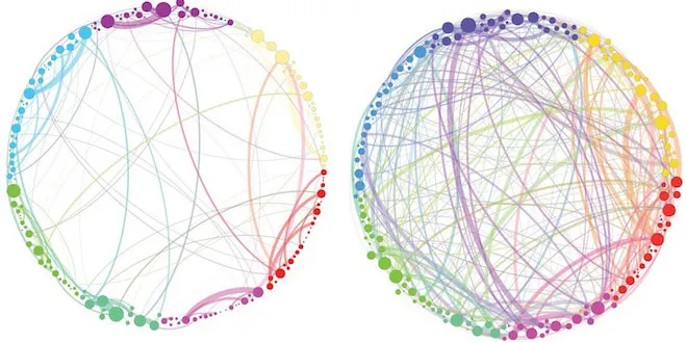
Communication between brain networks in people given psilocybin (right) or placebo (left).
(Petri et al 2014)

Buddhists and many other meditators refer to the self as an illusion. This is somewhat misleading. The sense of self is real content experienced in everyday consciousness. That it is produced by the DNM means that it is a product of the brain in the same sense that a dream or hallucination is. It can change or disappear and is an illusion in the sense that it is not a fundamental and permanent essence of a human being. We can obviously conclude that the “many little selves” many philosophers agonize about, how they can combine to form a single big self, is all irrelevant.

Anneka Harris (2022) identifies the illusion of the self as the solution to the problem of particles having minds and of the combination problem. I would argue that she misses a much simpler conclusion. The “self” is only one of the contents of consciousness, and there is no need for panpsychism to be saddled with any of the other contents of consciousness going all the way down. It is much simpler to identify contentless awareness as all that needs to go all the way down to the basic constituents of everything.

Harris gets very close to this realization when she distinguishes between consciousness and thought. And says we would not expect a rock to have a single unified point of view (as a rock) or to have anything like thoughts or intentions. Because the rock particles are not configured to do that. She is so close to recognizing that brains produces all the contents of consciousness.

4. The supposed combination problem

Goff (2019, pp.144ff) describes the combination problem “how little minds could somehow combine to make up a big mind” as the biggest problem for panpsychism. Without a solution, panpsychism is a lost cause. Most of the 42 experts also see the combination problem as the biggest problem facing panpsychism.

The problem just goes away once we realize that only consciousness (defined as contentless awareness) needs to go all the way down to solve the hard problem without invoking strong emergence. I think there is also good evidence from direct experience to suggest that contentless pure awareness must be identical everywhere, for essentially the same reason that electrons are perfectly identical. There are no properties of electrons that differ across electrons. There is no property of contentless awareness per se that can differ across instances though any contents can and will differ.

Why does the combination problem not exist? Consider atoms, or their fundamental particle constituents, which have mass and hence a small gravitational field. There is no combination problem for larger aggregations of atoms. Whether it is a cannonball or a planet, there is a single gravitational field resulting from the combined mass of the constituents. Why should contentless awareness be any different? Following this analogy, the only aspect of contentless awareness that might vary across instances of it is the “strength” of the awareness “field”.

However, I think there is a more useful physical analogy for understanding how contentless awareness might combine across the constituents of a brain and interact with content produced by that brain. Let us consider a bar magnet. Individual atoms have magnetic fields arising from electron spin and motion and align within a microscopic domains to create an overall magnetic field. These domains are unaligned in an unmagnetized metal bar.

When they do become aligned (say by a strong magnetic field from an external source), then the overall metal bar becomes a permanent magnet with a north and south pole and a net magnetic field running between those two poles outside the bar. Normally, most of the domains are aligned though increasing temperature will result in fewer domains being aligned, and beyond a specific temperature, alignment ceases and the bar is no longer magnetized.

Perhaps consciousness of atoms or molecules combines in a similar way to form consciousness domains, and these combine to produce a single overall consciousness in a normal brain. What is combining is pure contentless awareness, which is not separate any more than the magnetic fields of the domains remain separate in a permanent bar magnet. That awareness experiences contents of contents produce by the related brain.

For simplicity, I will refer to the smallest amount of consciousness (say at electron or hadron level) as a quantum of consciousness. I am not invoking quantum theory here, in any way, just borrowing a piece of terminology.

Why are conscious subjects at the human scale separate in terms of the experiences in consciousness? Biologists tend to see this as an argument for emergence from brains. The real answer is likely in what is needed for quanta of consciousness to form a broader field at organ or organism level in such a way as to have causal connections with brain products.

5. The evolution of conscious minds

As nervous systems and brains evolve, their capacity to create and process thoughts, feelings, sense experiences generally increase. If the basic constituents of these nervous systems have a primitive contentless awareness, which can combine into a single larger field of awareness, how and why do the contents of awareness appear in that field? In what follows, I will refer to brains for simplicity but intend that reference to cover “brains and associated nervous systems”.

Is this a causal process from brain to consciousness or is the “eye of awareness” just aware of content without causal connections. When I read Chalmers (1996), he semi-convinced me that pure consciousness was an epiphenomenon that did not causally affect its contents or the neurons producing them. There is no doubt that those contents, produced by the brain, are experienced in consciousness. Does that experiencing in turn have causal effects on the brain?

While writing this article, I have been examining my meditation experience for any clues. I do have a memory of what my most profoundly non-dual state of consciousness was like. In fact, it made a huge impression and was a major reason why I spent the next decade practicing zen meditation in week-long retreats under the guidance of several Zen master.

I tentatively conclude that memories of largely contentless states of consciousness do get made. Presumably by a causal pathway from consciousness to memory-making processes of the brain. And it follows that the experiencing in consciousness of content produced by the brain also has a causal feedback mechanism to the brain.

Why is it useful for humans to “experience” with feedback to the brain, on top of collecting and processing sensory and other data? Or put slightly differently, why would evolution select for brain structures that supported increasingly strong causal connections with consciousness?

“Among all the aspects of an animal or human being that contribute to its fitness, few make a greater contribution than consciousness. There is much evidence that the focus of a person’s consciousness can be trained and that a trained attention underlies the skills of an athlete, a musician, or a hunter. It seems possible, if not likely, that consciousness or awareness had and has a lot to do with the thriving of our species.

“It is then very natural to suppose that, if the existence of consciousness is to be explicable, it must perform some function that increases the fitness of the creature that is endowed with it. But this requires that consciousness can intervene in the network of causes in the physical universe. But when we try to develop this idea, we run immediately into a very strong argument that the physicalists have to their credit, based on the causal completeness — or ‘causal closure’ — of the of the standard Newtonian paradigm” (Cortês, Smolin and Verde (2022).

Cortês et al. conclude that there must be a yet unknown causal pathway between the experience of qualia and the brain. It makes the will to live and to reproduce more real and motivating to the organism. An unconscious brain can be programmed with these drives, but there is likely some additional oomph provided by the “experiencing” of things.

The psychologist Nicholas Humphrey (2017), who thinks consciousness is an illusion, has argued that it comes with a significant survival advantage. Creatures who believe they have a subjective inner life develop a great interest in preserving and enriching that inner life through complex engagement with their environment.

Strawson (2006) also realizes that natural selection will act on experiential consciousness:

“Human experience or sea snail experience (if any) is an emergent property of structures of ultimates whose individual experientiality no more resembles human or sea snail experientiality than an electron resembles a molecule, a neuron, a brain, or a human being. Once upon a time there was relatively unorganized matter, with both experiential and non-experiential fundamental features. It organized into increasingly complex forms, both experiential and non-experiential, by many processes including evolution by natural selection. And just as there was spectacular enlargement and fine-tuning of non-experiential forms (the bodies of living things), so too there was spectacular enlargement and fine-tuning of experiential forms.” (Strawson 2024a, p48)

However, because he thinks it is experiences which go all the way down to fundamental constituents, he misses what natural selection is really doing. As primitive nervous systems evolved into more complex organization of neurons and neurotransmitters, natural selection will give an evolutionary advantage to forms of organization which align basic quanta of consciousness at molecular level into a coherent field of consciousness that can have experiences and give causal feedback to the nervous system.

What natural selection must have done is evolve the alignment of basic quanta of consciousness into a larger field of consciousness in such a way as to have two-way causal paths between that field and the associated brain. Natural selection will also be fine-tuning brains to produce more complex contents to be experienced in consciousness.

Complex brain content is weakly emergent, and we already largely understand how thought, feelings and sense experiences arise in terms of the properties of the basic constituents of brains. Contentless organism-level consciousness is also now weakly emergent since its properties are entirely explicable in terms of the quanta of contentless consciousness of the basic constituents of matter.

6. Towards a defensible form of panpsychism

The panpsychism theory proposed in this article can be summarized as follow:

  1. Consciousness is real, it exists.
  2. The term consciousness refers to contentless awareness per se, not to mind or self or thoughts or qualia or other contents of consciousness.
  3. Consciousness cannot be strongly emergent from purely physical constituents.
  4. Some degree of consciousness is a property of the basic constituents of matter.
  5. Contents of consciousness (thoughts, feelings, sense experiences) are produced in brains and experienced in consciousness.
  6. Without the involvement of a brain (or perhaps nervous system), there are no thoughts, no thinking, no feelings etc just some degree of contentless awareness.
  7. There is no combination problem for basic quanta of consciousness.
  8. Either such quanta naturally form a single field of contentless awareness in aggregates of matter, or the alignment and combination of elementary quanta of consciousness only occurs in specific circumstances (e.g., in brains evolved to provide those circumstances)
  9. Consciousness connected causally with brain content provides an evolutionary advantage and (soft) emerges in organisms under the influence of natural selection.
  10. Contents of consciousness are emergent phenomena, a soft emergence associated with the evolution of increasingly complex nervous systems and brains.

Given the long use of the term “panpsychism” for proposals based on a mind-body dichotomy rightly rejected by most philosophers and lay people as clearly nonsensical, we need a distinguishing label for this theory. I will provisionally call it emergent panpsychism, since both consciousness and brain contents are weakly emergent and there is no longer a hard problem of strong emergence.

Some of the commentators criticized panpsychism on the grounds that it changes nothing and has no testable hypotheses. It will be important to try to clarify the evidence for causal connections between consciousness and brain processes. This will necessarily involve systematic exploration using techniques such as meditation.

Luke Roelofs (2022) notes that the claim that panpsychism and a theory of hard emergent consciousness are observationally equivalent has been used by critics to argue that panpsychism is unfalsifiable. Roelofs argues that they do differ in their predictions of whether or not I am subjectively conscious: panpsychism predicts that I should be, while materialism gives no basis for predicting this.

Emergent panpsychism likely has a number of other predictions. I have not thought about this much yet, but will list a few predictions off the top of my head:

  • Consciousness, qualia, and a sense of self are not confined to humans, but present in other animals and organisms to varying degrees (likely correlated with the complexity of the nervous system).
  • The emergence of consciousness and causal connections to brains is due to natural selection. There is negligible probability that the relevant structures and interactions required for consciousness will occur in computer circuits built by humans entirely ignorant of them.
  • Until and unless we discover such knowledge, digital processes and AI programs will never become conscious. Not even genuine “thinking” AI of the future, let alone the massive statistical autocomplete software we currently call AI.
  • Contentless awareness is likely a single universal field, but content is only ever experienced locally in relation to specific organisms. Content cannot be shared across organisms or shared communally except through linkages between brains.

Strawson made some quite similar predictions in a recent interview (Andrew 2025):

“Yeah, I would think that of larger things that are conscious, probably they’re all biologically evolved. That would be my bet. Well, now it’s partly because I think that interesting animal consciousness biologically evolved for a purpose, and that wouldn’t happen in the case of the chair.

“And, empirically, I think it’s highly plausible that you need some incredibly complicated electrochemical shenanigans to get interesting consciousness — and chairs don’t have it. My brain has it, and the molecular structure of a chair just doesn’t have the kind of electrochemical goings-on of the sort that would be needed for interesting consciousness.”

To be clear, Strawson here is talking about the emergence of interesting animal consciousness from existing basic quanta of consciousness, not about hard emergence from purely physical materials.

8. Conclusions

Having done a deep dive into philosophers’ debates on panpsychism, I was very surprised to find that almost all of them think panpsychism refers to minds, even little selves, and then they get stuck in the combination problem “how can lots of little minds combine into one big mind?” More importantly, this erroneous dualism leaves the contents of consciousness (thoughts, feelings, experiences) on the side of mind, and even most philosophers instinctively recoil from a version of panpsychism in which spoons and toasters have minds, and hence thoughts, feelings and experiences. This is why Strawson rejected panpsychism after writing an article about the need for it.

The books reviewed here included considerable discussion of Descartes, the mind-body dichotomy and the problems of dualism. A committed practice of meditation, even for a few months, will usually yield the insight that contents of consciousness come and go, in a field of contentless consciousness. Once that distinction is made, it becomes obvious that strong emergence only requires pure contentless consciousness to go all the way down — leading to the emergent panpsychism I have outlined in this article.

Even those philosophers like Chalmers, who seems passionate to understand the nature of consciousness, ignore systematic observations. In a 2017 interview with Chalmers, John Horgan (2017) reported that Chalmers has “never had the patience” for meditation, and he has doubts about basic Buddhist claims, such as anatta, the insight that the self does not really exist. What would we think of a physicist who never had the patience for experiments, said he also doubted the evidence of the experimentalists (or never actually looked at it) and preferred to do thought experiments based on assumptions that seemed reasonable to him?

This is main reason that there has been no real progress in the philosophy of mind or consciousness over many centuries (see Koch 2022, quoted in Section 3 above). So why do even the philosophers passionate about the nature of consciousness ignore direct first-person evidence? Anyone serious about elucidating the nature of an aspect of reality would surely be willing to devote years of research to either the systematic first-person exploration of consciousness or the collective reporting of those who have done so. Are these philosophers simply not serious?

I think there are several reasons for this. First, they may be stuck in a cultural bubble which includes the mind-body dualism paradigm and a view of evidence restricted to the third-person data of science. Second, some may simply be playing the academic game of publish or perish and unwilling to risk going outside accepted academic disciplinary boundaries. Thirdly, some may see the major forms of direct evidence from meditation or psychedelics as unacceptable woo-woo or meaningless.

Strawson, Goff and a couple of other philosophers have come close to an understanding that only the simplest form of consciousness has to go all the way down but lack the direct experience of contentless consciousness that would allow them to articulate this clearly. Of course, no-one should just take a single person’s report or interpretation of their experience as gospel. Ideally you experience it for yourself, taking into account the advice of those who have traveled this direct experiential path, testing it, evaluating it for yourself. Persevere until you have experience and understanding of the main techniques, plus experiences of the various important states of consciousness that can be reached. Then you can join the conversation.

This article was earlier published on Medium here.

References

Andrew JP (2025). My Interview With Galen Strawson, Part I: On Galen’s background, his conception of philosophy, and panpsychism. Substack, 3 May 2025.

Azarias FR, Almeida GHDR, de Melo LF, Rici REG, Maria DA. The Journey of the Default Mode Network: Development, Function, and Impact on Mental Health. Biology. 2025; 14(4):395. https://doi.org/10.3390/biology14040395

Benes M, Paleníček T, Horaček J (2025). What fMRI studies say about the nature of the psychedelic effect: a scoping review. Frontiers in Neuroscience. 2025 19; https://www.frontiersin.org/journals/neuroscience/articles/10.3389/fnins.2025.1606798

Carhart-Harris RL, Leech R, Hellyer PJ, Shanahan M, Feilding A, Tagliazucchi E, et al. (2014). The entropic brain: a theory of conscious states informed by neuroimaging research with psychedelic drugs. Front. Hum. Neurosci. 8:20. https://www.frontiersin.org/journals/human-neuroscience/articles/10.3389/fnhum.2014.00020/full

Chalmers, David (1996), The Conscious Mind: In Search of a Fundamental Theory, New York: Oxford University Press.

Bourget, D. & Chalmers, D.J. (2014) What do philosophers believe? Philosophical Studies, 170, pp. 465–500.

Chalmers, D.J. (2015) Why isn’t there more progress in philosophy? Philosophy, 90, pp. 3–31.

Chalmers, David, and McQueen, Kelvin (2022). “Consciousness and the Collapse of the Wave Function,” in S. Gao, ed., Quantum Mechanics and Consciousness. New York, 2022; online edn, Oxford Academic, 20 Oct. 2022, https://doi.org/10.1093/oso/9780197501665.001.0001

Colman, Sam (2024). A Panqualityist Manifesto, In Goff, Philip and Moran, Alex (eds.). Is Consciousness Everywhere: Essays on Panpsychism. Andrews UK Limited 2022, Kindle Edition, p. 466-488.

Cortês, Marina, Smolin, Lee, and Verde, Clelia (2022). Physics, Time, and Qualia. In Goff, Philip and Moran, Alex (eds.). Is Consciousness Everywhere: Essays on Panpsychism. Andrews UK Limited 2022, Kindle Edition, p. 54-75.

Davey CG, Harrison BJ. The brain’s center of gravity: how the default mode network helps us to understand the self. World Psychiatry. 2018 Oct;17(3):278-279. https://doi.org/10.1002/wps.20553

Gattuso JJ, Perkins D, Ruffell S, Lawrence AJ, Hoyer D, Jacobson LH, Timmermann C, Castle D, Rossell SL, Downey LA, Pagni BA, Galvão-Coelho NL, Nutt D, Sarris J (2023). Default Mode Network Modulation by Psychedelics: A Systematic Review. Int J Neuropsychopharmacol. 2023 Mar 22;26(3):155-188. doi: 10.1093/ijnp/pyac074.

Goff, Philip (2006) Experiences Don’t Sum. In Strawson (2024). Consciousness and Its Place in Nature. Andrews UK Limited. Kindle Edition, p. 97.

Goff, Philip (2019). Galileo’s Error: Foundations for a New Science of Consciousness. Ebury Publishing.

Goff, Philip (2022). Putting Consciousness First: Replies to Critics. In: Goff, Philip and Moran, Alex (eds.). Is Consciousness Everywhere: Essays on Panpsychism. Andrews UK Limited 2022, Kindle Edition, p. 409-461.

Goff, Philip and Moran, Alex (eds.) (2022). Is Consciousness Everywhere: Essays on Panpsychism. Imprint Academic. Kindle Edition.

Harris, Annaka (2019). Conscious: A Brief Guide to the Fundamental Mystery of the Mind, New York: Harper Collins.

Harris, Annaka (2022). A Solution to the Combination Problem and the Future of Panpsychism. In Goff, Philip and Moran, Alex (eds.). Is Consciousness Everywhere: Essays on Panpsychism. Andrews UK Limited 2022, Kindle Edition, p. 187-202.

Horgan, John (2017). David Chalmers Thinks the Hard Problem Is Really Hard. Scientific American 2017, April 10. https://www.scientificamerican.com/blog/cross-check/david-chalmers-thinks-the-hard-problem-is-really-hard/

Humphrey, Nicholas (2017) The invention of consciousness. Topoi: An International Review of Philosophy, 39(1), 13-21. https://www.researchgate.net/publication/310466128_The_Invention_of_Consciousness

Koch, Christof (2022). Reflections of a Natural Scientist on Panpsychism, In Goff, Philip and Moran, Alex (eds.). Is Consciousness Everywhere: Essays on Panpsychism. Andrews UK Limited 2022, Kindle Edition, p. 94.

Mc Ginn, Colin (2024). Hard Questions: comments on Galen Strawson. In Strawson, Galen. Consciousness and Its Place in Nature: Why Physicalism Entails Panpsychism. 2nd Edition 2024, p.160-175.

Menon, V. (2023). 20 years of the default mode network: A review and synthesis. Neuron, 111(16), 2469–2487. https://doi.org/10.1016/j.neuron.2023.04.023

Nagel, Thomas (1979), ‘Panpsychism’, in Mortal Questions. Cambridge: Cambridge University Press: 181–95.

Petri G, Expert P, Turkheimer F, Carhart-Harris R, Nutt D, Hellyer PJ, Vaccarino F (2014). Homological scaffolds of brain functional networks. J R Soc Interface 6 December 2014; 11 (101): 20140873. https://doi.org/10.1098/rsif.2014.0873

Roelofs, Luke (2022) Is Panpsychism at Odds with Science? In Goff, Philip and Moran, Alex (eds.). Is Consciousness Everywhere: Essays on Panpsychism. Andrews UK Limited 2022, Kindle Edition, p. 171-185.

Seager, William (2024). From Panpsychism to Neutral Monism… and Back Again(?). In Strawson, Galen. Consciousness and Its Place in Nature: Why Physicalism Entails Panpsychism. 2nd Edition 2024, p.509-532.

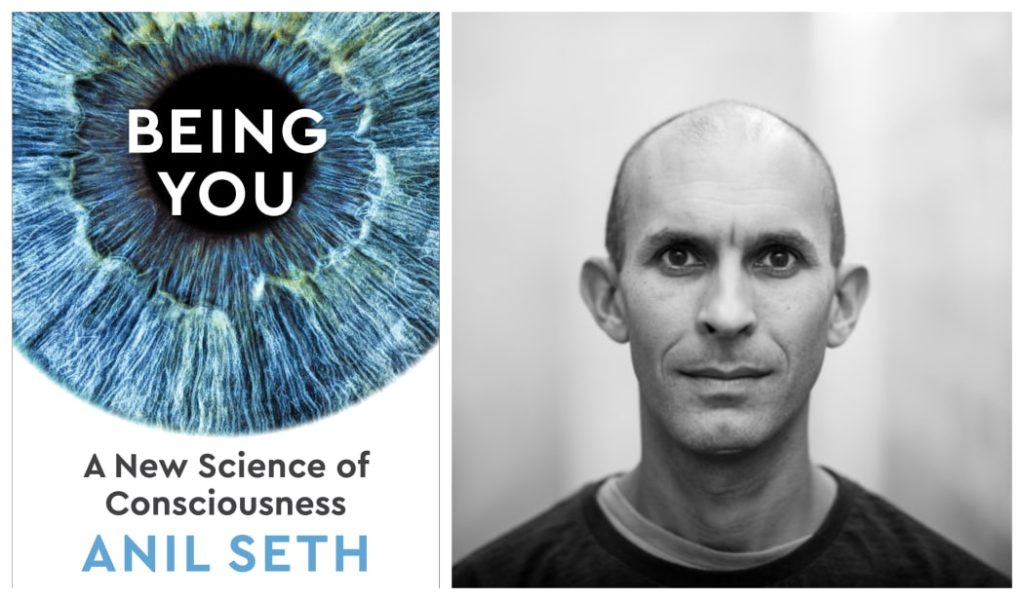
Seth, A. (2021) Being You – A New Science of Consciousness, New York: Dutton. https://www.anilseth.com/being-you/

Simons, Peter (2024). The Seeds of Experience. In Strawson, Galen. Consciousness and Its Place in Nature: Why Physicalism Entails Panpsychism. 2nd Edition 2024, p.251-258.

Strawson, Galen (2006). Realistic monism – why physicalism entails panpsychism. Journal of Consciousness Studies 13 (10-11):3-31. Reprinted in Strawson (2024).

Strawson, Galen (2024a) Consciousness and Its Place in Nature: Why Physicalism Entails Panpsychism. 2nd Edition 2024.

Strawson, Galen (2024b) The Impossibility of Subjectless Experience. Journal of Consciousness Studies, Volume 31, Numbers 5-6, June 2024, pp. 26-36(11).


Questions about Panpsychism

Like many scientists, I dismissed panpsychism as hugely implausible until recently. Then I read discussions of it in Annaka Harris’s 2019 book “Conscious” and David Chalmers’ 1996 book The Conscious Mind: In Search of a Fundamental Theory. They persuaded me that panpsychism should be considered as a potential solution to the hard problem.

There has been a revival of interest in panpsychism and I bought three recent books on it. Before reading them, I decided to think through for myself what a defensible form of panpsychism would look like, and what questions it raises.

The Hard Problem — two options

David Chalmers famously termed this the “hard problem” of consciousness. Most scientists and philosophers simply assume it must be an emergent property of the brain.

The alternative option is some form of panpsychism: consciousness is a fundamental property of matter alongside things such as charge, spin, etc. Chalmers also suggested a hybrid option, that consciousness derives from some other class of more fundamental non-physical properties. Consciousness is emergent from these more fundamental non-physical properties in sufficiently complex arrangements of matter.

Emergence

Emergence refers to properties or behaviors of a complex entity that its parts do not have on their own and emerge only when they interact in a wider whole. Some examples of emergent properties/behaviours include the structure of snowflakes, waves and chaotic fluid flow, chaotic behaviours of simple predator-prey systems, ant colonies, and the blood pumping properties of hearts.

These are all examples of what philosophers call weak emergence. The emergent properties are still descriptions of matter and how it behaves as witnessed from the outside, they are in the same category of things as the underlying basic properties of that matter.

Strong emergence refers to a fundamentally different category of thing emerging from things lacking that category. The proposed emergence of first-person experience from non-sentient matter would be an example of strong emergence. There are no known examples of strong emergence as far as I know.

All discussions of consciousness as an emergent phenomenon simply assume it is emergent. Chalmers argues that strong emergence is uncomfortably like magic, but the emergent phenomena are still regarded as being utterly dependent on the physical.

Panpsychism

Panpsychism is the view that all matter is imbued with consciousness in some sense. The term has been used to describe a wide range of thinking from the animism of primitive religions to a mind-like aspect, or to some much simpler form of basic awareness.

Panpsychism was a common view among philosophers in the 19th century, but fell out of favour in the twentieth century. There has been a recent revival of interest among philosophers such as Thomas Nagel, Galen Strawson, David Skrbina and Philip Goff. Even some neuroscientists such as Giulio Tononi and Christof Koch have proposed that consciousness is widespread and can be found in simple systems.

Most scientists are very reluctant to consider panpsychism, and many dismiss it as obviously ridiculous. The idea that “rocks are conscious” is taken as so obviously ludicrous that panpsychism can be safely dismissed out of hand.

Chalmers has noted that panpsychism avoids the need to have consciousness wink-in or switch-on at some particular level of complexity. Rather it may be a universal property, with very simple systems having very simple phenomenology and very complex systems having very complex phenomenology. Annaka Harris also noted that “In actuality, if a version of panpsychism is correct, everything will still appear to us and behave exactly as it already does.”

What does consciousness refer to?

In a previous article, I discussed the experience of pure conscious awareness when thoughts, feelings, sensations drop away. Zen refers to this as “body and mind dropped away”. This experience is accessible through a range of meditation practices and also occurs spontaneously in some circumstances.

This experience allows the meditator to realize that they are not their thoughts, or their feelings, that these arise and pass away. Contentless consciousness is pure awareness per se. The part of my brain responsible for assigning labels and meaning — to objects, events, interactions — is not currently online.

Is this pure awareness inherently nondual? I’ve have had a taste of nondual consciousness once or twice. Insufficient for me to claim to understand it or draw any conclusions yet. I suspect the pure state is indeed an unchanging non-dual awareness. Duality starts with brain processes classifying what is experienced.

Contents of consciousness

These include thoughts, verbalized or not, feelings and emotions, and sensory perceptions.

Are qualia also contents of consciousness? They are not illusory, the one thing direct experience of the suchness of something cannot be is an illusion. And they are not reducible to underlying neural activity as they refer to the first-person suchness of experiencing the particular content. I am inclined to think that suchness remains part of the content of awareness.

Pierz Newton-John makes an argument I find convincing that colours convey information about the environment (dangers, food, etc) and that evolution results in the attachment of emotions to colours to ensure we react appropriately to such colour information. In other words, the experience of a colour develops an emotional richness, ie complex qualia. This can only arise in systems that possess the ability to summarise and respond to complex information in their environment.

He sees this as ruling out panpsychism (because he considers qualia as defining of consciousness). I don’t. If qualia are contents of consciousness, then indeed they will require nervous systems to have any complex suchness. Objects without brains will have nothing but some rudimentary awareness and very rudimentary suchness of that awareness. There is likely not something it is like to be a rock beyond some very tiny awareness per se, no different to our pure contentless awareness.

Philosophers see qualia as being key to what it is like to be human, or a bat, or a dog. And it seems reasonable to me that what it is like to be a bat is very much about the qualitative aspect of bat sensory, bat feeling and bat thoughts, because these will be quite different to, say, human qualia for sensory, feeling and thinking inputs to consciousness. And that would fit with my suspicion that contentless consciousness (pure contentless subjective awareness) might not differ across species, except perhaps in some sort of strength measure (depth?) of awareness.

My experiences of contentless consciousness in meditation seem to confirm that qualia drop away along with other content of consciousness. The hard problem relates to contentless consciousness, pure awareness, The easy problem relates to qualia and other contents of consciousness, and their origins in brains and nervous systems.

Non-ordinary states

There are many of these states other than everyday waking consciousness. We experience several of these each day, including the hypnagogic state, REM (dream) sleep and deep sleep. Let’s consider psychedelic-induced states as an example. In these states, is it only the contents of consciousness that change or does consciousness per se (aka pure awareness) also change?

We know that psychedelics alter neurotransmitter levels and block or activate neurotransmitter receptors. We also know that brain networks are up- or down-regulated, and that brain network connectivity is altered. Qualia and sensory experiences are altered. An example is synesthesia when sensory crossovers occur, such as tasting colours or feeling sounds.

I think it most likely that psychedelic experiences are all about the contents of consciousness. Pure awareness remains unchanged in altered states. But I could be wrong.

Attention

We can focus our attention on specific content of consciousness, such as breath counting, mantras, visual images, flames, or koans, and on awareness itself. Or we can expand attention to be non-specific and broad (mindfulness meditation, shikantaza). How does attention work? What is driving it? The brain? Thoughts? decisions?

While meditative traditions talk a lot about attention in terms of how it can be used, I’ve either ignored or not encountered an analysis of what it is and where it arises. What is attention? How does it work?

Causal connections

The brain and nervous system produce content experienced by consciousness. Is this a causal process from brain to consciousness, or is the “eye of awareness” just aware of content without causal connections, unlike our physical eyes which are causally affected by the light arriving at them.

Are there connections the other direction? We can remember experiencing the suchness of qualia. We can remember (to some extent) experiencing meditative states, even non-dual states of contentless awareness. This must surely imply some causal feedback from the experiences to the memory centres of the brain.

Pure awareness is likely always on (even in deep sleep). The primary evidence for this is from advanced meditators, particularly in the Tibetan tradition. Ken Wilber also reports experiencing this in his book One Taste.

In most of us, the link to memory disappears in states like deep sleep and anaesthetic-induced unconsciousness. This is also the case for most dreams, that do not make it to long-term memory, and traces in short-term memory can rapidly evaporate after waking. Likely most of us do not lay down memories of that residual pure awareness during deep sleep. Maybe neuroscience will find evidence one way or the other?

Once the brain can register memories of conscious awareness, that opens a causal pathway for consciousness to affect other brain processes such as conclusions, choices or reporting of experiences.

When I read Chalmers, he semi-convinced me that pure consciousness was an epiphenomenon that did not causally affect its contents or the neurons producing them. But memories of meditative states do get made. Is there a causal pathway from conscious awareness per se to laying down memories of that awareness? How does that work?

What should a panpsychism hypothesis look like?

  • Consciousness is pure unchanging awareness, not mind or self or thoughts or qualia or other contents of consciousness
  • Some degree of consciousness is a basic property of matter.
  • Without the involvement of a brain (or perhaps nervous system), there are no thoughts, no thinking, no feelings etc just some degree of contentless awareness.

Some speculations about panpsychism

Without a brain to provide content, and to store memories, pure consciousness at lower levels can be no more than some microscopic “pure awareness” with possibly some direct connection to very primitive “physical inputs” that do not require sensory organs or nervous system. That might be nothing more than some sort of very limited awareness of temperature or quantum fields.

But does pure awareness have a “strength”. Is awareness at the atomic level very weak or is awareness just awareness, and it is the connection to content that changes with scale and complexity?

If there is some scaling of awareness with size, whether linear or not, how do we get an apparent unified “field” of awareness at human-level?

I think it likely that some very primitive consciousness increased probability of survival and reproduction. Evolutionary selection pressures have selected organisms that developed nervous systems with structures that favoured some alignment/coupling of atomic-level consciousness. Maybe those same selection pressures selected arrangements that fostered two-way causal communications between the growing first-person awareness and the increasingly complex brain.

The human brain weights around 1.3 kg. Assuming a weight of 1 kg and an average atomic weight of 6 for brain atoms, there are approximately 10²⁶ atoms in a human brain. One atom might thus have about one hundred million-billion-billionth of the pure contentless awareness of a human. That could at most have only an extremely faint direct experience of quantum interactions with force transmitters (virtual particles, real particles etc).

How might these atomic quanta of consciousness align to form a “macroscopic” consciousness. Perhaps the alignment process is somewhat analogous to what occurs in ferromagnetic materials.

The atomic level magnetic fields of atoms (arising from the spin of the electrically charged electrons) can align in magnetic materials to produce a macroscopic and continuous magnetic field. Perhaps elementary quanta of consciousness can similarly align to produce a larger field of consciousness. This is of course only an analogy, the interactions of “quanta” of consciousness may be completely different to any interactions in the physical domain.

Without a brain to produce thoughts and other inputs to that awareness it cannot act in any way. Perhaps the evolution of brains involved an emergent process producing a more aware consciousness able to experience inputs from the brain. The hard problem is avoided. In the same way a bar magnet avoids the hard problem of magnetism by organizing the already existing magnetic fields of atoms so that their spins are aligned.

Is there any way to test the emergence or panpsychism hypotheses?

No. To a certain extent we can infer that simpler brained animals have “less consciousness” although their consciousness (pure contentless awareness) is likely to be exactly the same as ours apart from possibly its “strength”. The big difference is the contents of consciousness, the thoughts and perceptions are simpler, and almost definitely non-verbal and less complex. Sensory inputs may be wildly different to ours.

There are likely some predictions that can fall out of this proto-theory of panpsychism. One example would be a prediction that computing machines that have programs to emulate thoughts and process sensory and language inputs will not align their atomic level awarenesses into an analogue of human consciousness. Why? Because we have no idea what aspects of brain structure enable this coordination and linking of atomic level consciousnesses, and we certainly have not designed computer circuits to incorporate such factors, as yet unknown to us.

Of course, we have no idea whether particles have consciousness or not. We cannot even tell whether anyone other than ourselves is truly conscious. We assume so because they are a human like us, and we have consciousness, and they act as though they do and tell us they do.

Annaka Harris makes an analogy to the Higgs field. Physicists realized it needed to exist to give mass to electrons and quarks. Eventually, after 48 years, its carrier, the Higgs boson, was detected experimentally. If consciousness is another property of matter that we have yet to discover, it is not at all clear whether it is possible to discover it, given that we have no way of detecting consciousness outside first-person experience of it. But it may need to exist, if emergence continues to remain only a magical explanation.

Only by hooking up pure awareness to a brain that can produce inputs to awareness and record and report memories of what its like to experience those contents can we have the full experience of what its like to be conscious. Neuroscientists might be wrong that consciousness is an emergent property of the brain. But it can still be true, that without a brain, consciousness is not all that big a deal for the atoms, or the toaster or the computer running an AI program.

Where does this leave us?

It’s hard for me to see how scientists could ever explain the emergence of first-person awareness from unconscious matter, no matter how well organized, but it remains a possibility. No-one to date has made any plausible proposal for how it would happen. Rather like the creationists, who have no ideas, no hypotheses, just “god did it”.

I think a defensible version of panpsychism is starting to emerge from the thoughts and questions I have documented here. Its also possible that the solution to the hard problem may be forever beyond our reach,

I will now start reading some of the recent writings on panpsychism. Are others thinking along the same lines? Do they have plausible hypotheses to address questions I have raised here?

Consciousness: natural or supernatural?

I recently read an article on Medium in which Prudence Louise argued that consciousness is fatal to the philosophy of naturalism. Consciousness is supernatural, and the hard problem is the impossible problem because consciousness is not natural.

I was astonished. Consciousness is clearly part of our reality and its existence was famously termed the “the hard problem” by the philosopher David Chalmers. In a previous post, I described how Chalmers set himself the following constraints in tackling the hard problem. First, to take consciousness seriously and not redefine it as something else (as per Daniel Dennett). Second, to take science seriously in the domains where it has authority. Third, to take consciousness to be a natural phenomenon.

Why does Prudence Louise think consciousness must be supernatural? She correctly points out that we have no evidence that consciousness is an emergent property of the brain, though many people, and most neurologists assume it must be. We don’t have any theory of emergence, a proposed mechanism to explain how consciousness could emerge. I agree with her so far.

Continue reading

Consciousness and free will – Part 2

“Free will is an illusion so convincing that people simply refuse to believe we don’t have it.” Jerry A. Coyne (Professor of Evolution and Ecology) commenting on Sam Harris’s book Free Will. An Australian Professor Daniel Stojar is an example of the many people who simply refuse to believe we don’t have free will, saying “It seems as obvious as anything that we have free will. ….. We are free to move our finger. That is neither determined nor random — it’s a choice we can feel in our bones.”

How universal is this belief that we have free will in the ordinary sense, not in the philosopher’s compatibilist sense?

Continue reading

Consciousness and free will – Part 1

Like most people, it seemed obvious to me that we have free will and up until about three years ago, I had not thought about it much or questioned it. Then I read Sam Harris’ small book Free Will (2012, Free Press) which made the case that we do not have free will. In my previous posts on consciousness, I noted that Annaka Harris, David Chalmers and Anil Seth all had some discussion of free will in their books. So I re-read Sam Harris’s book, now with a much deeper understanding of its relationship to consciousness, and came away largely convinced that he is right in seeing free will as an illusion.

Free Will is a very short book, 66 pages of main text amounting to around 15,000 words. It is very well written and jargon-free and makes a very strong case that free will is an illusion. Thoughts and intentions emerge from background causes of which we are unaware and over which we exert no conscious control. Well worth reading, whatever your views on free will.

For most people, consciousness not only involves a sense of self but also the feeling of being in control of your actions, of being the author of your thoughts. In other words, you have free will, the ability to consciously choose among potential decisions or actions. I refer to this as free will in the ordinary sense. This idea of free will emerges from a felt experience, and most people do not question it. That included me until relatively recently.

Continue reading

The “real” problem of consciousness: a review of Being You by Anil Seth

In my fifth post in this series, I review Anil Seth’s 2021 book Being You. See here, here, here, and here for the previous posts. I read a Guardian review of this book in August 2021 which raved about it, as did various other reviewers. So, I went out and bought it, and when it came, I started to read it. It annoyed me so much (see below) that I put the book aside until recently. Seth is a Professor of Neuroscience at the University of Surrey, highly cited for his publications, and also a prolific popularizer of his views on consciousness (New Scientist, Scientific American, TED talks etc).

Seth starts well in the Prologue, with the comment that “consciousness is a mystery that matters. For each of us, our conscious experience is all there is. Without it there is nothing at all: no world, no self, no interior and no exterior.” But he continues with “For me, a source of consciousness should explain how the various properties of consciousness depend on, and relate to, the operations of the neuronal wetware inside our heads. The goal of consciousness science should not be ‑‑ at least not primarily ‑‑ to explain why consciousness happens to be part of the universe in the first place.”

Continue reading

The hard problem of consciousness: David Chalmers and The Conscious Mind

In my fourth post in this series, I review David Chalmer’s 1996 book The Conscious Mind: In Search of a Fundamental Theory. See here, here and here for the previous posts. This is a long and often technical book (about 395 pages) though Chalmers has kindly flagged the Chapters and Sections that he recommends non-philosophers read and has asterisked the headings of Sections that he considers technical details likely of interest only to philosophers. I read some but not all asterisked sections, and I have to say that it is indeed the most technical and “academic” work of philosophy I have read in decades.  But let’s dive into it.

The hard problem of consciousness

It was like a breath of fresh air to read the introductory chapter. Instead of dismissing consciousness as an illusion, Chalmers sees it as the largest outstanding obstacle in our quest for a scientific understanding of the universe. He coined the phrase “the hard problem” around 1994 and it caught on. In contrast to the hard problem of why we have first-person experience, issues such as how the brain processes environmental stimuli, or how it integrates information into a coherent whole, might be called “easy” problems, and many books about consciousness, such as Dennett’s, are largely about the easy problems. Consciousness remains a big, deep mystery about which science has almost nothing to say, and where there is no agreement even in the broad about how consciousness occurs.

Chalmers says he has found that around one-third of people think that solving the easy problems explains everything that needs to be explained about consciousness, and around two thirds hold that there is a further “hard” problem. This ratio is fairly constant across academics and students in a variety of fields.  He sets out explicitly to address the hard problem and to develop at least a basis for a scientific theory of consciousness though he recognizes that it is not open to investigation by the usual scientific methods.

He outlines a set of constraints within which attempts to obey in this quest. First, to take consciousness seriously and not redefine it as something else (as per Dennett). Second, to take science seriously in the domains where it has authority. Third, to take consciousness to be a natural phenomenon.

Two fundamental questions about consciousness

In the Introduction and Chapter 1, Chalmers clarifies what he means by consciousness. It’s the way we experience the world, the way it feels to us subjectively. Using the phrase Nagel made famous in 1974, Chalmers says “We can say that a being is consciousness if there is something it is like to be that being …”

Chalmers identifies two fundamental questions about consciousness that we currently cannot answer. (1) Why does conscious experience exist and how does it arise in physical systems, and (2) why do conscious experiences have their particular nature? Why does the experience of red differ from the experience of blue? 

First, Chalmers draws our attention to the range of conscious experiences by presenting a set of examples ranging from visual experiences, through mental imagery, to emotions, and to our sense of self. It seems odd that he completely ignores non-ordinary states of consciousness though he touches on changes in consciousness with a discussion of how his visual experience dramatically changed as a child when he was fitted with glasses.

This leads into an important distinction that he makes between the psychological concept of mind and the phenomenal concept of mind. The phenomenal aspect of mind is conscious experience. The psychological aspect of mind refers to the mental states construed as the (ultimately physical) states relevant to the causation and explanation of behavior. It matters little or not at all whether these mental states are conscious or not. The materialist hopes that the phenomenal and psychological minds turn out to be the same thing, Chalmers argues that they are different things, a form of dualism.

Chalmers approaches the study of consciousness from a completely nonspiritual, nonreligious perspective. The dualism he advocates is governed by natural laws, it is just that these natural laws extend beyond the laws of our current sciences. He is not a mysterian, someone who throws their hands up and say that consciousness is a fundamental mystery outside the reach of human understanding. Rather he wants to understand and explain consciousness as a natural phenomenon.

Zombies and other arguments against a reductive materialist explanation

Chalmers argument against a materialist explanation of consciousness relies heavily on two things: supervenience and logically possible worlds. The definition of logical supervenience is as follows: B facts/properties logically supervene on A facts if no two logically possible worlds are identical with respect to their A facts while differing in their B facts. A phenomenon is reductively explainable in terms of low level physical facts if and only if it logically supervenes on those properties.

These issues are dealt with in detail in a long and philosophically technical chapter 2. Its worth reading to get a grasp of Chalmers’ arguments in following chapters, but it is a heavy read with technical terms such as “intension” and “instantiation” much used.

Chalmers then argues that everything in our world logically supervenes on the low-level physical facts except for consciousness. He actually gives five arguments in Chapter 3 for this conclusion. The first and third, which I find the most compelling, are the zombie argument and the epistemic asymmetry argument.

The zombie argument is that it is logically possible to imagine zombies who are just like us, fuctionally, psychologically and behaviourally, but yet have no phenomenal mind, no experiences, nothing that it is like to be them. These are often referred to as philosophical zombies, as opposed to the Hollywood zombies who are functionally impaired. It is logically possible to imagine a world physically identical to ours inhabited by philosophical zombies. Therefore consciousness does not supervene on the physical facts. So consciousness cannot be reductively explained in terms of the physical and materialism is false.

The epistemic asymmetry argument stems from the fact that we know about it only through our own experience. Even if we had a completed theory of cognition (and biochemistry, chemistry, and physics) that information would not lead us to postulate consciousness. There is also the problem of other minds. Even if we know everything physical about other creatures, we do not know for certain if they are conscious. There is no problem with physical things like “other lives”, or other “economies” or “other heights”. Chalmers argues there is no epistemic asymmetry in these cases precisely because they are logically supervenient on the physical.

Chalmers concludes that consciousness cannot be logically supervenient “because a logically supervenient property can be detected straightforwardly on the basis of external evidence, and there is no special role for the first-person case.”  This is as close as Chalmers comes in the whole book to saying in straightforward jargon-free terms why consciousness cannot be reduced to the physical. The physical is objective, third-person, the “outside”. Consciousness is subjective, first-person, the “inside”. It seems quite obvious to me that the subjective cannot derive from the objective, the first-person from the third-person, the inside from the outside.

Chalmers’ five arguments are all “intuition” pumps to help the skeptical see that consciousness does not logically supervene. Briefly, his other three arguments are:

2. The inverted spectrum. Imagine someone physically identical to you, but with different conscious experiences. For example, their experience of the colour spectrum is inverted relative to yours.

4. Someone raised in a black and white room could have complete knowledge of neuroscience but still have no idea what it is like to see green or any other colour.

5. The lack of any remotely plausible analysis of consciousness that can explain even in outline how it arises from non-conscious processes.

In the rest of Chapter 3, Chalmers examines in detail and refutes all the various objections that he thinks might be raised against his arguments and conclusion. As Dennett, caustically but wittily has said, “Chalmers never leaps to conclusions; he oozes to conclusions, checking off all the caveats and pitfalls and possible sources of error along the way with exemplary caution.” Dennett has concluded that nothing can shake Chalmers intuition that consciousness is not reductive to the physical, because he has presented excellent versions himself of every one of Dennett’s objections and failed to convince himself. Dennett in quite an entertaining attack then suggests a number of reasons Chalmers may “cling like a limpet” to dualism. These include that it is a parody of academic philosophic scholarship, or that it is a philosopher performing (I am a philosopher and this is what philosophers do). See Dennett’s 2012 article “The mystery of David Chalmers” for these and other entertaining observations.

I am quite sure that Chalmers is largely correct in his conclusions, but rather than writing in clear language for a general intelligent reader as Anaka Harris does, Chalmers is indeed “doing what philosophers do” and doing it in excruciating detail.

Naturalistic dualism

In Chapter 4, Chalmers examines the implications of his conclusion that consciousness is a feature of the world over and above the physical, and not reducible to it.  However, consciousness is systematically associated with physical structures and functions. Chalmers develops this into the concept of “natural supervenience”, that there is an as yet unknown lawful association between the phenomenal mind and the psychological mind, between consciousness and physical processes. Again, a very technical and jargon-filled set of arguments. To my mind, its completely obvious that the inside (the first-person) is systematically associated with the outside (the third person).

Chalmers then suggests that a theory of consciousness could go one of two ways. First, that consciousness is a fundamental property alongside things such as charge, spin, etc. Second, that consciousness derives from some other class of more fundamental properties, which cannot be physical properties since consciousness is not supervenient on the physical.

Chalmers calls this position “naturalistic dualism” because it posits that everything is a result of basic properties and laws and is compatible with existing “physical” science. There need be nothing transcendental about consciousness, it is just another natural phenomenon. He then examines a range of possible objections to naturalistic dualism, particularly the concept of emergence of consciousness from complex systems, probably the dominant view among neuroscientists.  Like Annaka Harris, Chalmers rejects emergence on the grounds that consciousness is not supervenient on the physical and so cannot be emergent from it.  The first-person subjective cannot emerge from sufficiently complex arrangements of third-person objective things.

Annaka Harris says this much more clearly than Chalmers does: “when scientists assume they have bypassed the hard problem by describing consciousness as an emergent property — that is, a complex phenomenon not predicted by the constituent parts — they are changing the subject. All emergent phenomena — like ant colonies, snowflakes, and waves — are still descriptions of matter and how it behaves as witnessed from the outside. What a collection of matter is like from the inside and whether or not there is an experience associated with it is something the term “emergence” doesn’t cover. Calling consciousness an emergent phenomenon doesn’t actually explain anything, because to the observer, matter is behaving as it always does.”

Can consciousness play a causal role in events?

Next, Chalmers tackles the issue of whether consciousness is epiphenomenal. If all physical events are caused by physical causes, then consciousness cannot play a causal role in physical events, it is an epiphenomenon.  Chalmers examines a number of potential strategies for avoiding epiphenomenalism but concludes that none of them justify rejecting the conclusion that consciousness is mostly epiphenomenal, perhaps with some subtle exceptions.  This clearly is fundamental to the issue of whether or not we have free will, and I find it odd that Chalmers does not discuss free will directly. He is on record as saying he does not have strong feelings about free will. In any case, I will leave the issue of free will for a following post to examine.

In Chapter 7, Chalmers examines the issue of phenomenological judgements. This refers to when we use our cognition (thinking functions) to make judgements about the experience of consciousness. Chalmers argues that phenomenal judgements are themselves cognitive acts, and so fall within the domain of psychology and thus are not mysterious, potentially explicable scientifically, unlike consciousness. This leads to a paradox since our claims about consciousness should be reductively explicable in terms of cognitive science whereas consciousness is not.

Chalmers then argues that our judgements (and the things we say about the experience of consciousness) would be the same whether or not we actually experience consciousness. In other words, the zombie will describe experiences of consciousness exactly in the way that we do, although he does not experience consciousness.  This simply makes no sense at all to me and seems like a convincing argument that the complete philosophical zombie is actually not a logical possibility. A zombie cannot report his experiences of consciousness in the same way that I do. In other words, there is an area where consciousness plays a causal role in behaviour.

Annaka Harris makes exactly the same point: “consciousness seems to play a role in behaviour when we think and talk about the mystery of consciousness. When I contemplate “what it’s like” to be something, that experience of consciousness presumably affects the subsequent processing taking place in my brain. And almost nothing I think or say when contemplating consciousness would make any sense coming from a system without it. How could an unconscious robot (or a philosophical zombie) contemplate conscious experience itself without having it in the first place?”

Why does Chalmers ignore the evidence from meditation?

Most people who have had sufficient training in meditation realize that an experience of consciousness needn’t be accompanied by thoughts—or any input to the senses, for that matter. I have experienced what it is like to be acutely aware of my subjective awareness in the absence of any content such as thought, sights, sounds, or other perceptions. I have practiced for many hours to become aware of my awareness as an observer of thoughts and sensory perception, that is separate from them. And then to take that awareness and turn it back on itself, letting thoughts and sensory perceptions fall away.  While I might have difficulty finding words that can convey a sense of that experience, there are many such descriptions in the Zen literature, for example. I really don’t see how a zombie could carry out such a program, or report the experiences that result, let alone in similar terms to what I might report. 

Chalmers’ explanation for how a zombie is still conceivable in theory is that the language and concepts of consciousness could be built into the program of a zombie. The unstated implication is that we could also have the same language and concepts of consciousness built into us.  And the implication of that is that we also are not actually conscious, but our sense of the inexplicable wonder of consciousness is actually an illusion built into us somehow by evolutionary processes.  This totally destroys Chalmers claim that consciousness is not reducible. The idea that its logically possible for zombies to replicate the outcomes of a long-term meditation practice seems nonsensical to me.

Chalmers would seem to have no real experience of meditation. In a 2017 interview with Chalmers, John Horgan reported that Chalmers has “never had the patience” for meditation, and he has doubts about basic Buddhist claims, such as anatta, the doctrine that the self does not really exist.

I find this astonishing. Chalmers has made the nature of consciousness his life’s work and understands intellectually that consciousness cannot be investigated using the third-person objective methods of science. But he apparently does not have the patience to investigate the very sophisticated first-person methods that have been developed over thousands of years to exactly investigate the nature of consciousness. While Chalmers is of course entirely free to doubt that the self does not really exist, it seems enormously arrogant to do this while dismissing the no-self experiences of many people, including myself, through meditation or through exploration with psychedelics.

Does functional organization fully determine conscious experience?

In chapters 6 and 7, Chalmers starts to outline a possible approach to developing a naturalistic dualist theory of consciousness. He argues for a general principle that consciousness is an organizational invariant, i.e., that “functional organization fully determines conscious experience. In other words, if a silicon brain is organized identically to a human brain, it will also be conscious. He did not present any evidence for this claim that I could see, and I don’t find it plausible. In another review, Eric Dietrich comments that this principle is unintuitive and not widely believed among philosophers.

Chalmers gives some thought experiments to argue for this principle: his examples show that, without it, humans could be massively mistaken about their experience of qualia (whether absent, fading or dancing). I found all these thought experiments unconvincing, not least because once Chalmers has decided that zombies can be programmed to think they are conscious even when they are not, then humans can also be massively mistaken about their actual experiences and his arguments self-implode.

Panpsychism: maybe not as silly as people tend to assume

Chapter 8 is even more speculative. Chalmers proposes that the basic stuff of the universe is information and that has two aspects: a phenomenal and a physical aspect. He largely lost me here. I did not find it at all compelling. But this leads him to consider panpsychism, since even simple systems containing information must then have associated experience. Of course, the experience of a simple system will not be associated with a mental life, a sense of self, or memory.

I discussed panpsychism in my previous post about Annaka Harris’s book, and that it is largely dismissed as ridiculous by scientists, who imagine it implies rocks must have human-like consciousness. Chalmers makes all the same points, very clearly, and also notes that panpsychism avoids the need to have consciousness wink-in or switch-on at some particular level of complexity. Rather it may be a universal property, with very simple systems having very simple phenomenology and very complex systems having very complex phenomenology.

Chalmers also discusses the possibility that we have various information-processing systems in the brain with associated consciousness, to which we do not have access.  This indeed is what has been found in some split-brain patients. Chalmers concludes that his theory results in a variant of “outrageous” panpsychism, but it is a view that can grow surprisingly satisfying with reflection. I am inclined to agree with him.

In conclusion

The two final chapters deal with conscious machines and strong artificial intelligence (chapter 9) and quantum mechanics and consciousness (chapter 10). I will leave these subjects for later discussion.

While Chalmers does indeed take consciousness seriously and recognize that it is fundamentally different to physical functions and cannot be reductively explained, most of his philosophic machinery and some of the principles he argued for in the second half of the books I found unconvincing. Consciousness exists in the real world, it is our primary experience and in fact ALL our experiences of physical systems are mediated through consciousness. So consciousness must be explored using evidence, not by using thought experiments of what is guessed to be logically possible. And the primary evidence is direct personal exploration of consciousness through tools like meditation, breathwork, psychedelics. None of which Chalmers appears to have any interest in or experience with.  Sure, these first-person experiences are much more difficult to work with than the objective observational tools of current science, but philosophical thought experiments about “logically possible” worlds are even less adequate for understanding such an important aspect of our reality.

Consciousness Explained…..or Consciousness Ignored?

In my third post on consciousness, I review Daniel Dennett’s 1991 book Consciousness Explained. My preliminary reading suggested this was an important contribution to the debate on the nature of consciousness.

His first chapter starts with the brain in the vat. He argues that the creation of all the inputs needed to fool the brain in the vat they were having real experiences is simply computationally impossible, due to the massive number of scenarios requiring inputs. And also claims that hallucinations are rarely “deep” in the sense of being solidly realized hallucinations that the person can interact with, walk around, view from different angles etc.

He seems to have a very limited understanding of the range of hallucinogenic experiences that people have, or for that matter, lucid dreams in which they can have detailed interactions, conversations etc with other dream characters and interact in detail with their dreamscape, including changing and influencing it.  He does have some interesting thoughts on how dreams can be randomly generated in a way which means they reflect the concerns of the dreamer, but have no “internal author”.

Continue reading

Annaka Harris on the fundamental mystery of consciousness

In my previous post on consciousness, I noted that the 2019 book Conscious: a guide to the fundamental mystery of the mind, by Annaka Harris, was a superb discussion of the various issues, evidence and theories about consciousness. Of the seven books on consciousness I listed in the previous post, hers is the only one to take into account insights derived from meditation, use of psychedelics, and of altered states of consciousness more generally. It is also the only one to review, fairly honestly as far as I can tell, most of the major approaches to understanding and explaining consciousness and to discuss their pros and cons rather than making a partisan case for one approach.

Harris starts by explaining what she means by the word “consciousness”. She basically takes the philosopher Thomas Nagel’s definition in his famous essay “What is it like to be a Bat?” and posits that an organism is conscious if there is something that it is like to be that organism.  She says:

“Consciousness is experience itself , and it is therefore easy to miss the profound question staring us in the face in each moment : Why would any collection of matter in the universe be conscious ? We look right past the mystery as if the existence of consciousness were obvious or an inevitable result of complex life , but when we look more closely , we find that it is one of the strangest aspects of reality.”

Continue reading

What is consciousness

Over the last couple of years, I’ve been thinking more and more about the nature of consciousness. My Zen meditation practice basically involves letting go of thoughts, letting go of the self, and simply experiencing consciousness without content. I have direct experiences from my meditation practice, as well as a reasonably wide reading of Zen and Buddhist masters and their experiences and understanding of consciousness, self and reality.  At times, I feel like I have had openings to experiences which have “enlightened” me about the nature of self, consciousness etc, but I have not really integrated these tastes of non-self into any sort of stable or mature understanding of reality.

I had read a few articles by philosophers who have explored the nature of consciousness, particularly the so-called hard problem of consciousness and last year read a review of a new book by Anil Seth which led me to think he had made advances from the neuroscience perspective.

Apart from my direct explorations through Zen meditation, breathwork and psychedelics, I also have worked with several Zen teachers and read extensively on consciousness in Buddhist literature and in the works of Ken Wilber, who has explored and mapped states and stages of consciousness in his writings. More recently, I read and reviewed Sam Harris’s book Waking Up, which also discusses the nature of consciousness and self.

So I decided I would read some of the key books and articles on consciousness from the philosophers and neuroscientists, to complement my experience and understanding gained from meditation and psychedelic explorations.

I bought the following books:

Anil Seth is a neurologist, Peter Godfrey-Smith a biologist and philosopher of science. Annaka Harris is a science writer (fun fact: also the wife of Sam Harris). Lewis-Williams and Pearce are both archaeologists. The final three are all philosophers. I guess the other relevant discipline I am missing is artificial intelligence research. I’ve read a little in this area and have found it mostly irrelevant to the issues relating to consciousness that I am interested in, and tedious reading to boot.

I browsed Chalmers book on consciousness and discovered the entire book ignores the entire knowledge base on states of consciousness, meditation, nondual states, etc. As if it’s irrelevant. So I quickly browsed the books by the other two philosophers, and the book by Anil Seth the neurologist. Not a single mention of meditation, altered states, psychedelics. I had bigger problems with Seth’s ideas, but will leave that to a separate review.

My initial reaction was to dismiss the philosophers as inhabiting a limited sterile corner of academia ignoring large parts of human experience. But then realized if I did that, I would be no better than them.

Ken Wilber has gone down this same path of integrating Western psychology and philosophy with Eastern first-person methods and understanding and has been largely ignored by academia and philosophers.  In part, because he does somewhat go over the top, and despite his focus on empirical methods, does seem to uncritically accept aspects of Tibetan Buddhism at more or less face value. Such as rebirth.

Sam Harris seems to get it more right. And his conclusions are very much aligned with mine. And even he gets dismissed by Western commentators as being arrogant. By telling them they cannot just critique from the outside, without trying the methods for themselves. So much for open-mindedness to all the relevant evidence.

For consciousness per se, which is a subjective experience, its clear that the objective methods of science are going to be at best marginally relevant. What is most relevant is the actual massive domain of experiences of consciousness. Particularly those focused not on the contents of consciousness (as the psychologists and neuroscientists like to do) but those focused on the exploration of consciousness per se when the contents are out of the way. The recent book by Anneka Harris is the only other one on my list above which examines what meditation tells us about consciousness.  And when I started reading it, I found it a superb discussion of the various issues and theories about consciousness.  So my next post will be a closer look at Harris’ book, and then I will dive into the philosophers.

Links to my later posts on consciousness are given below:

Anneka Harris on the fundamental mystery of consciousness Oct 6 2022

Consciousness Explained…..or Consciousness Ignored? Oct 16 2022