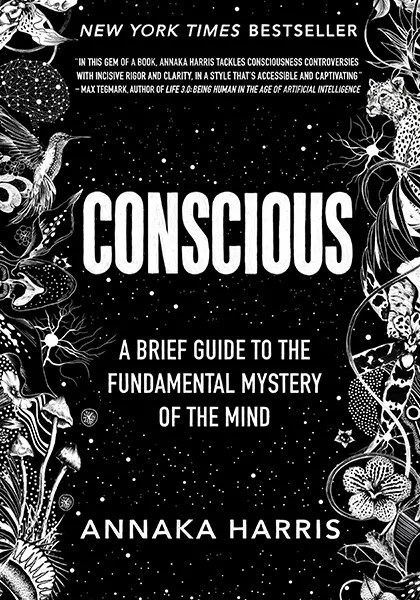
In my previous post on consciousness, I noted that the 2019 book Conscious: a guide to the fundamental mystery of the mind, by Annaka Harris, was a superb discussion of the various issues, evidence and theories about consciousness. Of the seven books on consciousness I listed in the previous post, hers is the only one to take into account insights derived from meditation, use of psychedelics, and of altered states of consciousness more generally. It is also the only one to review, fairly honestly as far as I can tell, most of the major approaches to understanding and explaining consciousness and to discuss their pros and cons rather than making a partisan case for one approach.
Harris starts by explaining what she means by the word “consciousness”. She basically takes the philosopher Thomas Nagel’s definition in his famous essay “What is it like to be a Bat?” and posits that an organism is conscious if there is something that it is like to be that organism. She says:
“Consciousness is experience itself , and it is therefore easy to miss the profound question staring us in the face in each moment : Why would any collection of matter in the universe be conscious ? We look right past the mystery as if the existence of consciousness were obvious or an inevitable result of complex life , but when we look more closely , we find that it is one of the strangest aspects of reality.”
Over the last couple of years, I’ve been thinking more and more about the nature of consciousness. My Zen meditation practice basically involves letting go of thoughts, letting go of the self, and simply experiencing consciousness without content. I have direct experiences from my meditation practice, as well as a reasonably wide reading of Zen and Buddhist masters and their experiences and understanding of consciousness, self and reality. At times, I feel like I have had openings to experiences which have “enlightened” me about the nature of self, consciousness etc, but I have not really integrated these tastes of non-self into any sort of stable or mature understanding of reality.
I had read a few articles by philosophers who have explored the nature of consciousness, particularly the so-called hard problem of consciousness and last year read a review of a new book by Anil Seth which led me to think he had made advances from the neuroscience perspective.
Apart from my direct explorations through Zen meditation, breathwork and psychedelics, I also have worked with several Zen teachers and read extensively on consciousness in Buddhist literature and in the works of Ken Wilber, who has explored and mapped states and stages of consciousness in his writings. More recently, I read and reviewed Sam Harris’s book Waking Up, which also discusses the nature of consciousness and self.
So I decided I would read some of the key books and articles on consciousness from the philosophers and neuroscientists, to complement my experience and understanding gained from meditation and psychedelic explorations.
Anil Seth is a neurologist, Peter Godfrey-Smith a biologist and philosopher of science. Annaka Harris is a science writer (fun fact: also the wife of Sam Harris). Lewis-Williams and Pearce are both archaeologists. The final three are all philosophers. I guess the other relevant discipline I am missing is artificial intelligence research. I’ve read a little in this area and have found it mostly irrelevant to the issues relating to consciousness that I am interested in, and tedious reading to boot.
I browsed Chalmers book on consciousness and discovered the entire book ignores the entire knowledge base on states of consciousness, meditation, nondual states, etc. As if it’s irrelevant. So I quickly browsed the books by the other two philosophers, and the book by Anil Seth the neurologist. Not a single mention of meditation, altered states, psychedelics. I had bigger problems with Seth’s ideas, but will leave that to a separate review.
My initial reaction was to dismiss the philosophers as inhabiting a limited sterile corner of academia ignoring large parts of human experience. But then realized if I did that, I would be no better than them.
Ken Wilber has gone down this same path of integrating Western psychology and philosophy with Eastern first-person methods and understanding and has been largely ignored by academia and philosophers. In part, because he does somewhat go over the top, and despite his focus on empirical methods, does seem to uncritically accept aspects of Tibetan Buddhism at more or less face value. Such as rebirth.
Sam Harris seems to get it more right. And his conclusions are very much aligned with mine. And even he gets dismissed by Western commentators as being arrogant. By telling them they cannot just critique from the outside, without trying the methods for themselves. So much for open-mindedness to all the relevant evidence.
For consciousness per se, which is a subjective experience, its clear that the objective methods of science are going to be at best marginally relevant. What is most relevant is the actual massive domain of experiences of consciousness. Particularly those focused not on the contents of consciousness (as the psychologists and neuroscientists like to do) but those focused on the exploration of consciousness per se when the contents are out of the way. The recent book by Anneka Harris is the only other one on my list above which examines what meditation tells us about consciousness. And when I started reading it, I found it a superb discussion of the various issues and theories about consciousness. So my next post will be a closer look at Harris’ book, and then I will dive into the philosophers.
Links to my later posts on consciousness are given below:
Late last year I volunteered to participate in a research study on psilocybin-occasioned mystical experiences. I completed an online survey and later was interviewed by the principal researcher in a more than hour long semi-structured zoom interview. In the survey, I had answered a question on religious affiliation with “Atheist”. During the interview, the interviewer expressed surprise that I practiced Zen meditation as she equated atheism with a materialist philosophy. I in turn was surprised at her assuming that a spiritual practice implied a belief in God or gods, particularly as my practice was to a large extent within a Zen Buddhist context, which does not treat the historical Buddha as a god or invoke concepts of gods.
I refined my thoughts on this topic in several online discussions, where I found both religious believers and some other atheists were very hostile to the idea that an atheist could have a spiritual practice. And I noticed that some of the atheists who did say they were spiritual, defined “spiritual” in terms of experiences like the enjoyment of a sunset or a moving piece of music, or the feeling of being part of nature.
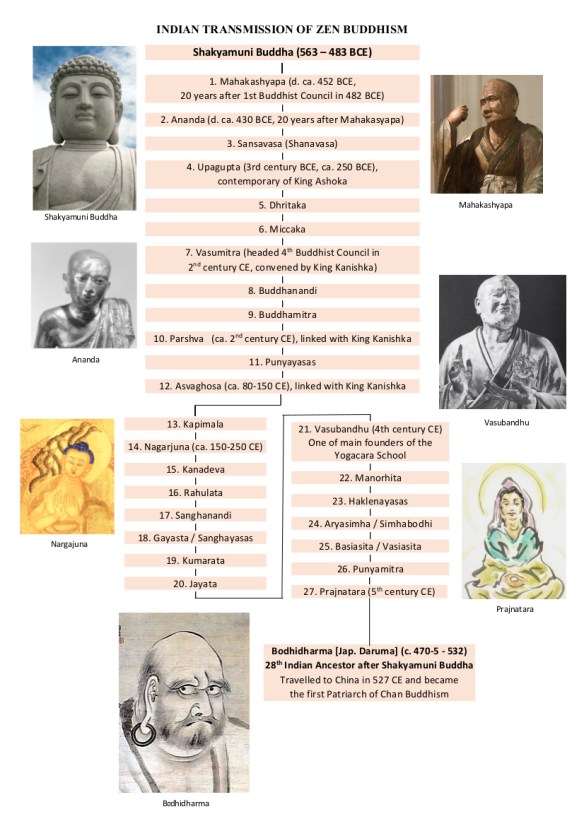
A previous post examined the Zen tradition of “lineages” of teachers transmitting enlightenment person-to-person and documented the lineages of my Zen teachers down from Bodhidharma, the first Patriarch of Chinese Ch’an (Zen). In this post, I examine the Zen tradition of an Indian lineage which reaches back from Bodhidharma through 27 ancestors to the the historical Buddha, Shakyamuni. Shakyamuni Buddha’s birth and death dates are somewhat contested, but 563-483 BCE seem to be the most generally accepted dates.




 Mountains and rivers