Powerlifting after total knee replacement — Part 3.

Does lubrication of the TKR by synovial fluid need to be taken into account in estimating wear?

In Part 2 of this series (see here), I examined whether powerlifting would significantly reduce the lifetime of a total knee replacement (TKR).  I used Archard’s Law to do some analysis of the additional wear associated with the increased load on the joint of typical powerlifting training. Archard’s Law assumes a constant wear coefficient for the polyethylene bearing in the TKR so that the polyethylene wear rate is proportional to the load on the joint.

A reader asked me whether researchers have tried to model polyethylene wear rates, taking into account any lubrication effect that the body’s synovial fluids might provide to the prosthetic joints? If synovial fluids act as a true lubricant to prevent wear contact between the surfaces, then Archard’s Law may not apply.

How lubrication affects wear

Synovial fluids are complex fluids responsible for the lubrication present in our joints. These fluids consist of various constituents, including hyaluronic acid, surface-active proteins (i.e., lubricin), surface-active phospholipids, as well as various other proteins, each of them playing an essential role in lubrication.

Kung et al. (2015) reviewed 11 papers that examined synovial fluids providing lubrication to knee prostheses after joint replacement. They found that the cells in the fluid were similar to those in normal joints, protein and phospholipid concentrations were similar, but that the synovial fluids around joint replacement devices were typically lower in viscosity than pre-arthroplasty fluids. They concluded that the lubricant formed after joint replacement was adequate for good performance in most cases, but that studies were needed on its role in component wear or failure.

The primary purpose of lubrication is to create an acceptable lubricant film to sufficiently keep the two moving surfaces apart while allowing them to move with reduced friction. This is the ideal condition, but a lubricant can pass through several different regimes before it achieves this full film format. These regimes are associated with different frictional levels and can effectively result in non-linear changes in wear as a function of load (Mang and Dresel 2007, Maru and Tanaka 2007).

Lubrication works by separating surfaces with a film of fluid, but in boundary and mixed lubrication regimes, there are still contact points called asperities. When the load increases, these asperities come into greater contact, leading to increased wear and adhesion. 

The effective distance between the surfaces is the main parameter that influences lubricated wear behaviour. This distance usually is measured in terms of the ratio between the effective distance between the surfaces and the root mean square of roughness height (λ). In machines, the main factors that reduce λ are increased load or surface roughness and reduced relative speed or lubricant viscosity.

The following Figure illustrates the relation between the friction coefficient (μ), the wear coefficient (k), and λ. Values of λ greater than 3 results in little or no solid contact, which causes negligible wear and increased wear and adhesion. If changes in load result in transition across  any of these regimes, this can effectively result in non-linear changes in wear rate as a function of load.

Figure 1. The Stribeck curves shows how friction and lubrication regimes change with load. Four different regimes can be identified for lubricated contacts: hydrodynamic; elasto-hydrodynamic (EHL);  mixed; and boundary. In the boundary lubrication phase, which occurs at higher loads or in thinner films, the wear coefficient tends to increase. . Hydrodynamic lubrication results in increased separation, reducing contact and thus wear (Mang and Dresel 2007).

Increasing the load on sliding surfaces should reduce the thickness of the lubricant layer and increase the wear coefficient. However, I came across one paper which carried out experiments with lubricated metal-metal contact and found that the wear coefficient effectively decreased as load increased so that wear was less than predicted by Archard Law’s proportionality to load (Ideris et al 2023).

Modelling the impact of synovial fluid lubrication on prosthesis wear rates

As for the modelling of the effect of synovial fluid lubrication in reducing wear in a TKR, researchers are only beginning to grapple with the challenges of determining the impact of synovial fluids on hip and knee prosthesis wear (Marian et al 2021, Gao et al 2022)

However, the analysis I performed in my previous article used observed failure rates of TKRs and such failure rates already include whatever impact synovial fluids have in lubricating the prostheses. Where the simplistic analysis I made using Archard’s Law may go wrong is in its assumption of a constant wear coefficient – meaning that that wear is proportional to load according to Archard’s Law. If changes in the lubricants film thickness or flow characteristics are associated with increased load, it possible that the additional wear associated with the additional load during powerlifting training may be greater than that estimated assuming its proportional to total load.

Potential impact of powerlifting on prosthesis failure rates

My previous calculations estimated that my typical training regime might result in a 1-2% increase in wear debris overall, and this would correspond to a 1-2% increase in the revision rate at 20 years from 8.7% to 8.9%.  Suppose that deviations from Archard’s Law associated with synovial lubrication resulted in the additional powerlifting load adding double or triple that percentage to wear debris. The revision rate at 20 years might rise from 8.7% to 9.0 or 9.2%.

We also need to factor in the continuing improvements in prosthesis failure rates. The failure rates I used in my previous calculations came from an analysis of data from national joint replacement registries and the 20-year failure rates would have mainly related to TKRs carried out in the late 1990s. My prostheses implanted in 2022 and 2025 almost certainly have lower average failure rates. 

The most recent data I could find from the Australian national registry had 20-year revision rates of 7.7%, 7.6% and 8% in 2023, 2024 and 2025 (Smith et al 2023, Lewis et al 2024, Lewis et al 2025). I think its reasonable to assume that improvements in failure rates for prostheses of the 2020s compared to those of the early 2000s have more than outweighed any increase in failure rate associated with powerlifting training.

Pending improved data on the relationship of prosthesis wear to load, I stick by my conclusions in the previous article. “Powerlifting training after joint replacements by an experienced lifter with attention to technique and careful progression appears unlikely to significantly decrease hip or knee replacement lifetimes. Indeed, the improvements in muscular strength around these joints from training may result in less forces acting in the joint across all activities and more than offset the effects of higher loads on wear.

My second total knee replacement and rehabilitation

I had my second TKR of the right knee just over four months ago on 2 September 2025. I saw a physiotherapist twice a week for three months and improved my maximum knee flexion to 140 degrees. My left knee, three and a half years after TKR, has a maximum flexion of 145 degrees. However, I had some pain in flexing my right knee through 90 degrees which took close to four months to fully go away.

Just a week ago, I did a walk in the French mountains to the east of Geneva with my son. It had snowed the night before and we walked 14 kilometres involving an 800-metre ascent and descent on sometimes steep and icy trails. I had no pain whatsoever in either knee and felt like I was definitely back to good functioning, even if needing a little more cardiovascular endurance. I include a  few photos below.

At the three-month mark, I started powerlifting training again. Initially with an empty bar, and then a slow and steady progression to build strength not only in the muscles but also in the tendons and ligaments. Currently I am deadlifting 100 kg for sets of five and squatting below parallel with 70 kg for sets of five. Today I tested what I could lift for 1 rep, achieving 90 kg for the squat and 130 kg for the deadlift. If my training continues to go well, I hope to compete in late March, aiming for squat around 100 kg or more and a deadlift around 160 kg or more.


Walking on Les Voirons in winter
Me admiring the fresh snow on the trees
The view from the summit ridge towards the Alps. Mont Blanc (4820m) is the high peak in the middle. Ten years ago I climbed it via the ridge visible in the middle, with the sun on one side.
My dog Loki, the Dog of Mischief, admiring the view.

REFERENCES

Gao L, Lu X, Zhang X, Meng Q, Jin Z (2022). Lubrication Modelling of Artificial Joint Replacements: Current Status and Future Challenges. Lubricants. 2022; 10(10):238. https://doi.org/10.3390/lubricants10100238

Ideris M, Kamaruddin S, Sulaiman M, Sukindar NA, Azhar A, Yasir A. (2023). Effects of Coating and Lubrication on Friction and Wear for Metal-to Metal Application. Journal of Advanced Research in Applied Mechanics. 110. 52-62. 10.37934/aram.110.1.5262.

Kung MS, Markantonis J, Nelson SD, Campbell P (2015). The Synovial Lining and Synovial Fluid Properties after Joint Arthroplasty. Lubricants. 2015; 3(2):394-412. https://doi.org/10.3390/lubricants3020394

Mang T, Wilfried Dresel W (2007). Lubricants and Lubrication. Second, Completely Revised and Extended Edition, Wiley and Co, 2007. https://onlinelibrary.wiley.com/doi/book/10.1002/9783527610341

Marian M, Shah R, Gashi B, Zhang S, Bhavnani K, Wartzack S, Rosenkranz A (2021), Exploring the lubrication mechanisms of synovial fluids for joint longevity – A perspective, Colloids and Surfaces B: Biointerfaces, Volume 206, 2021, 111926, https://doi.org/10.1016/j.colsurfb.2021.111926.

Maru MM, Tanaka, DK (2007). Consideration of stribeck diagram parameters in the investigation on wear and friction behavior in lubricated sliding. Journal of the Brazilian Society of Mechanical Sciences and Engineering, 29(1). https://doi.org/10.1590/s1678-58782007000100009

Lewis PL, Gill DR, McAuliffe MJ, McDougall C, Stoney JD, Vertullo CJ, Wall CJ, Corfield S, Du P, Holder C, Harries D, Edwards S, Xu A, Lorimer MF, Cashman K, Smith PN (2024). Hip, Knee and Shoulder Arthroplasty: 2024 Annual Report, Australian Orthopaedic Association National Joint Replacement Registry, AOA: Adelaide, South Australia. 2024. https://doi.org/10.25310/GLOL7776

Lewis PL, Gill DR, McAuliffe MJ, Stoney JD, Vertullo CJ, Wall CJ, Corfield S, Esaian R, Moylan S, Du P, Holder C, Edwards S, Xu Q, Oakey H, Lorimer MF, Smith PN (2025). Hip, Knee and Shoulder Arthroplasty: 2025 Annual Report, Australian Orthopaedic Association National Joint Replacement Registry, AOA: Adelaide, South Australia. 2025. https://doi.org/10.25310/MXFR3061

Smith PN, Gill DR, McAuliffe MJ, McDougall C, Stoney JD, Vertullo CJ, Wall CJ, Corfield S, Page R, Cuthbert AR, Du P, Harries D, Holder C, Lorimer MF, Cashman K, Lewis PL (2023). Hip, Knee and Shoulder Arthroplasty: 2023 Annual Report, Australian Orthopaedic Association National Joint Replacement Registry, AOA: Adelaide, South Australia. 2023. https://doi.org/10.25310/YWQZ9375
Four new records set in Swiss Powerlifting Championships 2024

My younger son Felix Strong competed in the Swiss Full Power Championships in Steinmaur on 28 September. He competed in the T3 (18-19 year) age category and in the 82.5-90 kg weight class. 

He was the best male lifter of the competition. Swiss Champion 2024, with a total of 645 kg, beating the current world record for his age weight class by 15 kg.

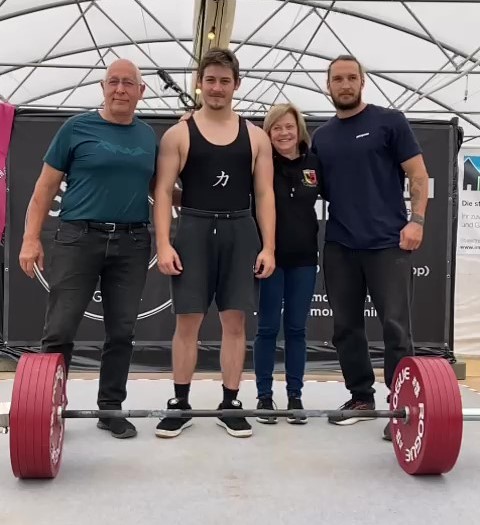
Dad, Felix, Mum and Chris (Felix’s coach) in from of the 275 kg bar that he lifted.

He did extremely well, setting new Swiss records for all three lifts and for the total: squat 220 kg, bench press 150 kg, deadlift 275 kg and total 645 kg (1422 lb). His deadlift was 10 kg higher than the current world record of 265 kg. Short videos of his three lifts are below.

Continue reading

Powerlifting after total knee replacement – Part 2.

Summary

There appear to be no long-term studies of people who do serious strength training or powerlifting in particular after joint replacement.

Current total knee replacement prostheses utilizing ultra-high molecular weight polyethylene bearings can be expected to last more than 20 years, with a cumulative rate of revision surgery of less than 10% at 20 years.

Polyethylene wear due to contact pressure and other consequences of higher load force may be responsible for up to 40 to 50% of problems resulting in revision surgery.

Polyethylene wear rates appear to be well-described by Archard’s Law which states that the wear rate is essentially proportional to the contact pressure on the polyethylene surface and hence to the loading force on the joint.

From analysis of videos of my lifts, I estimate that time under a loaded bar for a single squat is around 11 seconds and for a single deadlift around 5 seconds. I have estimated the total time under loads higher than bodyweight is 10 minutes per week averaged across two of my typical powerlifting training programs for squat and deadlift. This works out at the equivalent of an additional 22 minutes per week with bodyweight load. 

Based on reported average activity levels of people aged 65 and over, the additional 22 minutes under load results in an average increase in the rate of cumulative wear debris of 1-2%. This would result in a 2% increase in the expected TKR revision rate at 20 years from 8.7% to 8.9%. Calculations for hip replacement result in a similar increase in expected revision rate.

Powerlifting training after joint replacements by an experienced lifter with attention to technique and careful progression appears unlikely to significantly decrease hip or knee replacement lifetimes. Indeed, the improvements in muscular strength around these joints from training may result in less forces acting in the joint across all activities and more than offset the effects of higher loads on wear.

Continue reading

Competing in the 2024 World Single Lift Championships after two joint replacements

A little over a week ago, I competed in the WDFPF World Drug-Free Single Lift Championships in Aalsmeer, Netherlands, on 1-2 June 2024.

It is now a little over two years since I had a total knee replacement of my left knee, and then six months later also a hip replacement of my right hip (see here). After the surgery and a month or so of rehab work with a physio, I started doing some powerlifting training building up very gradually over 18 months to a national competition in September 2023 (see here). At that competition, I qualified to compete at international level in the bench press and deadlift.

I made an application to compete in the World Single Lift Championships in 2024. My son Felix Strong had competed in the 2023 World Championships in Sardinia and set a world record of 260 kg for the deadlift (see here and here). He decided not to compete this year, because his final exams were scheduled through most of May. However, at the last minute, he changed his mind and also decided to apply.

Three Swiss athletes competed at the World Championships in Aalsmer, close to Schiphol Airport in the Netherlands.  Like Felix, Gina Berther had also set a world record for the deadlift in Sardinia last year (195 kg) and was also competing in all three lifts.

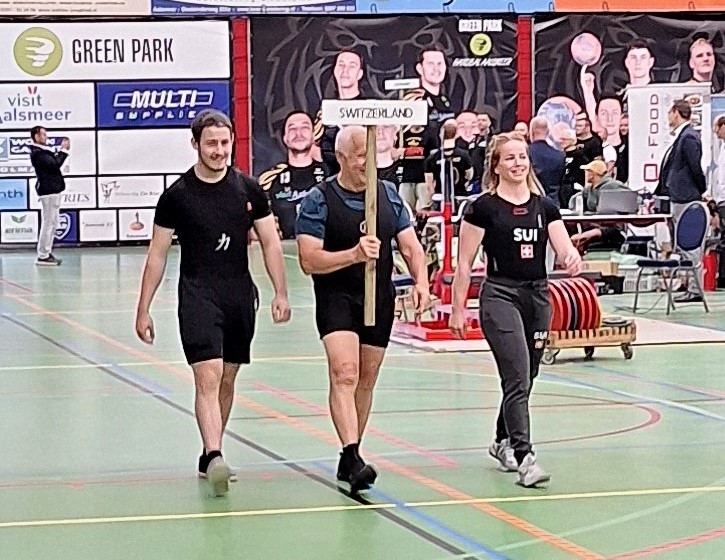
Felix Strong, Colin Mathers and Gina Berther, Opening Ceremony, World Championships 2024
Continue reading

Some photos from the World Single Lift Championship 2023

My younger son Felix Strong competed at the World Drug Free Single Lift Championship in Sardinia on 2-4 June this year. My previous post included videos of his three lifts for squat, bench press and deadlift. He competed in the 16-17 year age category (T2) and the <82.5 kg weight category and set a new world record of 260 kg for the deadlift, and two Swiss records for the squat (180 kg) and bench  press (115 kg).

We also purchased some photos taken by a professional photographer, Luca Antonio Piga, and I’ve posted some of them below.

245 kg going down after a successful first deadlift
Continue reading

New World Record for the deadlift at the World Single Lift Championship 2023

After setting three Swiss records and a world record at the Swiss Full Powerlifting Championship in March this year (see earlier post), my younger son Felix Strong was invited by the Swiss Drug Free Powerlifting Federation to compete at the World Single Lift Championship in Sardinia on 2-4 June. This WDFPF competition was held in Alghero on the northwest coast of Sardinia. Felix, accompanied by his father (me) and mother, flew to Olbia on the northeast coast on 30 May. We spent a couple of days exploring the Olbia region before driving across to Alghero on 1 June.

Felix did extremely well, setting a new world record for the deadlift in his age-weight class, and new Swiss records for the squat and bench press.  He competed in the T2 (16-17 year) age category having turned 17 earlier in 2023 and in the 75-82.5 kg weight class. As each lift was a separate competition on a different day, he had to weigh in each morning. His weight ranged from 81.5 to 82.2 kg. 

The video below shows his world record deadlift of 260 kg. This exceeded the previous record of 255 kg for his age-weight class by 5 kg. Apart from coming first in his age-weight category, he also came third overall in the weight category (75-82.5 kg), which included around 30 men of all ages. As the Italian commentator said, “È straordinario!”

Continue reading

Powerlifting after total knee replacement – Part 1.

I discovered I had osteoarthritis in both knees in early 2015. I found strength training very helpful and I took up powerlifting, competing at national level from 2017 to 2021 in the 60-64 then 65-69 year age category. I had a total knee replacement (TKR) of the left knee in March 2022. 

Before doing the TKR, I spoke to my surgeon about what I would still be able to do with a TKR and also searched the web for information. My surgeon echoed the standard advice that high impact activities such as running and jumping should be avoided completely, as should activities that involve aggressive pivoting (tennis, basketball, most martial arts). A few specifically mention Olympic weightlifting as involving high impact and should be avoided (for example here). Even so, I have come across people who have continued to run or do martial arts after joint replacement.

Continue reading

New World record set in Swiss Powerlifting Championship

My younger son Felix Strong trained hard this year for the Swiss Full Powerlifting Championship in Lausanne on 25 March. He competed in the T2 (16-17 year) age category having turned 17 a month earlier, and in the 75-82.5 kg weight class. 

Felix sets a new world record of 245 kg for the unequipped deadlift during a full powerlifting competition

He did extremely well, setting new Swiss records for all three lifts and for the total: squat 172.5 kg, bench press 110 kg, deadlift 245 kg and total 520 kg (1146 lb). His deadlift was almost 15 kg higher than the current world record of 230.5 kg and the Swiss Drug Free Powerlifting Federation has submitted it to the world body (WDFPF) for approval as the new world record. Short videos of his three lifts are below.

Continue reading

My son sets powerlifting records at age 16

I equipped a garage gym during the Covid-19 lock-downs at the urging of my older son and my younger son has now also caught the strength training bug. My older son is focusing on Olympic weightlifting, which involves explosive lifts to chest or overhead. The competition lifts are the snatch and the clean and jerk. My younger son has shown an aptitude for powerlifting with its three competition lifts: the squat, the bench press and the deadlift.

I suggested he compete in the Swiss Drug Free Single Lift and Powerlifting Championships 2022 on 25 September. He set new Swiss single lift records for bench press (95 kg) and dead lift (210 kg) in the 16-17 year age category and the under 82.5 kg weight category. The short video below shows his 210 kg deadlift.

Continue reading

Competing at the SDFPF Powerlifting Championship 2021

Last weekend, I competed at the Swiss Drug Free Powerlifting Championship 2021, held in Basel on 25 September. This was my first national powerlifting competition since competing in the last SDFPF Championship in February 2019. The 2020 Championship was cancelled due to the Covid-19 pandemic.

During the pandemic I managed to lose around 10 kg bodyweight and competed this year in the 82.5 – 90 kg category at a body weight of 87.3 kg, almost 10 kg lighter than my weight of 96.5 kg in 2019. Despite my efforts to improve my squat and ensure that I squatted below parallel, I discovered by filming my squats in the week leading up to competition that I was only getting clearly below parallel around 50% of the time.

I opened my squat attempts conservatively at 90 kg, and succeeded in getting a below-parallel valid lift. However, I was disappointed to fail the next two attempts at 100 kg with inadequate depth.

For the other two lifts, I exceeded my anticipated results with a 100 kg bench press and 190 kg deadlift. These were both new Swiss records for the under 90 kg Master M6 age category (65-69 years), as was my powerlifting total of 380 kg. Below are short videos of the deadlift and bench press.

Continue reading