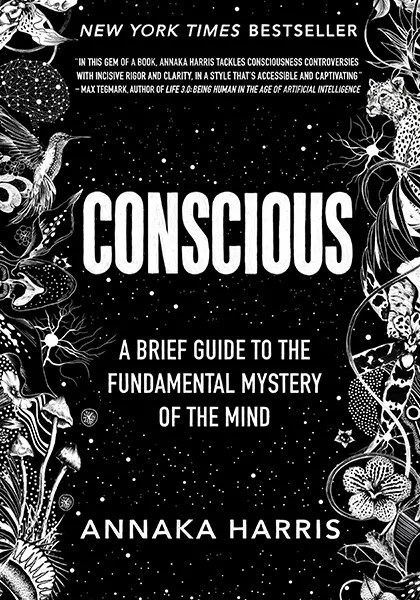
In my previous post on consciousness, I noted that the 2019 book Conscious: a guide to the fundamental mystery of the mind, by Annaka Harris, was a superb discussion of the various issues, evidence and theories about consciousness. Of the seven books on consciousness I listed in the previous post, hers is the only one to take into account insights derived from meditation, use of psychedelics, and of altered states of consciousness more generally. It is also the only one to review, fairly honestly as far as I can tell, most of the major approaches to understanding and explaining consciousness and to discuss their pros and cons rather than making a partisan case for one approach.
Harris starts by explaining what she means by the word “consciousness”. She basically takes the philosopher Thomas Nagel’s definition in his famous essay “What is it like to be a Bat?” and posits that an organism is conscious if there is something that it is like to be that organism. She says:
“Consciousness is experience itself , and it is therefore easy to miss the profound question staring us in the face in each moment : Why would any collection of matter in the universe be conscious ? We look right past the mystery as if the existence of consciousness were obvious or an inevitable result of complex life , but when we look more closely , we find that it is one of the strangest aspects of reality.”
Over the last couple of years, I’ve been thinking more and more about the nature of consciousness. My Zen meditation practice basically involves letting go of thoughts, letting go of the self, and simply experiencing consciousness without content. I have direct experiences from my meditation practice, as well as a reasonably wide reading of Zen and Buddhist masters and their experiences and understanding of consciousness, self and reality. At times, I feel like I have had openings to experiences which have “enlightened” me about the nature of self, consciousness etc, but I have not really integrated these tastes of non-self into any sort of stable or mature understanding of reality.
I had read a few articles by philosophers who have explored the nature of consciousness, particularly the so-called hard problem of consciousness and last year read a review of a new book by Anil Seth which led me to think he had made advances from the neuroscience perspective.
Apart from my direct explorations through Zen meditation, breathwork and psychedelics, I also have worked with several Zen teachers and read extensively on consciousness in Buddhist literature and in the works of Ken Wilber, who has explored and mapped states and stages of consciousness in his writings. More recently, I read and reviewed Sam Harris’s book Waking Up, which also discusses the nature of consciousness and self.
So I decided I would read some of the key books and articles on consciousness from the philosophers and neuroscientists, to complement my experience and understanding gained from meditation and psychedelic explorations.
Anil Seth is a neurologist, Peter Godfrey-Smith a biologist and philosopher of science. Annaka Harris is a science writer (fun fact: also the wife of Sam Harris). Lewis-Williams and Pearce are both archaeologists. The final three are all philosophers. I guess the other relevant discipline I am missing is artificial intelligence research. I’ve read a little in this area and have found it mostly irrelevant to the issues relating to consciousness that I am interested in, and tedious reading to boot.
I browsed Chalmers book on consciousness and discovered the entire book ignores the entire knowledge base on states of consciousness, meditation, nondual states, etc. As if it’s irrelevant. So I quickly browsed the books by the other two philosophers, and the book by Anil Seth the neurologist. Not a single mention of meditation, altered states, psychedelics. I had bigger problems with Seth’s ideas, but will leave that to a separate review.
My initial reaction was to dismiss the philosophers as inhabiting a limited sterile corner of academia ignoring large parts of human experience. But then realized if I did that, I would be no better than them.
Ken Wilber has gone down this same path of integrating Western psychology and philosophy with Eastern first-person methods and understanding and has been largely ignored by academia and philosophers. In part, because he does somewhat go over the top, and despite his focus on empirical methods, does seem to uncritically accept aspects of Tibetan Buddhism at more or less face value. Such as rebirth.
Sam Harris seems to get it more right. And his conclusions are very much aligned with mine. And even he gets dismissed by Western commentators as being arrogant. By telling them they cannot just critique from the outside, without trying the methods for themselves. So much for open-mindedness to all the relevant evidence.
For consciousness per se, which is a subjective experience, its clear that the objective methods of science are going to be at best marginally relevant. What is most relevant is the actual massive domain of experiences of consciousness. Particularly those focused not on the contents of consciousness (as the psychologists and neuroscientists like to do) but those focused on the exploration of consciousness per se when the contents are out of the way. The recent book by Anneka Harris is the only other one on my list above which examines what meditation tells us about consciousness. And when I started reading it, I found it a superb discussion of the various issues and theories about consciousness. So my next post will be a closer look at Harris’ book, and then I will dive into the philosophers.
Links to my later posts on consciousness are given below:
Let me not spend my life lamenting the world’s sorrows for above in the wide sky the moon shines pure
ukiyo to mo omoi-tōsaji oshikaeshi tsuki no sumikeru hisakata no sora
— Saigyo
I came across this poem quite by accident. But it really struck home, as I’ve been spending too much time thinking about the state of the world right now. The human race appears to be quite incapable of working together to address the existential crises of the pandemic, global heating and species extinctions, and overpopulation, as well as the rejection of reason and science dramatically exacerbating these potentially soluble crises. Humans have not reacted to these crises in general by pulling together, given that collective action can indeed address and ameliorate, if not completely address, them. But ratherhave retreated back into tribes who blame the “other” for all their problems. It is indeed difficult sometimes to remember the moon shining pure in the wide sky.
Saigyō was the Buddhist name of Fujiwara no Norikiyo (1118–1190), a Japanese Buddhist monk-poet. He is regarded as one of the greatest masters of the tanka (a traditional Japanese poetic form). He influenced many later Japanese poets, particularly the haiku master Basho.
Saigyo was born into a branch of the Fujiwara clan, the most powerful family in Japan in the early 12th century. As a young man he joined the Hokumen Guards who served at the retired Emperor’s palace. Despite a seemingly assured future, he decided at the age of 23 to “turn from the world” and become a reclusive wandering Buddhist monk. He spent the rest of his life in alternating periods of travel and seclusion with occasional periodic returns to the capital at Kyoto to participate in imperial ceremonies. During this period, the second half of the 12th century, Japan was wracked by civil war
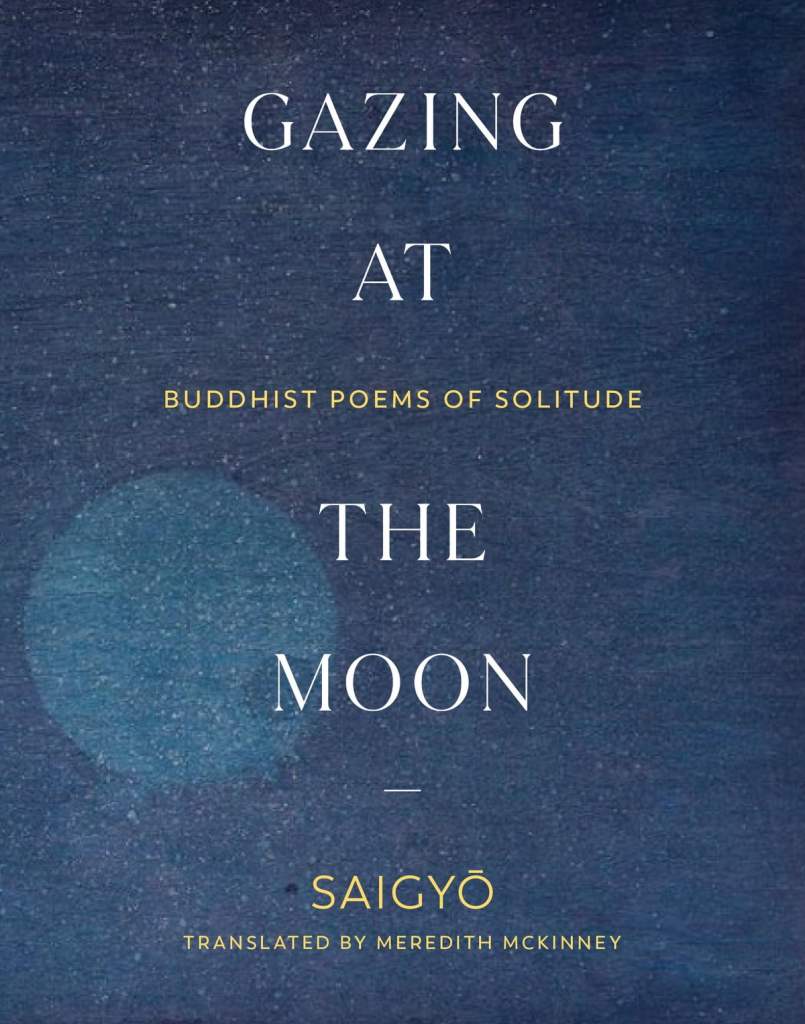
The translation of the poem above is by Meredith McKinney, who has published a selection of over 100 poems by Saigyo in the collection Gazing at the Moon: Buddhist Poems of Solitude (September 2021). The poems selected focus on Saigyo’s story of Buddhist awakening, reclusion, seeking, enlightenment and death. I can highly recommend this collection, which embodies the Japanese aesthetic of mono no aware — to be moved by sorrow in witnessing the ephemeral world.
Meredith McKinney is an award-winning translator of classical and modern Japanese literature, who lived and taught for around 20 years in Japan. She returned to Australia in 1998 and now lives near the small town of Braidwood, not far from Canberra where I lived until early 2000. I was interested to learn a little more about her, and was surprised to find out that she is the daughter of Judith Wright (1915-2000), one of Australia’s greatest poets and an activist for the environment and indigenous rights. For the last three decades of her life, Wright lived near Braidwood. She became completely deaf in 1992 after progressively losing her hearing since early adulthood.
Mary Beard covers what she calls the first thousand years of Roman history from around 753 BCE, the traditional date of the founding of Rome by the mythical Romulus and Remus, through to 232 CE when the Emperor Caracalla made every single free inhabitant of the Roman Empire a full Roman citizen. Unlike many histories which focus on the so-called decline and fall of the Roman Empire during the following period through to around 476 CE, when the Gothic Odoacer deposed the last Emperor and declared himself King of Italy, Beard attempts to examine the question of how one tiny and unremarkable Italian village became so dominant a power over so much territory in three continents.
In recent weeks, I’ve been reading SPQR: a history of Rome by Mary Beard (2015) and simultaneously dipping into the classic The Origins of Totalitarianism by Hannah Arendt (1951). Hannah Arendt in much slower going and about halfway into SPQR I became so engrossed I just binge read to the end.
Mary Beard covers what she calls the first thousand years of Roman history from around 753 BCE, the traditional date of the founding of Rome by the mythical Romulus and Remus, through to 232 CE when the Emperor Caracalla made every single free inhabitant of the Roman Empire a full Roman citizen. Unlike many histories which focus on the so-called decline and fall of the Roman Empire during the following period through to around 476 CE, when the Gothic Odoacer deposed the last Emperor and declared himself King of Italy, Beard attempts to examine the question of how one tiny and unremarkable Italian village became so dominant a power over so much territory in three continents.
During the last COVID wave, while activities were restricted and I was largely staying at home, I intensified my zazen (sitting meditation) practice. With more attention to my practice, I was surprised to find I was easily sitting for 45 minutes and spending less of that time lost in thoughts and more time simply being present here-now aware of the arising and passing on random thoughts, sensations and sensory inputs.
There are four main categories of things that distract my attention from being here-now:
Largely verbalised thought sequences. These can be somewhat spontaneous, jumping across subjects and concerns, or more focused on solving a problem, thinking through a situation or piece of work to be done, planning, strategizing, worrying, pondering the past or future.
Distracting sensory stimuli with associated thoughts and emotions, eg. An intrusive noise, an insect flying around or crawling on my skin, an itch, or an ache or pain.
Images that appear in the minds eye. These can be random or connected.
Full-blown dream-like visions or daydreams, sometimes short, sometimes long.
I also occasionally experience auditory or olfactory hallucinations. For example, a voice saying something, or a distinct smell. But these are rare.
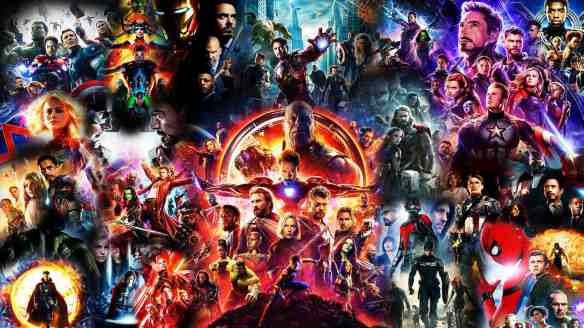
My previous post described my recent viewing of all 23 movies in the Marvel Cinematic Universe (MCU) and examined differences between my rankings of the movies and the rankings of critics, journalists and viewers. This post gives brief reviews of the MCU movies explaining why my rankings are sometimes quite different to others, and presents these in order from best to worst. Every other ranking I examined presents them in the opposite order from worst to best. However, I didn’t want to make readers plough through reviews of the worst movies first. Apart from the fact that nobody may be interested to read all my reviews, I’ve done them mainly to explore what I love and don’t love about the MCU, I’ve also included an index below, so you can jump straight to any particular review that interests you.
Warning: there are spoilers ahead. If you haven’t seen these movies, watch them in timeline order first. In each review, I also give the median ranking from the 23 rankings I analysed in my previous post. The range in brackets gives the 25th and 75tb percentiles of the ranks.
My sons have been fans of the Marvel superhero movies for most of their lives and insisted I watch Marvel’s latest offering, WandaVision, a nine part TV series released weekly on Disney+ from January15th to March 5th this year. When we got past the first two episodes, I was hooked. But the boys needed to explain quite a few of the characters and Easter Eggs to me and I realized my knowledge of the Marvel Cinematic Universe (MCU) was quite inadequate.
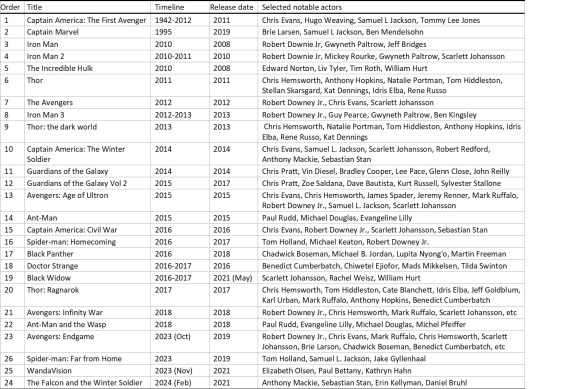
In just over eleven years since Iron Man was released in 2008, Marvel has released 23 movies that are all part of the same universe, the MCU. I saw quite a few of these in cinemas when first released or later on TV, but not all of them. So I decided to watch all 23 in timeline order, the order in which their events occurred in the MCU. WandaVision and the currently running Disney+ series The Falcon and the Winter Soldier are also part of the MCU, as is Black Widow due to be released in May. but I restricted my timeline viewing to the 23 movies in the following Table that were released before this year.
In the last decade or so, there has been a renaissance of interest in the therapeutic potential of psychedelics. While natural psychedelic substances have been used by humans for many thousands of years, psychedelics had a massive cultural impact on the West in the 1950s and 1960s. Albert Hoffman, a research scientist working for the Swiss pharmaceutical company Sandoz, accidentally invented LSD (lysergic acid diethylamide) in 1938 and discovered its psychedelic properties five years later. In 1955, a New York banker named Gordon Wasson sampled the psilocybe (magic) mushroom in Mexico and published an article on his experience in Life magazine.
Scientists discovered the role of neurotransmitters in the brain in the 1950s, and psychedelics inspired scientists to search for the neurochemical origins of mental disorders previously thought to be psychological. Psychedelics were also used in psychotherapy to treat various disorders, including alcoholism, anxiety and depression, with some promising results, although these studies generally did not reach modern standards of research design.
However, psychedelics were also embraced by the counterculture and became linked in the mind of authorities with youth counterculture and the anti-Vietnam war protests. By the end of the 1960s, most Western governments had outlawed and forced underground the psychedelic drugs which had been legal in most places previously, and also shut down all scientific research.
In the 1990s small groups of scientists managed to start conducting various trials of the therapeutic uses of psychedelics and this has led to the so-called psychedelic “renaissance” in which larger well-designed trials of psychedelic use for treating a range of mental disorders are being carried out by research groups at institutions such as Imperial College London, Johns Hopkins University and New York University. Just today, it was announced that the Australian government will be providing $15 million funding for clinical trials into the use of psilocybin and other psychedelics for the treatment of mental illnesses, including depression and PTSD. Michael Pollan’s book How to Change Your Mind gives an excellent account of the history of psychedelics, both above ground and underground, and the psychedelic renaissance, and was a best seller. See also this article by Michael Pollan on the “Psychedelic Renaissance”.
As part of my work on the global burden of disease for the World Health Organization (WHO), I carried out several assessments of the direct and indirect health impacts of the use of drugs, alcohol and tobacco. I recently did an approximate update to year 2019 for deaths directly due to drug use disorders (overdoses and directly toxic effects) and indirect deaths from road injury, suicide and infectious diseases attributable to drug use. A proportion of HIV, hepatitis B and hepatitis C deaths can be attributed to injecting drug use with contaminated needles. The great majority of direct and indirect deaths due to drug use are due to the use of opioids, both illicit and pharmaceutical opioids. Very few deaths are associated with psychedelic drug use, but I was curious to get a ballpark estimate for comparison with other drug deaths. I will present a brief summary of the broad estimates of drug-attributable deaths, then review evidence on the likely contribution of psychedelic drugs.
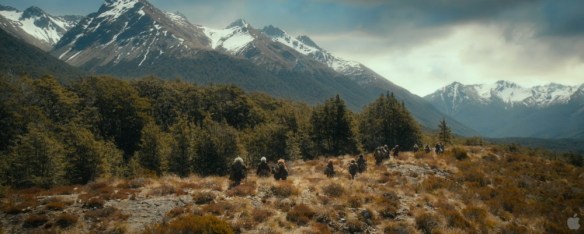
Having recently re-read The Lord of the Rings trilogy (see my earlier post) and realizing that Peter Jackson had changed more in the movie versions than I had realized, I decided to rewatch the three Lord of the Rings (LOTR) movies for the third time, but this time in the Extended Edition, which I’ve never seen. I purchased a copy of that, which has just arrived. But I have been pondering whether to watch the Hobbit movies before watching LOTR. I really disliked Peter Jackson’s padding out the story with made-up elements that were not in the book, and spinning it out to three overblown movies. There were some aspects I enjoyed, but I just could not bring myself to watch them again, let alone in the extended editions.
Then I stumbled across a “fan edit” of the Hobbit movies to make a single movie (of length just under 4 hours) which is reasonable faithful to the book, removes excess material and the more ridiculous action sequences. This fan edit, called “The Hobbit – The Cardinal Cut” is described here and can be downloaded or watched on Youtube.
As I discussed in my previous post, Tolkien set out to create a mythology for the English in the Lord of the Rings (LOTR), the Silmarillion and related writings on Middle-earth. He presented himself not as the author of LOTR, but as the translator of various histories written by Bilbo, Frodo and others in the Third and Fourth Age of Middle-earth. This makes Tolkien quite unusual among modern writers of fantasy in presenting it as set in the real worlc albeit in an imagined prehistory. What happened in that period before the Earth’s actual recorded history is otherwise remembered down through the generations as folk myths and legends, especially among the Old English. Tolkien’s life work was an attempt to reconstruct our prehistory, and more specifically the prehistory of the English. Critics Lee and Solopova commented that “Only by understanding this can we fully realize the true scale of his project and comprehend how enormous his achievement was” [1].
Tolkien described the region in which the Hobbits lived as “the North-West of the Old World, east of the Sea” in LOTR, ie. essentially Europe (including Britain). However, as he noted in a letter [2], the geographies do not match, and he did not consciously make them match when he was writing. In another letter [3] he became much more specific, saying “If Hobbiton and Rivendell are taken (as intended) to be at about the latitude of Oxford, then Minas Tirith, 600 miles south, is at about the latitude of Florence. The Mouths of Anduin and the ancient city of Pelargir are at about the latitude of ancient Troy.” In the Prologue to LOTR, Tolkien also notes that “Those days, the Third Age of Middle-earth, are now long past, and the shape of all lands has been changed…”
Fascinated by the detailed chronologies and calendars set out in the Appendices to LOTR and elsewhere, I have naturally wondered how long ago from now the events of LOTR took place. About 15 years ago, I came across an article in the Journal of the Tolkien Society [4¡ which deduced that the Fourth Age began on Wednesday 18 March 3,102 BCE. The events of LOTR took place during the preceding year. Despite the bizarre exactness of this, I was quite impressed by the argument, which I summarize here briefly.





 Having recently re-read The Lord of the Rings trilogy (see my
 Mountains and rivers