Vaccination is highly protective against Covid-19

As in Europe, the US is currently experiencing a surge in Covid-19 cases and hospitalizations driven by transmission among the unvaccinated.  Two days ago, health officials in Vermont noted that 90% of Covid cases in Intensive Care Units are unvaccinated. Currently 74% of the Vermont population is fully vaccinated. This information allows us to do a simple calculation using only high school algebra to estimate the difference in risk of severe Covid infection among vaccinated compared to unvaccinated.

Continue reading

Global, regional and country-level trends in religiosity and atheism: an update

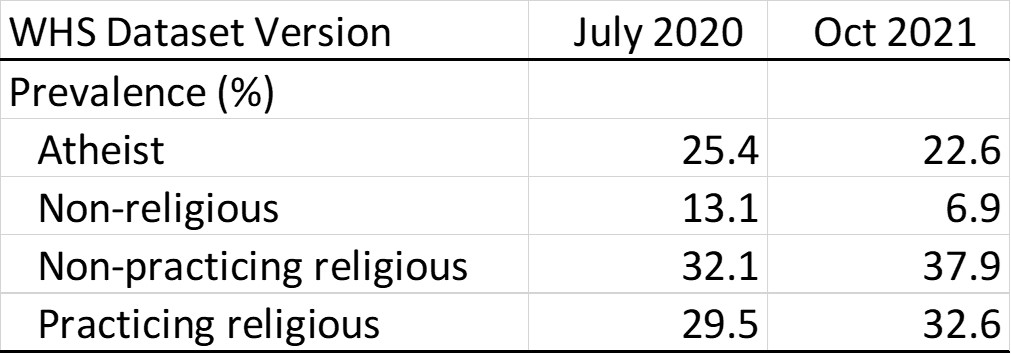
In two earlier posts (here and here), I examined global, regional and country-level trends in religious belief and practice, and the prevalence of atheism. The analysis was based on data from the  World Values Survey (WVS) and the European Values Study (EVS), covering the period 1981 to 2020. Earlier this year, I discovered that the World Values Survey dataset has been updated. Some data collected using a mobile phone app in the most recent US survey was incorrectly coded and this mainly affected the religiosity categories.  Comparison of the US prevalences for religiosity show that the coding errors resulted in an overestimate of the atheist and non-religious categories as shown in the following table:

Comparison of religiosity prevalence estimates
 for USA in year 2020

I have now updated the previous analyses using the 2021 release of the combined data for the WVS and EVS in the Integrated Values Surveys (IVS) 1981-2021 [1-3]. In carrying out these updates, I also addressed some definitional issues which have resulted in mostly slight changes to estimates for other countries. The details of the updated analysis are described elsewhere.

Continue reading

Booster shots and the current Covid-19 Delta wave

Switzerland is now offering a covid19 booster shot to to the 65+ and at-risk who has had their two covid19 vaccinations at least six months ago. It may soon be extended to all adults. I had my third shot last Thursday with no side effects (not even a localized sore spot) and was surprised to receive a Pfizer booster after being fully vaccinated earlier this year with the Moderna vaccine. The mRNA in both vaccines encode the same S-2P protein which differs from the covid19 spike protein by two amino acids only. These stabilize the spike protein so that it can train the immune system before it enters the host cell. I’ve been reading up on booster shots and will try to provide a brief summary below. If you want citations and more detail on the studies, see my professional blog here.

A large study of 1.14 million Israeli adults, aged 60 years and over who had received two Pfizer doses at least 5 months earlier, found that a third shot reduces the risk of infection by the dominant Delta variant by a factor of 11 compared to fully vaccinated people who have had two shots.  Receiving a different vaccine type as I did, further reduces the risk by around 30% or more. The booster shot lowers the risk of severe illness even more, by a factor of around 20 compared to those who have had two shots only.

Continue reading

A fourth Covid-19 wave hits Europe and Switzerland has a second referendum to end vaccine certificate requirements

Covid-19 cases rose by 7% and deaths by 10% over the last week in Europe, as it enters a fourth (or fifth) wave and currently accounts for about two-thirds of infections reported globally. Belgium and the Netherlands, which have fully vaccinated 73-74% of their populations, have the highest new case rates in Western Europe, almost double those of Britain. The fully vaccinated rate is Switzerland is 64%, higher than the USA at 57% but lower than Australia now at 69%.

Continue reading

Afghanistan, the war on terror and the war on drugs

Watching scenes from Kabul airport recently felt like déjà vu for me. The Vietnam War ended in eerily similar scenes. I’ve been astonished to read more than one article that has described the events in Afghanistan as an unprecedented military defeat for the USA, or as a sign that the era of neoliberal intervention in foreign countries was over. If the USA did not learn anything from Vietnam, why would we assume it will this time when facts and evidence are even less valued than in the past. Several commentators have noted the intersection of the US war on terror and the war on drugs in Afghanistan. I have been engaged for nearly 20 years now in work to update global estimates of conflict deaths and global estimates of deaths attributable to drug use. I was curious to look a little more closely at relevant statistics.

Continue reading

Definitions of God and the Motte-and-Bailey fallacy

Recently, I got involved in an online discussion about whether spirituality was compatible with atheism (see previous post Atheism and Spirituality) and foolishly did not clarify what the term “god” referred to. But it was clear from the general context that those arguing atheism was incompatible with spirituality were assuming spirituality required belief in God and were using a concept of God (singular) largely consistent with the standard Christian God who is conceived of as an eternal being who created the universe and life, and who is both transcendent (wholly independent of the material universe) and involved in the world.

Continue reading

Atheism and Spirituality

Late last year I volunteered to participate in a research study on psilocybin-occasioned mystical experiences.  I completed an online survey and later was interviewed by the principal researcher in a more than hour long semi-structured zoom interview. In the survey, I had answered a question on religious affiliation with “Atheist”. During the interview, the interviewer expressed surprise that I practiced Zen meditation as she equated atheism with a materialist philosophy.  I in turn was surprised at her assuming that a spiritual practice implied a belief in God or gods, particularly as my practice was to a large extent within a Zen Buddhist context, which does not treat the historical Buddha as a god or invoke concepts of gods.

I refined my thoughts on this topic in several online discussions, where I found both religious believers and some other atheists were very hostile to the idea that an atheist could have a spiritual practice. And I noticed that some of the atheists who did say they were spiritual, defined “spiritual” in terms of experiences like the enjoyment of a sunset or a moving piece of music, or the feeling of being part of nature.  

Continue reading

Zazen, left brain, right brain, self

During the last COVID wave, while activities were restricted and I was largely staying at home, I intensified my zazen (sitting meditation) practice. With more attention to my  practice, I was surprised to find I was easily sitting for 45 minutes and spending less of that time lost in thoughts and more time simply being present here-now aware of the arising and passing on random thoughts, sensations and sensory inputs.

There are four main categories of things that distract my attention from being here-now:

  • Largely verbalised thought sequences. These can be somewhat spontaneous, jumping across subjects and concerns, or more focused on solving a problem, thinking through a situation or piece of work to be done, planning, strategizing, worrying, pondering the past or future.
  • Distracting sensory stimuli with associated thoughts and emotions, eg. An intrusive noise, an insect flying around or crawling on my skin, an itch, or an ache or pain.
  • Images that appear in the minds eye. These can be random or connected.
  • Full-blown dream-like visions or daydreams, sometimes short, sometimes long.

I also occasionally experience auditory or olfactory hallucinations. For example, a voice saying something, or a distinct smell.  But these are rare.

Continue reading

Why do Americans die earlier than Europeans?

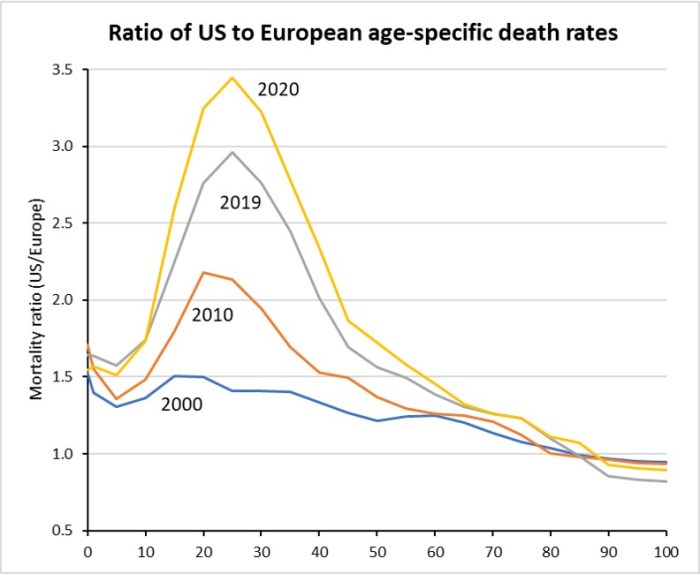
A recent paper by demographers Sam Preston and Yana Vierboom showed that there are an additional 400,000 deaths in the USA in 2017 that would not have occurred it the USA experienced European death rates. That is about 12% of all American deaths and higher than the COVID-19 death toll of around  380,000 in 2020.  In a Guardian article earlier this month they identified major factors contributing to this US “mortality penalty” including overweight and obesity, drug overdose, lack of health insurance, suicide, lack of gun control and racism. These deaths tend to occur at younger ages than Covid deaths on average, so that total potential years of life lost are three times greater for the excess deaths than for Covid in 2020 (13 million versus 4.4 million).

Preston and Vierboom used data from the Human Mortality Database (HMD) for their analysis. They calculated death rates based on the five largest European countries, whose combined population size is very similar to that of the United States: Germany, England and Wales, France, Italy, and Spain. They also argued that using these larger European countries  to provide a mortality standard would avoid unrealistic expectations that might result from comparisons including small countries with possibly exceptional combinations of factors affecting mortality (e.g., climate, diet, social history, and healthcare delivery).

A few days ago, I downloaded updated data from the HMD and replicated and extended their analysis to include years up to and including 2020, drawing on recent data from Eurostat and national health statistics agencies (see here for details of data, sources and methods).

Continue reading

Premodern religious values and happiness

I recently came across a ranking of countries by average reported happiness. This year’s World Happiness Report, released on March 20, uses data from the Gallup World Poll to calculate average reported happiness by country for over 150 countries for years 2005 to 2020. The focus of the report is on the impact of COVID-19 on happiness in 2020 by comparison with years 2017-2019. I was interested to see to what extent modern versus premodern religious values might explain variations in happiness across countries, along with a number of other factors that were examined in the World Happiness Report. I have posted here previously on my analysis of premodern or “fundamentalist” religious values.

The main measure used for happiness in the World Happiness Report is based on the national average response to the question on life evaluation in the Gallup World Poll (GWP). The English wording of the question is  “Please imagine a ladder, with steps numbered from 0 at the bottom to 10 at the top. The top of the ladder represents the best possible life for you and the bottom of the ladder represents the worst possible life for you. On which step of the ladder would you say you personally feel you stand at this time?”

The following graph shows the happiness rankings of 101 countries for which I have both happiness measures and estimates of the modern/premodern religious values index I developed (see here). The happiness scores are averages for years 2017 to 2019.

Continue reading