Climate change and Australian politics

Australia recently held a Federal election in which all the opinion polls for months had shown that the Labor Party was going to win by 52% to 48% and the Liberal National Party (LNP – the coalition of conservative parties in Australia) would lose government. Over the last 6 years, the LNP government has abandoned the country’s policy for cutting greenhouse-gas emissions, and effectively dropped its commitment to the 2015 Paris climate agreement (although it is pretending it will still meet the emissions-reduction target by use of misleading statistics).  The urgency of addressing climate change became a major issue, particularly for younger people, in the recent election campaign, and The Labor party ran with a much stronger set of policies to address climate change in the recent election campaign, and this issue was a principal issue for many urban and younger voters.

The Labor party also ran with a very detailed list of policies including getting rid of some tax breaks which predominantly favoured relatively rich investors, and some tax policies on ownership of second houses which had the impact of raising house prices to the disadvantage of first house buyers. The LPNP ran scare campaigns about Labor taxes (that were largely false) and together with the concern of working class voters particularly in rural areas where coal and other mining were important, this resulted in the loss for Labor.
Continue reading

The Canal de Versoix

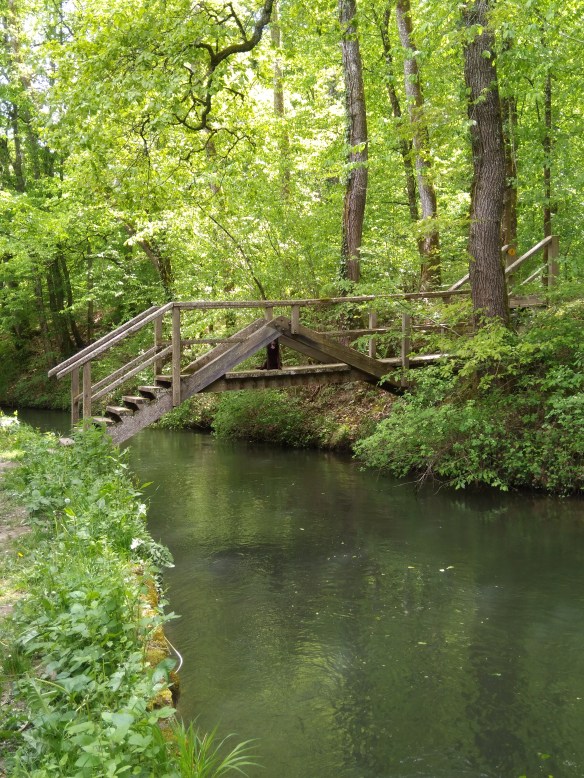
Just beyond the northern boundary of Geneva, a small river, the Versoix River, flows from neigbhouring France eastwards through mixed farm and forest to Lake Leman. I often go for a bicycle ride or take the dog for a walk along the Versoix River and nearby forest tracks. Last week I set out with the dog to walk to the River from a small village called La Bâtie, but I could not find somewhere to park the car with convenient access to the river. So I took a small path into the forest labelled only “Sentier Pedestre” (walking path). It took us to a beautiful canal, which I had never seen before. The photo below shows the dog sitting on a wooden bridge that crossed the canel to a path on its other bank.

Bridge over the Versoix Canal

The Versoix canal was built by Nicolas Céard (1745-1821) in 1785 to feed water to the lakeside town of Versoix. It also provided water power for a mill and paperworks at La Bâtie during the 19th century. Céard was a French civil engineer, one of whose first projects after graduation in 1769 was the construction of Port-Choiseul at Versoix on Lake Leman a few kilometres north of where I live. He fled the Terror (French Revolution) to Switzerland and later became mayor of Versoix from 1790 to 1792.

After a few hundred metres, we came to a dam that we had to cross via the dam wall. We came to a fishway, built to enable the river trout (local name “truite fario”) to migrate upstream. It is a vertical slot fishway, quite deep and with a strong current. I took a photo of the dog crossing it, then called her back to try another shot. She fell in and was swept down. I managed to pull her out before the end of the fishway, though she probably would have been fine if she had gone all the way through.

Fishway on the Versoix Canal

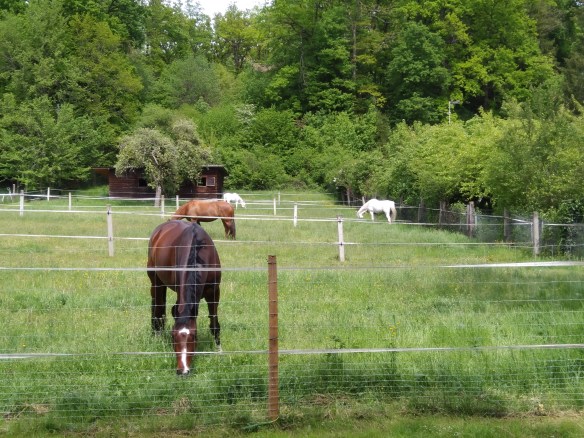
We took a shortcut through a horse dressage and jumping school (the Centre Equestre La Bâtie) to get back to the car.

Myers-Briggs Personality Types

The US housewife and writer Katharine Cook Briggs with her daughter Isabel, the eventual creator of the test, c1905

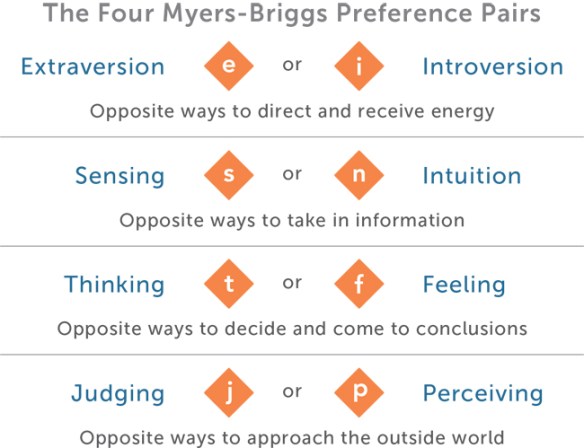
I first came across the Myers-Briggs Type Inventory (MBTI) around 30 years ago. The MBTI was developed by Isabel Myers, a layman, and her mother Katherine Briggs, around the middle of the twentieth century.  They developed a questionnaire  that classified people into 16 types based on Carl Jung’s theory of psychological types, along with their own considerable experience of observing people in action, and some inspirational speculation. Jung’s theory was based on differences in the way that we prefer to use our mental capacities to function in the world – and Myers and Briggs simplified this to identify four dimensions of functioning preferences.  Their questionnaire and most others classify people’s preferences on these four dimensions and assign a letter based to each dimension based on which side of the middle-point you fall. The combinations of these letters result in 16 so-called “personality types”.

The Myers-Briggs Type Inventory (MBTI) has become extremely popular and is a very widely used tool in management training. There are many variants of the questionnaire and of the type classification available for free online, as well as copyrighted versions used by management training companies and others.  It is estimated that since the 1960s, when the test began to be rolled out across the corporate world, more than 50 million people around the world are estimated to have taken it (A).

There are many free online variants of the MBTI, of varying quality. I give links to several that I have found useful.

Continue reading

12 Rules for Life (part 2)

This is the second half of my review of “12 Rules for Life” by Jordan Peterson, the controversial Canadian psychologist who has become an internet sensation.  The first half of my review can be found at 12-rules-for-life-jordan-peterson

Rule 7. Pursue what is meaningful (not what is expedient).

Peterson again turns to the Old Testament to the story of Paradise and the Fall as a guide to Being and right action. He prefaced this with a quite good explanation of how myths and legends encode guidance on Being, action and meaning based on human experience and behaviours that have evolved over a long period of time. But why he thinks Bronze Age myths are still our best source of understanding of these things, and ignores the important evolution of human societies and understanding in recent centuries, I don’t know.

Continue reading

Avengers: Endgame

I took my younger son to see Avengers: Endgame on the big IMAX 3D screen the day after it was released. The theatre was almost full, unusual for Geneva. My older son went later in the evening, and he and his friends got the last remaining seats in row A, only two or three metres from the screen.  He claims he enjoyed it and didn’t really notice he was almost in the action.

The movie is long at three hours, but we didn’t notice the passing of time. Lots of emotional scenes, if anything a bit overdone for my taste. But still satisfying, and overall, the movie certainly wraps up the entire arc of the Avengers cycle of movies in a deeply satisfying way. There are lots of good reviews out there and I won’t try to cover the same ground. Rotten Tomatoes has quite a few critics reviews and the Tomatometer has a score of 95% and audience score of 91%. IMDB has a rating of 9 out of 10.

Continue reading