Atheism and Spirituality

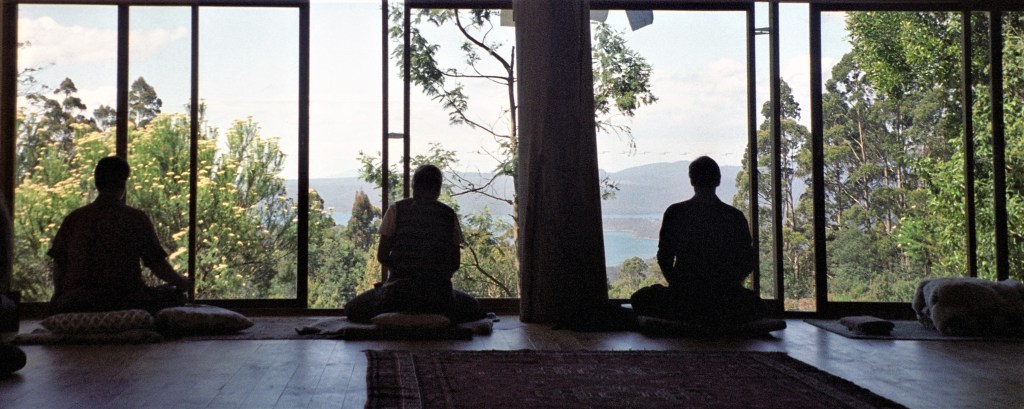
Late last year I volunteered to participate in a research study on psilocybin-occasioned mystical experiences.  I completed an online survey and later was interviewed by the principal researcher in a more than hour long semi-structured zoom interview. In the survey, I had answered a question on religious affiliation with “Atheist”. During the interview, the interviewer expressed surprise that I practiced Zen meditation as she equated atheism with a materialist philosophy.  I in turn was surprised at her assuming that a spiritual practice implied a belief in God or gods, particularly as my practice was to a large extent within a Zen Buddhist context, which does not treat the historical Buddha as a god or invoke concepts of gods.

I refined my thoughts on this topic in several online discussions, where I found both religious believers and some other atheists were very hostile to the idea that an atheist could have a spiritual practice. And I noticed that some of the atheists who did say they were spiritual, defined “spiritual” in terms of experiences like the enjoyment of a sunset or a moving piece of music, or the feeling of being part of nature.  

Continue reading

Zazen, left brain, right brain, self

During the last COVID wave, while activities were restricted and I was largely staying at home, I intensified my zazen (sitting meditation) practice. With more attention to my  practice, I was surprised to find I was easily sitting for 45 minutes and spending less of that time lost in thoughts and more time simply being present here-now aware of the arising and passing on random thoughts, sensations and sensory inputs.

There are four main categories of things that distract my attention from being here-now:

  • Largely verbalised thought sequences. These can be somewhat spontaneous, jumping across subjects and concerns, or more focused on solving a problem, thinking through a situation or piece of work to be done, planning, strategizing, worrying, pondering the past or future.
  • Distracting sensory stimuli with associated thoughts and emotions, eg. An intrusive noise, an insect flying around or crawling on my skin, an itch, or an ache or pain.
  • Images that appear in the minds eye. These can be random or connected.
  • Full-blown dream-like visions or daydreams, sometimes short, sometimes long.

I also occasionally experience auditory or olfactory hallucinations. For example, a voice saying something, or a distinct smell.  But these are rare.

Continue reading

Neurotransmitters and brain function

Although I’ve taken a general interest in brain function and states of consciousness, until the last few years I really only paid much attention to the relationship between brain waves and states of consciousness, and in particular the use of brainwave entrainment methods to facilitate certain states (see earlier post here). Only in the last few years have I looked more closely into the complex and interacting roles of brain waves, neurotransmitters and various brain networks.

By Thomas Splettstoesser (www.scistyle.com), https://commons.wikimedia.org/w/index.php?curid=41349083

Neurons (nerve cells) in the brain form elaborate networks, with each neuron having up to 15,000 connections with neighbouring neurons at contact points called synapses. While the nerve impulse travel through the neuron as an electrical impulse, it does not cross the gap known as the synaptic cleft but rather stimulates the release of a chemical messenger: a neurotransmitter. This crosses the synaptic cleft and is received by neurotransmitter receptors on the target cell. A neurotransmitter with increase (excitatory) or decrease (inhibitory) the probability that the target cell will produce a nerve impulse.

There are three main types of neurotransmitters in the brain: small molecules used for fast signal transmission between neurons, small used for slower modulation of network activity, and large molecules (peptides) used for even slower modulation of cell circuit functions. Most neurons have receptors for most of the neurotransmitters in all three of these categories.

Continue reading

Some jujutsu videos from the 1990s

During the second wave of the COVID-19 epidemic, I spent some time in January transferring video footage of jujutsu training from old VHS tapes that had been sitting in a cupboard since 2000. I included a link to one of these videos demonstrating some defences against knife attacks in my earlier post on my martial arts career.

The tapes date back to the 1990s when I was training with the Kokusai Jujutsu Ryu at the Australian National University and the KJR main dojo in Queanbeyan. These were transferred from the original VHS tapes, and so quality is not great. In the following short video, I am demonstrating jujutsu defences against attacks with baton (short stick) in 1995.

The following video was taken during a training session at the ANU Jujutsu Club, Canberra, in 1998. Zoltan Bacskai is attacking with a sword, a Japanese katana. This sword has a sharp blade and its important to control the blade during the defence and throw, not only to avoid injury, but also to avoid cutting the mats. During a national championship a few years earlier, I was too slow avoiding a sword strike and had my throat cut. The cut was not serious, a few centimetres in length and about a mllimetre deep, but it bled freely and certainly impressed the audience.

Continue reading

Psychedelics and the health risks of drugs, alcohol and tobacco

In the last decade or so, there has been a renaissance of interest in the therapeutic potential of psychedelics. While natural psychedelic substances have been used by humans for many thousands of years, psychedelics had a massive cultural impact on the West in the 1950s and 1960s. Albert Hoffman, a research scientist working for the Swiss pharmaceutical company Sandoz, accidentally invented LSD (lysergic acid diethylamide) in 1938 and discovered its psychedelic properties five years later. In 1955, a New York banker named Gordon Wasson sampled the psilocybe (magic) mushroom in Mexico and published an article on his experience in Life magazine.

Scientists discovered the role of neurotransmitters in the brain in the 1950s, and psychedelics inspired scientists to search for the neurochemical origins of mental disorders previously thought to be psychological. Psychedelics were also used in psychotherapy to treat various disorders, including alcoholism, anxiety and depression, with some promising results, although these studies generally did not reach modern standards of research design.

However, psychedelics were also embraced by the counterculture and became linked in the mind of authorities with youth counterculture and the anti-Vietnam war protests. By the end of the 1960s, most Western governments had outlawed and forced underground the psychedelic drugs which had been legal in most places previously, and also shut down all scientific research.

In the 1990s small groups of scientists managed to start conducting various trials of the therapeutic uses of psychedelics and this has led to the so-called psychedelic “renaissance” in which larger well-designed trials of psychedelic use for treating a range of mental disorders are being carried out by research groups at institutions such as Imperial College London, Johns Hopkins University and New York University. Just today, it was announced that the Australian government will be providing $15 million funding for clinical trials into the use of psilocybin and other psychedelics for the treatment of mental illnesses, including depression and PTSD. Michael Pollan’s book How to Change Your Mind gives an excellent account of the history of psychedelics, both above ground and underground, and the psychedelic renaissance, and was a best seller. See also this article by Michael Pollan on the “Psychedelic Renaissance”.

As part of my work on the global burden of disease for the World Health Organization (WHO), I carried out several assessments of the direct and indirect health impacts of the use of drugs, alcohol and tobacco. I recently did an approximate update to year 2019 for deaths directly due to drug use disorders (overdoses and directly toxic effects) and indirect deaths from road injury, suicide and infectious diseases attributable to drug use. A proportion of HIV, hepatitis B and hepatitis C deaths can be attributed to injecting drug use with contaminated needles. The great majority of direct and indirect deaths due to drug use are due to the use of opioids, both illicit and pharmaceutical opioids. Very few deaths are associated with psychedelic drug use, but I was curious to get a ballpark estimate for comparison with other drug deaths. I will present a brief summary of the broad estimates of drug-attributable deaths, then review evidence on the likely contribution of psychedelic drugs.

Continue reading

Looking back on 34 years in the martial arts

As a student at the University of Sydney in the early 1970s, I became interested in Zen Buddhism through the writings of Alan Watts and others, but the concept of actual “practice” was completely foreign to me. Then I picked up a second-hand copy of Zen Combat by Jay Gluck (Ballantine 1962) and was absolutely fascinated by its survey of Japanese martial arts and the role of Zen in them. Bruce Lee also sparked a huge surge of Western interest in the Asian martial arts with his 1973 film Enter the Dragon.  The idea of practicing a martial art was something I could relate to, and in 1974 I enrolled in a lunch-time karate class at the University during my 4th year Physics Honors Year. I was so enthusiastic about karate that I remember being puzzled why others were not joining once they knew about the availability of classes. Over the next two or three years I trained in several karate styles including Goju Ryu, Dioshin Lyanbukan and Kei Shin Kan.

Continue reading

The Indian Transmission of Zen Buddhism

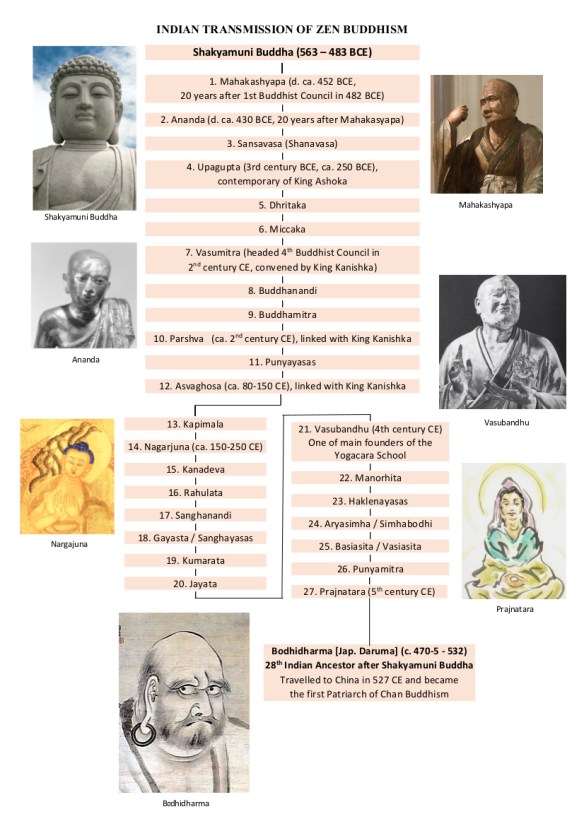
A previous post examined the Zen tradition of “lineages” of teachers transmitting enlightenment person-to-person and documented the lineages of my Zen teachers down from Bodhidharma, the first Patriarch of Chinese Ch’an (Zen).  In this post, I examine the Zen tradition of an Indian lineage which reaches back from Bodhidharma through 27 ancestors to the the historical Buddha, Shakyamuni. Shakyamuni Buddha’s birth and death dates are somewhat contested, but 563-483 BCE seem to be the most generally accepted dates.

Continue reading

Zen lineages and “transmission outside the scriptures”

I’ve mainly been doing shikantaza “just sitting” during the pandemic, but I recently started re-reading “Zen Koans: learning the language of dragons” by James Ishmael Ford. This is an excellent general introduction to Zen, the range of Zen methods of meditation, and particularly working with koans. Ford was given dharma transmission by my first Zen teacher, John Tarrant, who was the first Australian authorized to teach Zen.

Ford discusses the concept of Zen lineages in his book (pages 28-30) and this reminded me that I had collected information on the lineages of the teachers I have worked with, and inspired me to update it and turn it into a set of charts. These trace the transmission of Zen from India to China to Japan and then to my Western teachers. I’ve updated these and posted them below.

Continue reading

Explorations of hypnagogia during lockdown

The restrictions during the second wave of covid-19 have been less severe in Geneva than during the first wave, although France has closed my nearby border until mid-December and instituted strict lockdown again. However, I went to a bakery the other day and saw a notice that said people aged 65 and over were asked not to leave home. I had been keeping pretty much at home in any case, and one of the things I decided to do in this period was to see whether I could achieve WILD, ie. wake-induced lucid dreaming.  I’ve previously had success with DILD (dream-induced lucid dreaming) which is the best known technique and involves becoming aware you are dreaming while you are in a dream. WILD involves transitioning directly from the hypnagogic state into the dream state while maintaining awareness throughout.

The hypnagogic state is the transitional state between wakefulness and sleep, during which images, dreamlike visions and other sensory experiences may occur. To achieve WILD, you aim to remain aware as an awake dreamlike vision transitions into a full-blown dream as you fall asleep. I started to pay close attention to what I was seeing and experiencing during the hynagogic period, aiming to stay consciously aware as the dreamlike fragments arose, and to figure out how to figuratively “dive” into the dream. But this goal was postponed as I became fascinated with the variety of hypnagogic phenomena I experienced as I lay with my eyes closed transitioning towards sleep.

Continue reading

Strength training in the time of coronavirus

Geneva is about to ease the restrictions associated with the second wave of the pandemic. During this wave, average new cases per day in Geneva peaked at close to 3,000 confirmed cases per 100,000 population in the 14 days to 8 November. This was the highest recorded rate at regional level in western Europe. In other words, 3% of the population were confirmed new cases in that fortnight, and the real incidence would have been higher than that.

As can be seen in the figure above, the social restrictions introduced in most European countries have worked quite rapidly in turning the second wave downwards. The exceptions are Germany where it has plateaued by not yet coming down, though it never reached the levels of nearby countries, and Sweden where it is about to pass Switzerland on the way up. Daily new cases per million population in the USA now exceeds that in Switzerland. The USA now has 12 million confirmed cases, and the CDC estimates that the true number of infections is around 50 million, or 1 in 7 of the total population. Trump of course has gone AWOL and I suspect the USA is in for a bad winter.

My gym closed down again during this second wave. During the first wave it closed down for around 2 months and I tried to continue some light weight work at home. I had borrowed a couple of kettlebells from the gym and was somewhat aimlessly swinging these from time to time. However, my son took up a kettlebell challenge to do 10,000 swings of a 24 kg kettlebell in 4 weeks. He upgraded to 28 kg partway through.  That’s 500 a day, and he broke them up with some kettlebell presses every now and then.

I was inspired, and bought a 16 kg and 28 kg kettlebell and started using them 3 times a week. Initially, I was doing kettlebell swings at 28 kg and various double kettlebell routines with two 16 kg kettlebells (see video), though my favourite routine was the kettlebell snatch (second video). By the end of the lockdown I was doing 100 snatches, 100 clean and press and 100 double handed swings.

Continue reading