Centenary of the Battle of Passchendaele

The centenary of the Battle of Passchendaele was commemorated today in Belgium. This battle lasted from 31 July to 10 November 1917 and was the third and largest of the battles of Ypres. Overall, 800,000 soldiers from both sides of the conflict died at Ypres from 1914-1918. My grandfather, Will Mathers and his brother Tom served in the Australian Army Medical Corps in France during World War I and were at the Battle of Passchemdaele. They carried the wounded out of the battlefield from around 20 September 1917 until 7th October, when both were gassed. Will was hospitalized for 8 days.

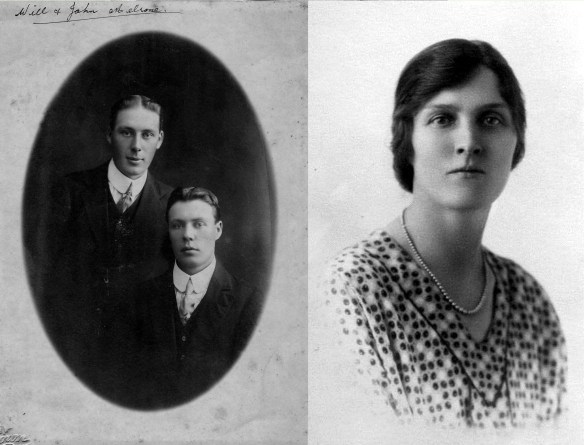
Left: Will Mathers 1915, Right: Will and Tom in Salisbury, 2 September 1916.

Will and Tom had two cousins John and William Melrose who both died at Ypres. Their uncle Robert Melrose lost both his children in 1917. John died on 7 June 1917 at Messines, a day on which 6,700 Australians died. The battle of Messines commenced in the early hours of 7 June with the detonation of a million pounds of explosives packed into tunnels dug under German positions on the Messines Ridge. The explosion was heard in London and Dublin and killed approximately 10,000 German soldiers, the deadliest non-nuclear manmade explosion in history. Five months later, his brother William was also killed on Oct 12, 1917 in the Battle of Passchendaele. John Melrose was the first husband of my (great-) Auntie Annie, who lived until 1989 and was like a second mother to my father. She was married to John for only two weeks before he left Australia for France.

Left: William and John Melrose, Right: Annie Melrose (née Gammie)

Rare footage of 1989 jujutsu training

I came across a video recently posted on youtube of my former jujutsu teacher, John Bear Shihan demonstrating futari kata in 1989.  Was surprised to see that I was the main receiver, joined partway through the video by Neil Phillips.

At that time, I was a shodan (1st Dan black belt) and Neil was probably 3rd kyu brown belt. This kata was a training exercise for 5th kyu purple belt level.


Méribel mountain views

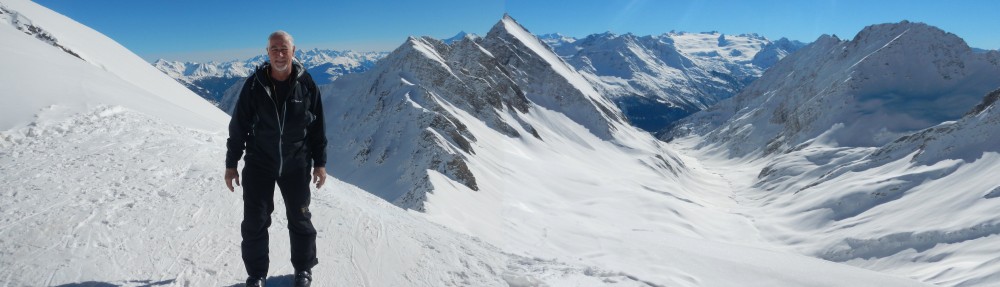
Some photos of the French Alps from the Saulire on the mountain ridge between Méribel and Courcheval. The Saulire is at 2738m and has spectacular views of the surrounding mountains, including Mont Blanc in the distance 63 km away. And then a thousand metre descent which made for great skiiing.

Looking west over the Méribel valley towards Val Torens

Continue reading

A week skiing at Méribel

We went to Méribel in February for a week skiing. It is a resort in the French Alps about halfway between Grenoble and the Italian border. Last winter was not a great year for snow, but it snowed heavily just before we arrived and there was lots of fresh powder. The entire week until the last day was clear blue skies.

At 2275 m on the Col des Lozes between Méribel and Coucheval

Continue reading

Snow on the pines

Thanks to the President of China, I spent a day in January skiing at Les Houches near Mont Blanc. Xi Jinping was visiting my organization, and we were told to avoid coming to work if possible, as the security arrangements were extreme. Juras and Swiss Alps were forecast to have low temperatures, low visibility and strong wind, so I headed up towards Mont Blanc where it was sunny and no wind. The temperature was still low at about -10 degrees C.

Mont Blanc seen from Les Houches

Mont Blanc seen from Les Houches

Continue reading

Hot and cold: from New Year in heatwave Australia to mid-winter Geneva

Somewhat belatedly, a few photos from a quick trip to Australia in the New Year break 2016-2017 to visit my family in Noosa on the Queensland coast.  Flying from the midwinter Geneva around zero C to heatwave in the middle of summer – middle 30s C and then back to a cold spell at -4 C. Around 35°C temperature drop from my last Saturday on Sunshine Beach to the first day in Geneva.

img_5674

Even though it was hot, there were some stormy days and some dark clouds on Noosa Main Beach. It was much more crowded when the sun was out.

Continue reading

Parapente flight from France to Switzerland

Yannick has combined parapente (paragliding) with alpine climbing and has a tandem harness. He told me he could arrange two more pilots and my boys and I could do a flight over Mont Salève, in neighbouring France near Geneva. The boys were very excited, my older boy had been lobbying for several years to do a parapente flight. And Yannick is very experienced and I know he does not take risks. So around the end of August, off we went. All three of us launched from the grassy slope on top of the Salève out over the cliffs. I cruised around the cliffs and above them. Saw the boys from time to time, though they ended up going up to around 1700 m altitude, much higher than me. Guess I am a bit heavier.

Below is a short 2:30 video of my flight. In the second half of this video, I flew the wing for a while, then Herve did some acrobatics before we landed back in Switzerland.

Fraser Island – largest sand island in the world

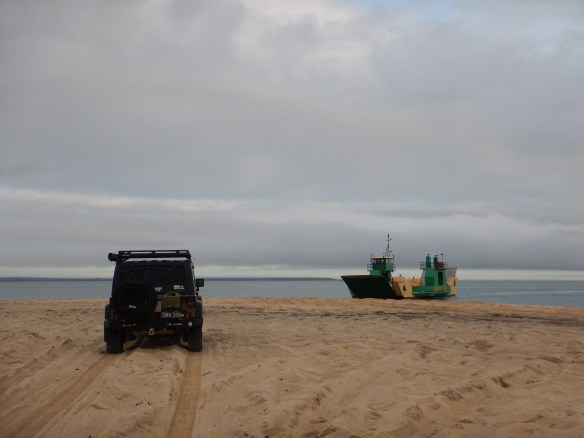
While in Australia in July, we hired a 4WD for a trip to Fraser Island, largest sand island in the world. From Noosa, it was a 50 km drive on Cooloola Beach to Rainbow Bay, then across to Fraser Island by barge to drive up 75 Mile Beach on the eastern side.

DSCN0609

Waiting at Rainbow Beach for the barge to cross to Fraser Island.

Early morning light on 75 Mile Beach

Early morning light on 75 Mile Beach

Continue reading

Thomas Wilson – convict ancestor

After my previous slightly light-hearted post about Thomas Wilson ( an-odd-fellow ), I thought I should tell his real story, his transportation to Sydney in the Lady Nugent in 1835 and his later role in the Mona Vale Outrages.

The Lady Nugent on the high seas. Pencil drawing by George Richard Hilliard, 1840 (4).

The Lady Nugent on the high seas. Pencil drawing by George Richard Hilliard, 1840 (4).

Continue reading

An odd fellow

Back in 2011, I discovered that one of my great-great- great-grandfathers (on grandpa Baker’s side) Thomas Wilson (1817-1890) had been transported to Australia in 1835 as a convict. He and two others had committed a highway robbery.

Just recently, I came across convict records that gave more information and a description of him. He was aged 21, single, a Protestant who could read and write. He came from Kent, and was a skinner and poulterer.  According to the convict records, he was 5 feet 4¾ inches tall, with ruddy and freckled complexion, brown hair and grey eyes, his eyebrows partially meeting. Among various marks and scars, he had (presumably tattooed) a sun, half moon, seven stars and a crucifix inside his lower left arm. At this point, I realized I was out of my depth, and called in the renowned symbologist, Professor Robert Langdon of Harvard, who told me that the sun, moon and seven stars were a set of symbols used by Freemasons and were also adopted by the Order of Oddfellows, founded in the eighteenth century. The Oddfellows modelled themselves on freemasons though were dedicated more to people of modest lifestyle, labourers and artisans. For the Oddfellows, the “sun, moon and stars” collectively might represent all God’s creation, all that is wonderful and admirable. The seven stars recalls The Pleaides constellation representing the “seven liberal arts”, and for a skinner and poulterer would probably translate to literacy and numeracy.

Langdon concluded that a literate 19 year old working class boy who was already a member of the Oddfellows and had a distinctive set of symbols tattooed on his arm was unlikely to have been a simple highway robber. Could he have deliberately set out on a course of action that would result in him being transported to NSW?  Was there any significance that after he was given his ticket of leave, he bought substantial land holdings in the Manly area in 1853? Land now worth $300 million. And in 1869 became tenants of the “Mona Vale” property belonging to William Charles Wentworth, one of the three explorers who found the first route across the Blue Mountains in 1813. Was it significant that when he arrived in Australia in 1835, Wilson was first sent to Paramatta to work for William Lawson one of the other three explorers. Could it be another coincidence that Thomas Wilson sold his land in 1877, exactly one year before the foundation stone was laid for the first Oddfellows Hall at Manly.

Langdon immediately flew to Geneva and interviewed Mathers, seeking any evidence of Oddfellows involvement in his life. Mathers was surprised at the turn this research had taken, and unwilling to believe that the location of the Oddfellows Hall in Casino just half a block from where he lived as a child was anything more than coincidence. Or that one of father’s close colleagues was the Warden of the local Oddfellows Lodge. And why did the Lodge reach out and offer Mathers a scholarship as a teenager that enabled him to visit New Zealand. Why did they try to bend his interest in astronomy towards astrology and more occult concerns? Clearly Langdon would have to follow the leads in New Zealand to see what connections were found.

Discussions with Mathers also revealed that in the 1940s, his grandfather had applied considerable pressure on his mother to get her to  visit two elderly women in Mosman, the granddaughers of Thomas Wilson. Why was it so important that this contact be made? Could the Oddfellows really have had a plan, a vision, reaching centuries ahead. And what could it possibly be?