The boys and I headed to Courmayeur, just over the Italian border to the south of Mont Blanc for a week skiing.

Cresta D’Arp, Italian Alps

The boys and I headed to Courmayeur, just over the Italian border to the south of Mont Blanc for a week skiing.
Cresta D’Arp, Italian Alps
This post has been superceded by a new post my-maternal-ancestors-from-eve-via-ice-age-europe-to-victorian-england which contains latest information from a recent more detailed analysis of my mtDNA together with revised and updated dates and locations of haplogroup founders.
In my previous post on my deep maternal ancestors (https://mountainsrivers.com/2014/02/16/deep-maternal-ancestors-out-of-africa-into-ice-age-europe/) I summarized the “grandmothers” who contributed specific mutations to my mtDNA that allow me to trace them (and approximately when and where they lived) all the way back to Mitochondrial Eve, the most recent common maternal ancestor of all living humans. These women were real and specific individuals, and Sykes and others have given the older ones specific names (usually starting with the letter of the haplogroup they founded). I have followed this by giving names to the founders of the subgroups to which I belong. In this post, I give a brief biography of each of these ancestral grandmothers, starting with Mitochondrial Eve, placing them in evolutionary, geographic, and climatic context. Continue reading
The Cathar castle of Montsegur sits on top of a limestone peak (or pog in Occitan) at around 3000 feet. Here several hundred Cathars held out for 10 months against the besieging French army of over 6,000 men in 1243-44.

Montsegur
This post has been superceded by a new post my-maternal-ancestors-from-eve-via-ice-age-europe-to-victorian-england which contains latest information from a recent more detailed analysis of my mtDNA together with revised and updated dates and locations of haplogroup founders.
I have only been able to trace my maternal ancestors back to my great-great-grandmother, Amelia Buckmaster, who was born in 1809 in Hounslow, Middlesex, England and who died in 1892 in Wallingford, Berkshire, England. I recently had my mitochondrial DNA tested (see an earlier post for more on mtDNA) and the results indicated that my mtDNA haplogroup is U. I did some research on the specific mutations identified in my mtDNA and identified my subgroup more specifically as U5a1a1.This means that I now know quite a lot about specific maternal ancestors and where and when they lived, all the way back to Mitochondrial Eve who lived in Africa 192,400 years ago.
A few photos of us all together:

Sitting on a bouncy castle, hired for a birthday party 2011

The Parc Eaux-Vives of Isle de la Serre is a whitewater playground for practicing kayak skills in rapids. It is on the Rhone River, between Geneva and Lyon. Its about an hour drive from Geneva, assuming they have not decided to renovate the tunnels for the motorway in the Juras (in which case it can be a very tedious 2.5 hour trip)! Continue reading
Mitochondrial Eve is the name given to the matrilineal most recent common ancestor (MRCA) of modern humans. In other words, she was the woman from whom all living humans today descend, on their mother’s side, and through the mothers of those mothers and so on, back until all lines converge on one person. Mitochondrial Eve is estimated to have lived around 192,400 years ago ago in southern Africa (which makes her approximately my great*9,650th grandmother). Continue reading
I have had an interest in the history of my family since childhood, when I wrote a short history of the Mathers family that drew heavily on documents and recollections of family members, particularly those of a great-uncle and great-aunt born in Scotland in the 19th century. When I discovered Tolkien’s Lord of the Rings trilogy as a teenager, I was fascinated by the genealogical charts in the Appendices to the Lord of the Rings. For some reason, I find the tracing of connections to a larger history deeply satisfying. Over the last ten years, I returned to researching my ancestry using the powerful tools offered by the Internet, with access to databases and historical records that I would not have dreamed possible before.
One of the southernmost Cathar castles, in the foothills of the Pyrenees, Puilaurens sits on a 700 m high rocky outcrop.. Perhaps the best-preserved of Languedoc’s many cathar castles of the area, it offers breathtaking views of the surrounding valleys. Very atmospheric! Puilaurens was originally built by the Visigoths
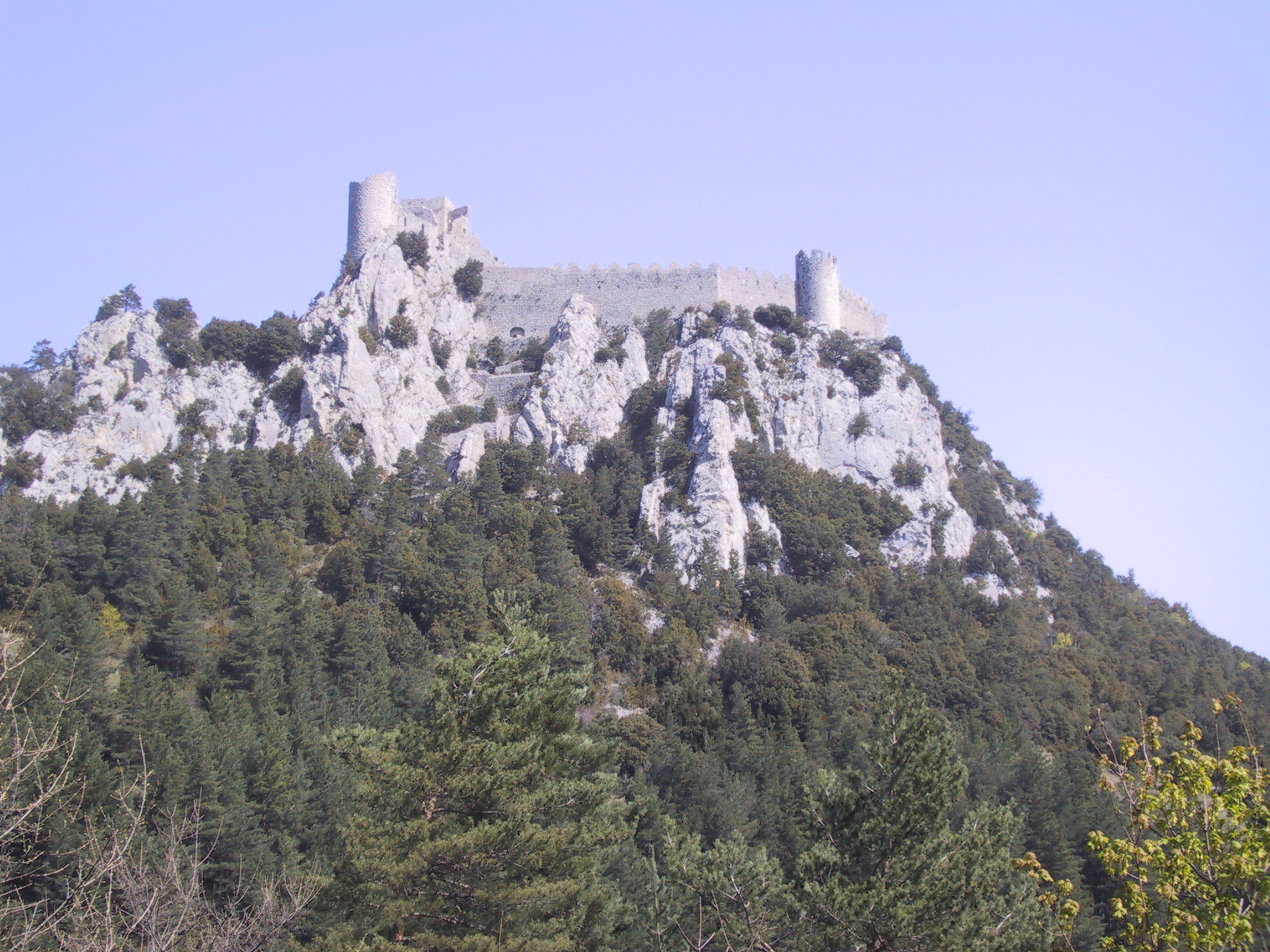
Chateau de Puilaurens, 2002

Roman mosaic floor discovered underneath the St Pierre Cathedral in Geneva, during excavations in 1976. Julius Caesar was stationed in Geneva for a while, I like to think he strode this floor.
http://sundaystills.wordpress.com/2014/02/09/sunday-stills-the-next-challenge-murals-or-graffiti/
"For man has closed himself up, till he sees all things thro' narrow chinks of his cavern" -- William Blake
Reflecting on what it all means
Neurofeedback
In Search of Inner Freedom
Motivate | Inspire | Uplift
Traveling Poet Philosopher & Occasional Wiseacre
The Philosopher's Stone
the look, feel, and stuff of the Dharma
A blog and Dharma forum from Jiryu Mark and Hondo Dave Rutschman-Byler
Philosophy | Psychology | Ecology | Sociology | Economics | Finance | Strategy | Scenarios | Futures | Foresight | Operational Research | Complexity | Networks | Systems | Dynamics
Explorations by Colin Mathers
Global health trends, summary measures, projections
A Book of Unconnected Dots
it always knows
Fun With Genealogy
Everyday, Everywhere We Are Guided Towards Happiness
Photography, memoirs, random thoughts.
Memoirs, writing, publishing and more
The Art and Craft of Blogging
 Mountains and rivers