
The 2025 US coup and the triumph of pre-modern values

The world is witnessing a coup taking place in the USA as Trump and Musk set about dismantling the US government, ignoring all congressional legislation and fiscal authority. The Constitution has effectively been suspended. Trump and Musk are leading extra-governmental operatives (young white male engineers employed by Musk) who have seized control of the Treasury payment system, and IT systems in other agencies such as USAID. They are starting to eliminate agencies created by Congress, the first being USAID. They are suspending payments authorized by law, re-interpreting the Constitution, and ignoring the judiciary. Already, several judges have made orders suspending various of their activities. They are being ignored. Ultimately, much later, such orders may end up in the Supreme Court who have already ruled that Trump has immunity for official actions.

What has led to this? How did the world’s richest man and a deeply ignorant psychopathic criminal get to seize control of government in the USA?

Continue reading
The widening gulf between values in Red and Blue states of the USA

Benjamin Cain recently posted an article on Medium.com, The Trump Cult and the Albatross Around America’s Neck, in which he argued that the Trump cult is fueled by southern racism, religious fundamentalism, and a backlash against modernity. He claims that “In this respect, half of the US is closer to the anti-modern Islamist states than to ultra-secular Europe.”

I realized that my recent analyses of levels of pre-modern beliefs in over 100 countries included in the Integrated Values Survey (IVS) (see here and here) could be extended to check this claim. The IVS is the combined data from the World Values Survey and the European Values Study, which have carried out seven waves of surveys in over 100 countries, spanning the period 1981 to 2021.

To examine variations in pre-modern versus modern values across countries and time, I estimated a continuous latent variable “modernity” based on responses to 11 selected questions in the IVS (see following box) whose responses will vary depending on how modern or pre-modern the respondent’s values are. which assumed there is an unobserved underlying continuous variable that describes the individual’s level of modernity of values and predicts (or correlates with) their answers to specific values questions. I used general linear modelling methods to estimate a continuous latent variable “modernity” from the responses to the 11 selected values questions. See here for more details.

Continue reading

Belief in heaven and hell – Part 2

In Part 1 of this post, I examined global variations in the prevalence of belief in heaven or hell, both in the total adult population and among Christians and those with other religious affiliations. I found that the prevalence of belief in heaven and hell among Christians in the USA is much higher than in any of the “West” culture zones, or the Orthodox East. In the developed countries other than the USA, only 52% of Christians say they believe in heaven, and significantly fewer say they believe in hell (42%). In contrast, Christians in the USA have a much higher level of belief, and similar levels of belief in heaven (85%) and hell (81%).

In social media, I’ve seen quite a few questions from Christians to atheists, essentially asking why they do not fear going to hell. And responses from atheists like myself, who simply cannot imagine how anyone could believe that a supposedly loving god would condemn people to eternal torture for a list of transgressions which seem to vary across flavors of Christianity and to be cherry-picked from a long list of sins mainly appearing in the Old Testament. A good starting point for understanding such different views are the levels and stages of moral development identified by Kohlberg [1].

Continue reading

Premodern religious values and happiness

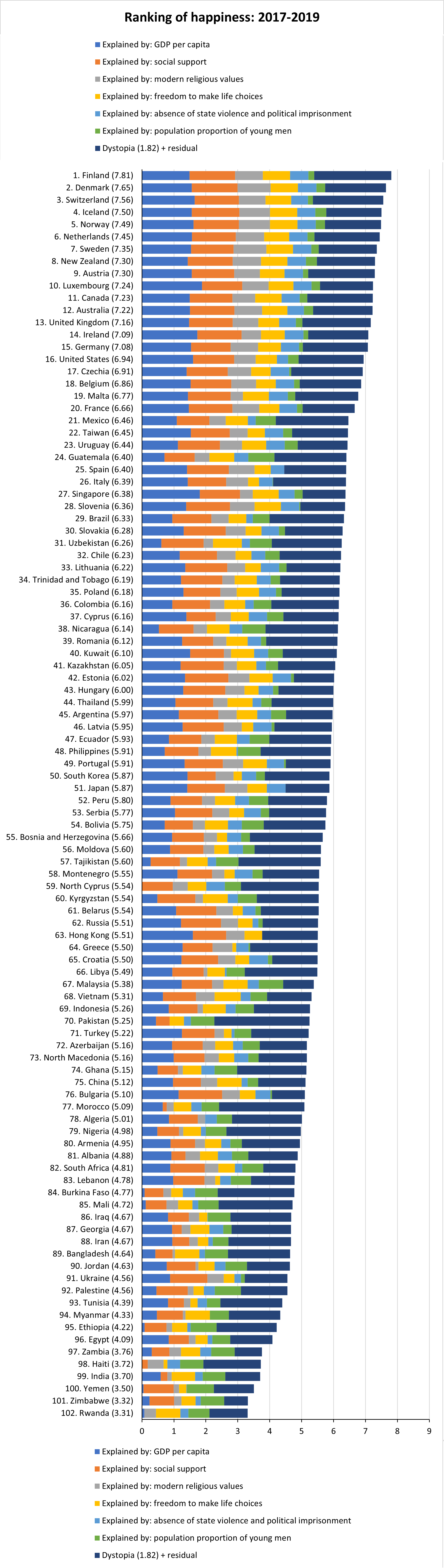
I recently came across a ranking of countries by average reported happiness. This year’s World Happiness Report, released on March 20, uses data from the Gallup World Poll to calculate average reported happiness by country for over 150 countries for years 2005 to 2020. The focus of the report is on the impact of COVID-19 on happiness in 2020 by comparison with years 2017-2019. I was interested to see to what extent modern versus premodern religious values might explain variations in happiness across countries, along with a number of other factors that were examined in the World Happiness Report. I have posted here previously on my analysis of premodern or “fundamentalist” religious values.

The main measure used for happiness in the World Happiness Report is based on the national average response to the question on life evaluation in the Gallup World Poll (GWP). The English wording of the question is  “Please imagine a ladder, with steps numbered from 0 at the bottom to 10 at the top. The top of the ladder represents the best possible life for you and the bottom of the ladder represents the worst possible life for you. On which step of the ladder would you say you personally feel you stand at this time?”

The following graph shows the happiness rankings of 101 countries for which I have both happiness measures and estimates of the modern/premodern religious values index I developed (see here). The happiness scores are averages for years 2017 to 2019.

Continue reading

Prevalence of pre-modern values across the world

In a previous post, I described my use of the World Values Survey (WVS) and European Values Study (EVS) to develop a measure of pre-modern religious values (approximately corresponding to “fundamentalism”). I have used this to calculate the prevalence of pre-modern religious values using data from waves 5-7 of the surveys, covering the period 2005-2020, but with most results relating to the recent decade 2010-2020. I somewhat arbitrarily chose a cutpoint of 6.45 on the religious values scale to classify people as having pre-modern values (<6.45) versus modern values (>=6.45). The value 6.45 was chosen as the point where the distribution of scores for individuals 2 and 3 (described in the  previous post) crossed over.

The following graph shows the prevalence of pre-modern values (as % of adult population) for countries in waves 5-7, ranked from lowest (Denmark at 13% and Sweden at 14%) to highest (Bangladesh, Myanmar and Qatar at 100%).

Continue reading

Pre-modern values, religion and culture

Many people outside the USA have watched with astonishment as fundamentalist Christians have aligned themselves with a serial adulterer and sexual assaulter who lost the recent election and is now seeking to undermine democracy in order to stay in power. Since first elected, Trump has worked hard to equate disagreement with treason. He has banished loyal opposition, sacked people for doing their jobs and called for the criminal investigation of ordinary opponents. But this alignment is not as bizarre as it seems on the surface. Fundamentalists share the value of demonizing and seeking to punish those they see as “other”, one of the key characteristics of fascism, as I discussed in my previous post. This applies to Christian fundamentalists and Muslim fundamentalists alike, as evidenced by the recent murders in France and Austria by Muslim terrorists angered by cartoons.

What is fundamentalism?

So I have extended my analysis of the the World Values Survey (WVS) and European Values Study (EVS) (see earlier post here) to see what it has to say about the extent of religious fundamentalism in the world today. Most religions developed in the pre-modern era and their sacred texts and teachings incorporate pre-modern culture and values to varying extents. Peter Herriot has written extensively on fundamentalist religious beliefs, characterized these movements as attempts to return to the pre-modern origins of their faith as prescribed by their sacred books [1]. He identifies five main general characteristics of fundamentalist religious movements:

Continue reading

Is religious belief in decline and atheism on the rise?

Ronald Inglehart has recently published an article in Foreign Affairs called “Giving up on God: the global decline of religion” in which he uses data from the most recent wave of the World Values Surveys (WVS) to claim that between 2007 and 2019, the importance of religion has declined in most countries [1]. This is based on a single question on the importance of God in the respondent’s life on a 10-point scale. The average importance declined in 39 countries and increased in only 5.  Apart from the fact that this is based only on a single question on the importance of God, it also does not tell us how regional or global average ratings have changed. Depending on the relative populations and scale shifts in different countries, it could potentially even be consistent with a global average increase.

I’ve taken a closer look at trends in religious belief and practice using data from the World Values Survey and European Values Study [2-5] which have interviewed over 630,000 people in 110 countries in seven waves of the surveys over the period 1981 to 2020. These surveys include a direct question on whether you believe in God (Yes/No/Don’t know), but also “Are you a religious person” (Religious, Non-religious, Confirmed Atheist) and questions on frequency and type of religious practices, and on the importance in your life of religion and God. Of the 105 countries, 76 have data for years in range 2017-2020, and another 17 have data on or later than 2010.

Continue reading