The world is witnessing a coup taking place in the USA as Trump and Musk set about dismantling the US government, ignoring all congressional legislation and fiscal authority. The Constitution has effectively been suspended. Trump and Musk are leading extra-governmental operatives (young white male engineers employed by Musk) who have seized control of the Treasury payment system, and IT systems in other agencies such as USAID. They are starting to eliminate agencies created by Congress, the first being USAID. They are suspending payments authorized by law, re-interpreting the Constitution, and ignoring the judiciary. Already, several judges have made orders suspending various of their activities. They are being ignored. Ultimately, much later, such orders may end up in the Supreme Court who have already ruled that Trump has immunity for official actions.
What has led to this? How did the world’s richest man and a deeply ignorant psychopathic criminal get to seize control of government in the USA?
I have compared the moral values of atheists and theists using data from the World Values Survey and the European Values Study for the last 20 years. This survey program includes 262 surveys in 112 countries over the period 2004-2021, with a total sample size of 386.870 respondents. See here for more details on the survey program.
Benjamin Cain recently posted an article on Medium.com, The Trump Cult and the Albatross Around America’s Neck, in which he argued that the Trump cult is fueled by southern racism, religious fundamentalism, and a backlash against modernity. He claims that “In this respect, half of the US is closer to the anti-modern Islamist states than to ultra-secular Europe.”
I realized that my recent analyses of levels of pre-modern beliefs in over 100 countries included in the Integrated Values Survey (IVS) (see here and here) could be extended to check this claim. The IVS is the combined data from the World Values Survey and the European Values Study, which have carried out seven waves of surveys in over 100 countries, spanning the period 1981 to 2021.
To examine variations in pre-modern versus modern values across countries and time, I estimated a continuous latent variable “modernity” based on responses to 11 selected questions in the IVS (see following box) whose responses will vary depending on how modern or pre-modern the respondent’s values are. which assumed there is an unobserved underlying continuous variable that describes the individual’s level of modernity of values and predicts (or correlates with) their answers to specific values questions. I used general linear modelling methods to estimate a continuous latent variable “modernity” from the responses to the 11 selected values questions. See here for more details.
I recently came across the 2017 Pew Research Center survey of more than 4,700 U.S. adults which found that of those who say they believe in God, 30% say they believe in some other higher power or spiritual force in the universe rather than the God of the Bible. Among those who say they do not believe in God (aka atheists), 47% say they believe in some other higher power or spiritual force. What do people mean when they say this? And do atheists and theists mean the same or different things?
Before discussing this, I first present some similar data for the United Kingdom, Australia, and Canada (the mother country and two other English speaking ex-colonies).
A 2020 YouGov poll in Britain found that 27% say they believe in “a god”, 16% say they believe in the existence of a higher spiritual power, but not a god, 41% do not believe in a god or a higher power and 18% don’t know. Among British Christians, just over half say they believe in God, 16% believe in a higher power, 10% don’t believe in God or higher power, and 16% don’t know.
The 2019 Australian Community Survey found that 29% of Australians say they believe in a personal God and 32% say they believe in some sort of spirit or life force. Around two in 10 (21%) do not believe and 18% remain unsure.
A very recent Canadian survey carried out in November 2022 found that just over a third of Canadians believe in God or gods (33.6%), with a further 32.1% saying that they believe in a higher power or spiritual force, but don’t necessarily believe in a god or gods. More than one-in-five (22.1%) don’t believe in any spiritual power.
In Part 1 of this post, I examined global variations in the prevalence of belief in heaven or hell, both in the total adult population and among Christians and those with other religious affiliations. I found that the prevalence of belief in heaven and hell among Christians in the USA is much higher than in any of the “West” culture zones, or the Orthodox East. In the developed countries other than the USA, only 52% of Christians say they believe in heaven, and significantly fewer say they believe in hell (42%). In contrast, Christians in the USA have a much higher level of belief, and similar levels of belief in heaven (85%) and hell (81%).
In social media, I’ve seen quite a few questions from Christians to atheists, essentially asking why they do not fear going to hell. And responses from atheists like myself, who simply cannot imagine how anyone could believe that a supposedly loving god would condemn people to eternal torture for a list of transgressions which seem to vary across flavors of Christianity and to be cherry-picked from a long list of sins mainly appearing in the Old Testament. A good starting point for understanding such different views are the levels and stages of moral development identified by Kohlberg [1].
My father was a Protestant minister and I grew up in a rural Protestant culture in Australia, went to lots of church services and never heard anyone trying to claim hell was a real place rather than a metaphorical place. Belief in a real hell tends to be reserved for fundamentalists who are a relatively small proportion of Christians outside USA and some other countries. I think for religious people focused on love and kindness it is clear that hell is a mythological concept dating from primitive times and literally believing your God would torture people for eternity marks you out as having premodern values. While I don’t know about the distribution of the real beliefs of individuals in the Christian community I grew up with I was not aware on any discussion of hell as a real place.
Recently, on social media forums, I’ve seen quite a few questions from Christians asking why aren’t atheists terrified of ending up in hell. And assumptions (mainly from Americans) that belief in hell is the mark of being a Christian. At least in the mainstream media, hell tends to only get a mention as part of the rantings of fundamentalists and religious extremists. These are a tiny minority in Australia and Switzerland. So I decided to see what the data from the World Values Survey (WVS) and the European Values Study (EVS) tell us about the prevalence of belief in heaven and hell.
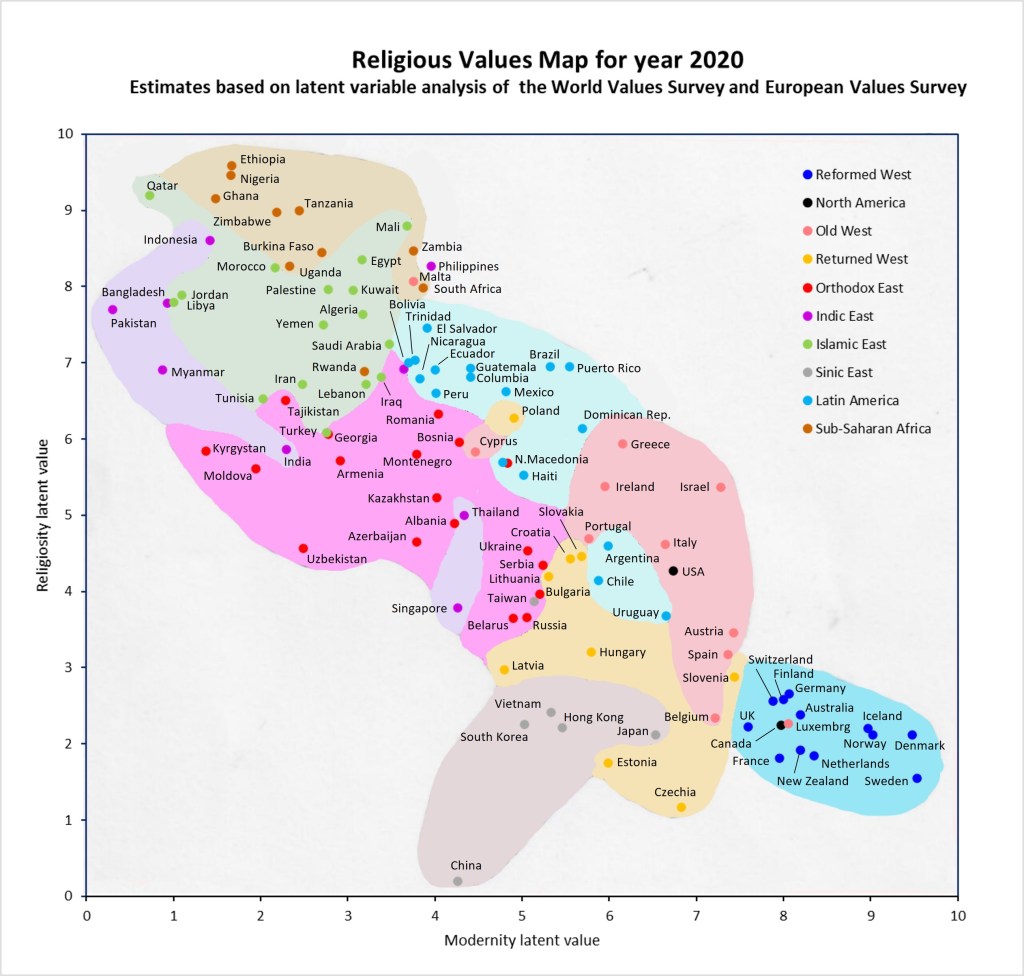
In my previous post, I presented updated estimates of trends in average religiosity and religious values for 110 countries using latent variable analysis of data from the World Values Survey and European Values Study [1-4]. The map below plots these countries according to their latent variable values for modernity (horizontal axis) and religiosity (vertical axis) in the year 2020. The colours indicate culture zone and the shading roughly indicates the main domain of countries in each culture zone. Moving downwards to the right on this graph indicates increasing modern values and decreasing religiosity. The inspiration for this map presentation was the culture zone maps produced for earlier waves of these surveys by the political scientists Ronald Inglehart and Christian Welzel [5]. The culture zones are defined in a previous post here.
Apart from the uncertainty in these values resulting from survey sample size limitations, differences in the ways surveys were administered, and differences in translation and cultural understanding of questions, there is also statistical uncertainty in the latent variable estimation process. Not too much should be made of small differences between countries, and I focus on the broader patterns.
The degree of premodernity of religious values is fairly similar for the Islamic East and Sub-Saharan Africa, but the African region is somewhat more religious than the Islamic region. The Indic East has higher levels of premodern values than either of these regions. One manifestation of this is the current rising level of Hindu nationalism in India along with the violent persecution of Indians of other religions. The degree of modernity of values is similar for the majority of Latin American countries and the former Soviet bloc countries, but religiosity is significantly lower in the latter, where religion is largely a marker of national identity and most are non-practicing.
The North America culture zone includes only two countries, the USA and Canada. It is clear from the map that Canada belongs with the Reformed West countries in contrast to the USA, which sits in the Old West zone close to Italy, and also not far from three South American countries: Argentina, Chile and Uruguay. Malta and Cyprus are also outliers for the Old West culture zone, with higher levels of religiosity and less modern values. Along the decreasing religiosity-increasing modernity axis, Qatar is at the top end and Sweden at the bottom end. China is an outlier to the lower left, with the lowest level of religiosity of all the countries, but also a modernity value towards the middle of the scale between modern and pre-modern.
It should be emphasised that this map reflects national averages for individuals and may not be reflected in laws and form of government. Increasingly authoritarian regimes across the world are imposing values that a substantial proportion of their population do not accept. The USA has a growing proportion of the population rejecting democracy in favour of minority rule and the restriction of various rights particularly for women and minority voters. Unhappiness with the results of neoliberal economic and social policies over recent decades has been successfully redirected into “values wars” rather than addressing the real causes of declining average incomes and reductions in social safety nets along with the reduction of taxation and regulation for high income individuals and companies.
References
Inglehart, R., C. Haerpfer, A. Moreno, C. Welzel, K. Kizilova, J. Diez-Medrano, M. Lagos, P. Norris, E. Ponarin & B. Puranen et al. (eds.). 2014. World Values Survey: All Rounds – Country-Pooled Datafile Version: https://www.worldvaluessurvey.org/WVSDocumentationWVL.jsp. Madrid: JD Systems Institute.
Haerpfer, C., Inglehart, R., Moreno,A., Welzel,C., Kizilova,K., Diez-MedranoJ., M. Lagos, P. Norris, E. Ponarin & B. Puranen et al. (eds.). 2020. World Values Survey: Round Seven–Country-Pooled Datafile. Madrid, Spain & Vienna, Austria: JD Systems Institute& WVSA Secretariat[Version: http://www.worldvaluessurvey.org/WVSDocumentationWV7.jsp].
Gedeshi, Ilir, Zulehner, Paul M., Rotman, David, Titarenko, Larissa, Billiet, Jaak, Dobbelaere, Karel, Kerkhofs, Jan. (2020). European Values Study Longitudinal Data File 1981-2008 (EVS 1981-2008). GESIS Datenarchiv, Köln. ZA4804 Datenfile Version 3.1.0, https://doi.org/10.4232/1.13486.
EVS (2020): European Values Study 2017: Integrated Dataset (EVS 2017). GESIS Data Archive, Cologne. ZA7500 Data file Version 3d. WVS. Archived from the original on October 19, 2013.
In a recent post, I presented revised estimates for trends in the prevalence of atheism and religiosity for 110 countries over the last 40 years. This was based on a new analysis of the 2021 release of combined data for the WVS and EVS in the Integrated Values Surveys (IVS) 1981-2021 [1, 2]. The main revision to the dataset was to correct an error in the data for the USA. This post summarizes my updated analysis of modern and pre-modern religious values and for the first time I have also carried out an analysis of time trends from 1980 to 2020. See here for full details of the construction of a revised latent variable for modern values and the analysis of time trends.
My earlier post discusses in some detail the conceptualization and operationalization of modern and pre-modern religious values. I here give a very brief overview of this in terms Kohlberg’s three stages of moral development. Stage 1 moral values focus on absolute rules, obedience and punishment and an individual is good in order to avoid being punished. In stage 2, the individual internalizes the moral standards of the culture and is good in order to be seen as a good person by oneself and others. Moral reasoning is based on the culture’s standards, individual rights and justice. In stage 3, the individual becomes aware that while rules and laws may exist for the greater good, they may not be applicable in specific circumstances. Issues are not black and white, and the individual develops their own set of moral standards based in universal rights and responsibilities. As moral values evolve through the three broad stages, the size of the in-group (“us”) with which an individual identifies typically expands from tribe to ethnic group or nation to all humanity.
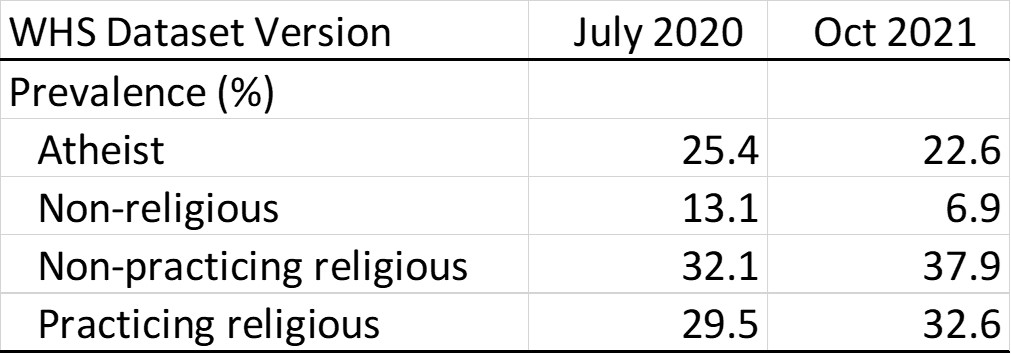
In two earlier posts (here and here), I examined global, regional and country-level trends in religious belief and practice, and the prevalence of atheism. The analysis was based on data from the World Values Survey (WVS) and the European Values Study (EVS), covering the period 1981 to 2020. Earlier this year, I discovered that the World Values Survey dataset has been updated. Some data collected using a mobile phone app in the most recent US survey was incorrectly coded and this mainly affected the religiosity categories. Comparison of the US prevalences for religiosity show that the coding errors resulted in an overestimate of the atheist and non-religious categories as shown in the following table:
Comparison of religiosity prevalence estimates for USA in year 2020
I have now updated the previous analyses using the 2021 release of the combined data for the WVS and EVS in the Integrated Values Surveys (IVS) 1981-2021 [1-3]. In carrying out these updates, I also addressed some definitional issues which have resulted in mostly slight changes to estimates for other countries. The details of the updated analysis are described elsewhere.
I recently came across a ranking of countries by average reported happiness. This year’s World Happiness Report, released on March 20, uses data from the Gallup World Poll to calculate average reported happiness by country for over 150 countries for years 2005 to 2020. The focus of the report is on the impact of COVID-19 on happiness in 2020 by comparison with years 2017-2019. I was interested to see to what extent modern versus premodern religious values might explain variations in happiness across countries, along with a number of other factors that were examined in the World Happiness Report. I have posted here previously on my analysis of premodern or “fundamentalist” religious values.
The main measure used for happiness in the World Happiness Report is based on the national average response to the question on life evaluation in the Gallup World Poll (GWP). The English wording of the question is “Please imagine a ladder, with steps numbered from 0 at the bottom to 10 at the top. The top of the ladder represents the best possible life for you and the bottom of the ladder represents the worst possible life for you. On which step of the ladder would you say you personally feel you stand at this time?”
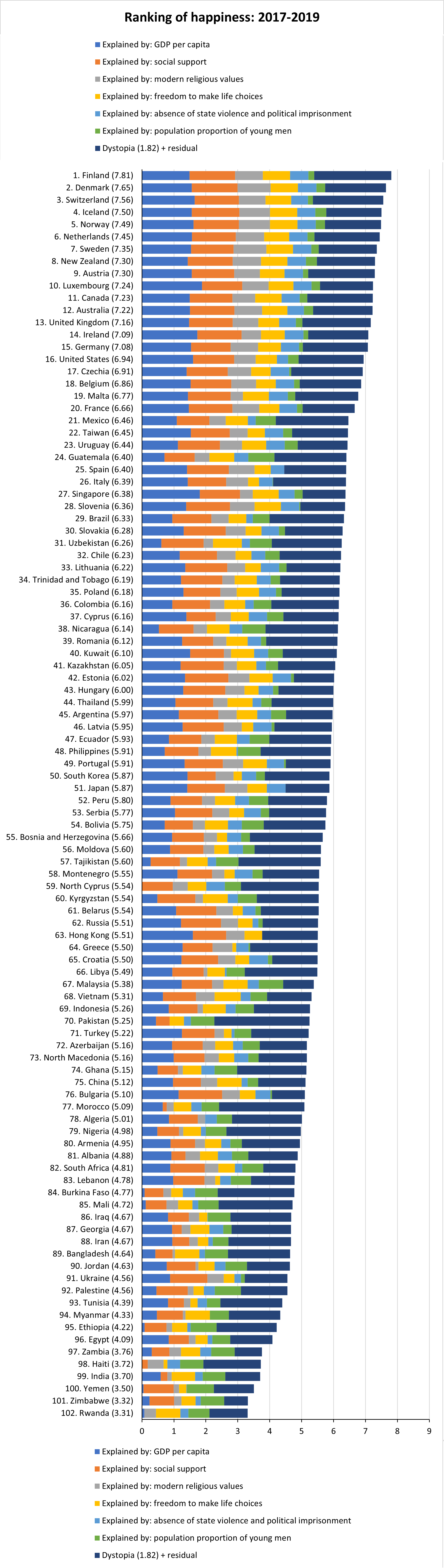
The following graph shows the happiness rankings of 101 countries for which I have both happiness measures and estimates of the modern/premodern religious values index I developed (see here). The happiness scores are averages for years 2017 to 2019.

 Mountains and rivers