Questions about Panpsychism

Like many scientists, I dismissed panpsychism as hugely implausible until recently. Then I read discussions of it in Annaka Harris’s 2019 book “Conscious” and David Chalmers’ 1996 book The Conscious Mind: In Search of a Fundamental Theory. They persuaded me that panpsychism should be considered as a potential solution to the hard problem.

There has been a revival of interest in panpsychism and I bought three recent books on it. Before reading them, I decided to think through for myself what a defensible form of panpsychism would look like, and what questions it raises.

The Hard Problem — two options

David Chalmers famously termed this the “hard problem” of consciousness. Most scientists and philosophers simply assume it must be an emergent property of the brain.

The alternative option is some form of panpsychism: consciousness is a fundamental property of matter alongside things such as charge, spin, etc. Chalmers also suggested a hybrid option, that consciousness derives from some other class of more fundamental non-physical properties. Consciousness is emergent from these more fundamental non-physical properties in sufficiently complex arrangements of matter.

Emergence

Emergence refers to properties or behaviors of a complex entity that its parts do not have on their own and emerge only when they interact in a wider whole. Some examples of emergent properties/behaviours include the structure of snowflakes, waves and chaotic fluid flow, chaotic behaviours of simple predator-prey systems, ant colonies, and the blood pumping properties of hearts.

These are all examples of what philosophers call weak emergence. The emergent properties are still descriptions of matter and how it behaves as witnessed from the outside, they are in the same category of things as the underlying basic properties of that matter.

Strong emergence refers to a fundamentally different category of thing emerging from things lacking that category. The proposed emergence of first-person experience from non-sentient matter would be an example of strong emergence. There are no known examples of strong emergence as far as I know.

All discussions of consciousness as an emergent phenomenon simply assume it is emergent. Chalmers argues that strong emergence is uncomfortably like magic, but the emergent phenomena are still regarded as being utterly dependent on the physical.

Panpsychism

Panpsychism is the view that all matter is imbued with consciousness in some sense. The term has been used to describe a wide range of thinking from the animism of primitive religions to a mind-like aspect, or to some much simpler form of basic awareness.

Panpsychism was a common view among philosophers in the 19th century, but fell out of favour in the twentieth century. There has been a recent revival of interest among philosophers such as Thomas Nagel, Galen Strawson, David Skrbina and Philip Goff. Even some neuroscientists such as Giulio Tononi and Christof Koch have proposed that consciousness is widespread and can be found in simple systems.

Most scientists are very reluctant to consider panpsychism, and many dismiss it as obviously ridiculous. The idea that “rocks are conscious” is taken as so obviously ludicrous that panpsychism can be safely dismissed out of hand.

Chalmers has noted that panpsychism avoids the need to have consciousness wink-in or switch-on at some particular level of complexity. Rather it may be a universal property, with very simple systems having very simple phenomenology and very complex systems having very complex phenomenology. Annaka Harris also noted that “In actuality, if a version of panpsychism is correct, everything will still appear to us and behave exactly as it already does.”

What does consciousness refer to?

In a previous article, I discussed the experience of pure conscious awareness when thoughts, feelings, sensations drop away. Zen refers to this as “body and mind dropped away”. This experience is accessible through a range of meditation practices and also occurs spontaneously in some circumstances.

This experience allows the meditator to realize that they are not their thoughts, or their feelings, that these arise and pass away. Contentless consciousness is pure awareness per se. The part of my brain responsible for assigning labels and meaning — to objects, events, interactions — is not currently online.

Is this pure awareness inherently nondual? I’ve have had a taste of nondual consciousness once or twice. Insufficient for me to claim to understand it or draw any conclusions yet. I suspect the pure state is indeed an unchanging non-dual awareness. Duality starts with brain processes classifying what is experienced.

Contents of consciousness

These include thoughts, verbalized or not, feelings and emotions, and sensory perceptions.

Are qualia also contents of consciousness? They are not illusory, the one thing direct experience of the suchness of something cannot be is an illusion. And they are not reducible to underlying neural activity as they refer to the first-person suchness of experiencing the particular content. I am inclined to think that suchness remains part of the content of awareness.

Pierz Newton-John makes an argument I find convincing that colours convey information about the environment (dangers, food, etc) and that evolution results in the attachment of emotions to colours to ensure we react appropriately to such colour information. In other words, the experience of a colour develops an emotional richness, ie complex qualia. This can only arise in systems that possess the ability to summarise and respond to complex information in their environment.

He sees this as ruling out panpsychism (because he considers qualia as defining of consciousness). I don’t. If qualia are contents of consciousness, then indeed they will require nervous systems to have any complex suchness. Objects without brains will have nothing but some rudimentary awareness and very rudimentary suchness of that awareness. There is likely not something it is like to be a rock beyond some very tiny awareness per se, no different to our pure contentless awareness.

Philosophers see qualia as being key to what it is like to be human, or a bat, or a dog. And it seems reasonable to me that what it is like to be a bat is very much about the qualitative aspect of bat sensory, bat feeling and bat thoughts, because these will be quite different to, say, human qualia for sensory, feeling and thinking inputs to consciousness. And that would fit with my suspicion that contentless consciousness (pure contentless subjective awareness) might not differ across species, except perhaps in some sort of strength measure (depth?) of awareness.

My experiences of contentless consciousness in meditation seem to confirm that qualia drop away along with other content of consciousness. The hard problem relates to contentless consciousness, pure awareness, The easy problem relates to qualia and other contents of consciousness, and their origins in brains and nervous systems.

Non-ordinary states

There are many of these states other than everyday waking consciousness. We experience several of these each day, including the hypnagogic state, REM (dream) sleep and deep sleep. Let’s consider psychedelic-induced states as an example. In these states, is it only the contents of consciousness that change or does consciousness per se (aka pure awareness) also change?

We know that psychedelics alter neurotransmitter levels and block or activate neurotransmitter receptors. We also know that brain networks are up- or down-regulated, and that brain network connectivity is altered. Qualia and sensory experiences are altered. An example is synesthesia when sensory crossovers occur, such as tasting colours or feeling sounds.

I think it most likely that psychedelic experiences are all about the contents of consciousness. Pure awareness remains unchanged in altered states. But I could be wrong.

Attention

We can focus our attention on specific content of consciousness, such as breath counting, mantras, visual images, flames, or koans, and on awareness itself. Or we can expand attention to be non-specific and broad (mindfulness meditation, shikantaza). How does attention work? What is driving it? The brain? Thoughts? decisions?

While meditative traditions talk a lot about attention in terms of how it can be used, I’ve either ignored or not encountered an analysis of what it is and where it arises. What is attention? How does it work?

Causal connections

The brain and nervous system produce content experienced by consciousness. Is this a causal process from brain to consciousness, or is the “eye of awareness” just aware of content without causal connections, unlike our physical eyes which are causally affected by the light arriving at them.

Are there connections the other direction? We can remember experiencing the suchness of qualia. We can remember (to some extent) experiencing meditative states, even non-dual states of contentless awareness. This must surely imply some causal feedback from the experiences to the memory centres of the brain.

Pure awareness is likely always on (even in deep sleep). The primary evidence for this is from advanced meditators, particularly in the Tibetan tradition. Ken Wilber also reports experiencing this in his book One Taste.

In most of us, the link to memory disappears in states like deep sleep and anaesthetic-induced unconsciousness. This is also the case for most dreams, that do not make it to long-term memory, and traces in short-term memory can rapidly evaporate after waking. Likely most of us do not lay down memories of that residual pure awareness during deep sleep. Maybe neuroscience will find evidence one way or the other?

Once the brain can register memories of conscious awareness, that opens a causal pathway for consciousness to affect other brain processes such as conclusions, choices or reporting of experiences.

When I read Chalmers, he semi-convinced me that pure consciousness was an epiphenomenon that did not causally affect its contents or the neurons producing them. But memories of meditative states do get made. Is there a causal pathway from conscious awareness per se to laying down memories of that awareness? How does that work?

What should a panpsychism hypothesis look like?

  • Consciousness is pure unchanging awareness, not mind or self or thoughts or qualia or other contents of consciousness
  • Some degree of consciousness is a basic property of matter.
  • Without the involvement of a brain (or perhaps nervous system), there are no thoughts, no thinking, no feelings etc just some degree of contentless awareness.

Some speculations about panpsychism

Without a brain to provide content, and to store memories, pure consciousness at lower levels can be no more than some microscopic “pure awareness” with possibly some direct connection to very primitive “physical inputs” that do not require sensory organs or nervous system. That might be nothing more than some sort of very limited awareness of temperature or quantum fields.

But does pure awareness have a “strength”. Is awareness at the atomic level very weak or is awareness just awareness, and it is the connection to content that changes with scale and complexity?

If there is some scaling of awareness with size, whether linear or not, how do we get an apparent unified “field” of awareness at human-level?

I think it likely that some very primitive consciousness increased probability of survival and reproduction. Evolutionary selection pressures have selected organisms that developed nervous systems with structures that favoured some alignment/coupling of atomic-level consciousness. Maybe those same selection pressures selected arrangements that fostered two-way causal communications between the growing first-person awareness and the increasingly complex brain.

The human brain weights around 1.3 kg. Assuming a weight of 1 kg and an average atomic weight of 6 for brain atoms, there are approximately 10²⁶ atoms in a human brain. One atom might thus have about one hundred million-billion-billionth of the pure contentless awareness of a human. That could at most have only an extremely faint direct experience of quantum interactions with force transmitters (virtual particles, real particles etc).

How might these atomic quanta of consciousness align to form a “macroscopic” consciousness. Perhaps the alignment process is somewhat analogous to what occurs in ferromagnetic materials.

The atomic level magnetic fields of atoms (arising from the spin of the electrically charged electrons) can align in magnetic materials to produce a macroscopic and continuous magnetic field. Perhaps elementary quanta of consciousness can similarly align to produce a larger field of consciousness. This is of course only an analogy, the interactions of “quanta” of consciousness may be completely different to any interactions in the physical domain.

Without a brain to produce thoughts and other inputs to that awareness it cannot act in any way. Perhaps the evolution of brains involved an emergent process producing a more aware consciousness able to experience inputs from the brain. The hard problem is avoided. In the same way a bar magnet avoids the hard problem of magnetism by organizing the already existing magnetic fields of atoms so that their spins are aligned.

Is there any way to test the emergence or panpsychism hypotheses?

No. To a certain extent we can infer that simpler brained animals have “less consciousness” although their consciousness (pure contentless awareness) is likely to be exactly the same as ours apart from possibly its “strength”. The big difference is the contents of consciousness, the thoughts and perceptions are simpler, and almost definitely non-verbal and less complex. Sensory inputs may be wildly different to ours.

There are likely some predictions that can fall out of this proto-theory of panpsychism. One example would be a prediction that computing machines that have programs to emulate thoughts and process sensory and language inputs will not align their atomic level awarenesses into an analogue of human consciousness. Why? Because we have no idea what aspects of brain structure enable this coordination and linking of atomic level consciousnesses, and we certainly have not designed computer circuits to incorporate such factors, as yet unknown to us.

Of course, we have no idea whether particles have consciousness or not. We cannot even tell whether anyone other than ourselves is truly conscious. We assume so because they are a human like us, and we have consciousness, and they act as though they do and tell us they do.

Annaka Harris makes an analogy to the Higgs field. Physicists realized it needed to exist to give mass to electrons and quarks. Eventually, after 48 years, its carrier, the Higgs boson, was detected experimentally. If consciousness is another property of matter that we have yet to discover, it is not at all clear whether it is possible to discover it, given that we have no way of detecting consciousness outside first-person experience of it. But it may need to exist, if emergence continues to remain only a magical explanation.

Only by hooking up pure awareness to a brain that can produce inputs to awareness and record and report memories of what its like to experience those contents can we have the full experience of what its like to be conscious. Neuroscientists might be wrong that consciousness is an emergent property of the brain. But it can still be true, that without a brain, consciousness is not all that big a deal for the atoms, or the toaster or the computer running an AI program.

Where does this leave us?

It’s hard for me to see how scientists could ever explain the emergence of first-person awareness from unconscious matter, no matter how well organized, but it remains a possibility. No-one to date has made any plausible proposal for how it would happen. Rather like the creationists, who have no ideas, no hypotheses, just “god did it”.

I think a defensible version of panpsychism is starting to emerge from the thoughts and questions I have documented here. Its also possible that the solution to the hard problem may be forever beyond our reach,

I will now start reading some of the recent writings on panpsychism. Are others thinking along the same lines? Do they have plausible hypotheses to address questions I have raised here?

The hard problem of consciousness: David Chalmers and The Conscious Mind

In my fourth post in this series, I review David Chalmer’s 1996 book The Conscious Mind: In Search of a Fundamental Theory. See here, here and here for the previous posts. This is a long and often technical book (about 395 pages) though Chalmers has kindly flagged the Chapters and Sections that he recommends non-philosophers read and has asterisked the headings of Sections that he considers technical details likely of interest only to philosophers. I read some but not all asterisked sections, and I have to say that it is indeed the most technical and “academic” work of philosophy I have read in decades.  But let’s dive into it.

The hard problem of consciousness

It was like a breath of fresh air to read the introductory chapter. Instead of dismissing consciousness as an illusion, Chalmers sees it as the largest outstanding obstacle in our quest for a scientific understanding of the universe. He coined the phrase “the hard problem” around 1994 and it caught on. In contrast to the hard problem of why we have first-person experience, issues such as how the brain processes environmental stimuli, or how it integrates information into a coherent whole, might be called “easy” problems, and many books about consciousness, such as Dennett’s, are largely about the easy problems. Consciousness remains a big, deep mystery about which science has almost nothing to say, and where there is no agreement even in the broad about how consciousness occurs.

Chalmers says he has found that around one-third of people think that solving the easy problems explains everything that needs to be explained about consciousness, and around two thirds hold that there is a further “hard” problem. This ratio is fairly constant across academics and students in a variety of fields.  He sets out explicitly to address the hard problem and to develop at least a basis for a scientific theory of consciousness though he recognizes that it is not open to investigation by the usual scientific methods.

He outlines a set of constraints within which attempts to obey in this quest. First, to take consciousness seriously and not redefine it as something else (as per Dennett). Second, to take science seriously in the domains where it has authority. Third, to take consciousness to be a natural phenomenon.

Two fundamental questions about consciousness

In the Introduction and Chapter 1, Chalmers clarifies what he means by consciousness. It’s the way we experience the world, the way it feels to us subjectively. Using the phrase Nagel made famous in 1974, Chalmers says “We can say that a being is consciousness if there is something it is like to be that being …”

Chalmers identifies two fundamental questions about consciousness that we currently cannot answer. (1) Why does conscious experience exist and how does it arise in physical systems, and (2) why do conscious experiences have their particular nature? Why does the experience of red differ from the experience of blue? 

First, Chalmers draws our attention to the range of conscious experiences by presenting a set of examples ranging from visual experiences, through mental imagery, to emotions, and to our sense of self. It seems odd that he completely ignores non-ordinary states of consciousness though he touches on changes in consciousness with a discussion of how his visual experience dramatically changed as a child when he was fitted with glasses.

This leads into an important distinction that he makes between the psychological concept of mind and the phenomenal concept of mind. The phenomenal aspect of mind is conscious experience. The psychological aspect of mind refers to the mental states construed as the (ultimately physical) states relevant to the causation and explanation of behavior. It matters little or not at all whether these mental states are conscious or not. The materialist hopes that the phenomenal and psychological minds turn out to be the same thing, Chalmers argues that they are different things, a form of dualism.

Chalmers approaches the study of consciousness from a completely nonspiritual, nonreligious perspective. The dualism he advocates is governed by natural laws, it is just that these natural laws extend beyond the laws of our current sciences. He is not a mysterian, someone who throws their hands up and say that consciousness is a fundamental mystery outside the reach of human understanding. Rather he wants to understand and explain consciousness as a natural phenomenon.

Zombies and other arguments against a reductive materialist explanation

Chalmers argument against a materialist explanation of consciousness relies heavily on two things: supervenience and logically possible worlds. The definition of logical supervenience is as follows: B facts/properties logically supervene on A facts if no two logically possible worlds are identical with respect to their A facts while differing in their B facts. A phenomenon is reductively explainable in terms of low level physical facts if and only if it logically supervenes on those properties.

These issues are dealt with in detail in a long and philosophically technical chapter 2. Its worth reading to get a grasp of Chalmers’ arguments in following chapters, but it is a heavy read with technical terms such as “intension” and “instantiation” much used.

Chalmers then argues that everything in our world logically supervenes on the low-level physical facts except for consciousness. He actually gives five arguments in Chapter 3 for this conclusion. The first and third, which I find the most compelling, are the zombie argument and the epistemic asymmetry argument.

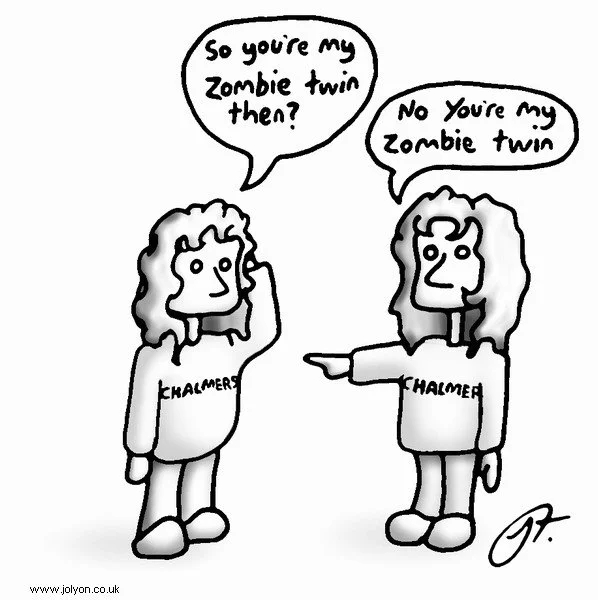
The zombie argument is that it is logically possible to imagine zombies who are just like us, fuctionally, psychologically and behaviourally, but yet have no phenomenal mind, no experiences, nothing that it is like to be them. These are often referred to as philosophical zombies, as opposed to the Hollywood zombies who are functionally impaired. It is logically possible to imagine a world physically identical to ours inhabited by philosophical zombies. Therefore consciousness does not supervene on the physical facts. So consciousness cannot be reductively explained in terms of the physical and materialism is false.

The epistemic asymmetry argument stems from the fact that we know about it only through our own experience. Even if we had a completed theory of cognition (and biochemistry, chemistry, and physics) that information would not lead us to postulate consciousness. There is also the problem of other minds. Even if we know everything physical about other creatures, we do not know for certain if they are conscious. There is no problem with physical things like “other lives”, or other “economies” or “other heights”. Chalmers argues there is no epistemic asymmetry in these cases precisely because they are logically supervenient on the physical.

Chalmers concludes that consciousness cannot be logically supervenient “because a logically supervenient property can be detected straightforwardly on the basis of external evidence, and there is no special role for the first-person case.”  This is as close as Chalmers comes in the whole book to saying in straightforward jargon-free terms why consciousness cannot be reduced to the physical. The physical is objective, third-person, the “outside”. Consciousness is subjective, first-person, the “inside”. It seems quite obvious to me that the subjective cannot derive from the objective, the first-person from the third-person, the inside from the outside.

Chalmers’ five arguments are all “intuition” pumps to help the skeptical see that consciousness does not logically supervene. Briefly, his other three arguments are:

2. The inverted spectrum. Imagine someone physically identical to you, but with different conscious experiences. For example, their experience of the colour spectrum is inverted relative to yours.

4. Someone raised in a black and white room could have complete knowledge of neuroscience but still have no idea what it is like to see green or any other colour.

5. The lack of any remotely plausible analysis of consciousness that can explain even in outline how it arises from non-conscious processes.

In the rest of Chapter 3, Chalmers examines in detail and refutes all the various objections that he thinks might be raised against his arguments and conclusion. As Dennett, caustically but wittily has said, “Chalmers never leaps to conclusions; he oozes to conclusions, checking off all the caveats and pitfalls and possible sources of error along the way with exemplary caution.” Dennett has concluded that nothing can shake Chalmers intuition that consciousness is not reductive to the physical, because he has presented excellent versions himself of every one of Dennett’s objections and failed to convince himself. Dennett in quite an entertaining attack then suggests a number of reasons Chalmers may “cling like a limpet” to dualism. These include that it is a parody of academic philosophic scholarship, or that it is a philosopher performing (I am a philosopher and this is what philosophers do). See Dennett’s 2012 article “The mystery of David Chalmers” for these and other entertaining observations.

I am quite sure that Chalmers is largely correct in his conclusions, but rather than writing in clear language for a general intelligent reader as Anaka Harris does, Chalmers is indeed “doing what philosophers do” and doing it in excruciating detail.

Naturalistic dualism

In Chapter 4, Chalmers examines the implications of his conclusion that consciousness is a feature of the world over and above the physical, and not reducible to it.  However, consciousness is systematically associated with physical structures and functions. Chalmers develops this into the concept of “natural supervenience”, that there is an as yet unknown lawful association between the phenomenal mind and the psychological mind, between consciousness and physical processes. Again, a very technical and jargon-filled set of arguments. To my mind, its completely obvious that the inside (the first-person) is systematically associated with the outside (the third person).

Chalmers then suggests that a theory of consciousness could go one of two ways. First, that consciousness is a fundamental property alongside things such as charge, spin, etc. Second, that consciousness derives from some other class of more fundamental properties, which cannot be physical properties since consciousness is not supervenient on the physical.

Chalmers calls this position “naturalistic dualism” because it posits that everything is a result of basic properties and laws and is compatible with existing “physical” science. There need be nothing transcendental about consciousness, it is just another natural phenomenon. He then examines a range of possible objections to naturalistic dualism, particularly the concept of emergence of consciousness from complex systems, probably the dominant view among neuroscientists.  Like Annaka Harris, Chalmers rejects emergence on the grounds that consciousness is not supervenient on the physical and so cannot be emergent from it.  The first-person subjective cannot emerge from sufficiently complex arrangements of third-person objective things.

Annaka Harris says this much more clearly than Chalmers does: “when scientists assume they have bypassed the hard problem by describing consciousness as an emergent property — that is, a complex phenomenon not predicted by the constituent parts — they are changing the subject. All emergent phenomena — like ant colonies, snowflakes, and waves — are still descriptions of matter and how it behaves as witnessed from the outside. What a collection of matter is like from the inside and whether or not there is an experience associated with it is something the term “emergence” doesn’t cover. Calling consciousness an emergent phenomenon doesn’t actually explain anything, because to the observer, matter is behaving as it always does.”

Can consciousness play a causal role in events?

Next, Chalmers tackles the issue of whether consciousness is epiphenomenal. If all physical events are caused by physical causes, then consciousness cannot play a causal role in physical events, it is an epiphenomenon.  Chalmers examines a number of potential strategies for avoiding epiphenomenalism but concludes that none of them justify rejecting the conclusion that consciousness is mostly epiphenomenal, perhaps with some subtle exceptions.  This clearly is fundamental to the issue of whether or not we have free will, and I find it odd that Chalmers does not discuss free will directly. He is on record as saying he does not have strong feelings about free will. In any case, I will leave the issue of free will for a following post to examine.

In Chapter 7, Chalmers examines the issue of phenomenological judgements. This refers to when we use our cognition (thinking functions) to make judgements about the experience of consciousness. Chalmers argues that phenomenal judgements are themselves cognitive acts, and so fall within the domain of psychology and thus are not mysterious, potentially explicable scientifically, unlike consciousness. This leads to a paradox since our claims about consciousness should be reductively explicable in terms of cognitive science whereas consciousness is not.

Chalmers then argues that our judgements (and the things we say about the experience of consciousness) would be the same whether or not we actually experience consciousness. In other words, the zombie will describe experiences of consciousness exactly in the way that we do, although he does not experience consciousness.  This simply makes no sense at all to me and seems like a convincing argument that the complete philosophical zombie is actually not a logical possibility. A zombie cannot report his experiences of consciousness in the same way that I do. In other words, there is an area where consciousness plays a causal role in behaviour.

Annaka Harris makes exactly the same point: “consciousness seems to play a role in behaviour when we think and talk about the mystery of consciousness. When I contemplate “what it’s like” to be something, that experience of consciousness presumably affects the subsequent processing taking place in my brain. And almost nothing I think or say when contemplating consciousness would make any sense coming from a system without it. How could an unconscious robot (or a philosophical zombie) contemplate conscious experience itself without having it in the first place?”

Why does Chalmers ignore the evidence from meditation?

Most people who have had sufficient training in meditation realize that an experience of consciousness needn’t be accompanied by thoughts—or any input to the senses, for that matter. I have experienced what it is like to be acutely aware of my subjective awareness in the absence of any content such as thought, sights, sounds, or other perceptions. I have practiced for many hours to become aware of my awareness as an observer of thoughts and sensory perception, that is separate from them. And then to take that awareness and turn it back on itself, letting thoughts and sensory perceptions fall away.  While I might have difficulty finding words that can convey a sense of that experience, there are many such descriptions in the Zen literature, for example. I really don’t see how a zombie could carry out such a program, or report the experiences that result, let alone in similar terms to what I might report. 

Chalmers’ explanation for how a zombie is still conceivable in theory is that the language and concepts of consciousness could be built into the program of a zombie. The unstated implication is that we could also have the same language and concepts of consciousness built into us.  And the implication of that is that we also are not actually conscious, but our sense of the inexplicable wonder of consciousness is actually an illusion built into us somehow by evolutionary processes.  This totally destroys Chalmers claim that consciousness is not reducible. The idea that its logically possible for zombies to replicate the outcomes of a long-term meditation practice seems nonsensical to me.

Chalmers would seem to have no real experience of meditation. In a 2017 interview with Chalmers, John Horgan reported that Chalmers has “never had the patience” for meditation, and he has doubts about basic Buddhist claims, such as anatta, the doctrine that the self does not really exist.

I find this astonishing. Chalmers has made the nature of consciousness his life’s work and understands intellectually that consciousness cannot be investigated using the third-person objective methods of science. But he apparently does not have the patience to investigate the very sophisticated first-person methods that have been developed over thousands of years to exactly investigate the nature of consciousness. While Chalmers is of course entirely free to doubt that the self does not really exist, it seems enormously arrogant to do this while dismissing the no-self experiences of many people, including myself, through meditation or through exploration with psychedelics.

Does functional organization fully determine conscious experience?

In chapters 6 and 7, Chalmers starts to outline a possible approach to developing a naturalistic dualist theory of consciousness. He argues for a general principle that consciousness is an organizational invariant, i.e., that “functional organization fully determines conscious experience. In other words, if a silicon brain is organized identically to a human brain, it will also be conscious. He did not present any evidence for this claim that I could see, and I don’t find it plausible. In another review, Eric Dietrich comments that this principle is unintuitive and not widely believed among philosophers.

Chalmers gives some thought experiments to argue for this principle: his examples show that, without it, humans could be massively mistaken about their experience of qualia (whether absent, fading or dancing). I found all these thought experiments unconvincing, not least because once Chalmers has decided that zombies can be programmed to think they are conscious even when they are not, then humans can also be massively mistaken about their actual experiences and his arguments self-implode.

Panpsychism: maybe not as silly as people tend to assume

Chapter 8 is even more speculative. Chalmers proposes that the basic stuff of the universe is information and that has two aspects: a phenomenal and a physical aspect. He largely lost me here. I did not find it at all compelling. But this leads him to consider panpsychism, since even simple systems containing information must then have associated experience. Of course, the experience of a simple system will not be associated with a mental life, a sense of self, or memory.

I discussed panpsychism in my previous post about Annaka Harris’s book, and that it is largely dismissed as ridiculous by scientists, who imagine it implies rocks must have human-like consciousness. Chalmers makes all the same points, very clearly, and also notes that panpsychism avoids the need to have consciousness wink-in or switch-on at some particular level of complexity. Rather it may be a universal property, with very simple systems having very simple phenomenology and very complex systems having very complex phenomenology.

Chalmers also discusses the possibility that we have various information-processing systems in the brain with associated consciousness, to which we do not have access.  This indeed is what has been found in some split-brain patients. Chalmers concludes that his theory results in a variant of “outrageous” panpsychism, but it is a view that can grow surprisingly satisfying with reflection. I am inclined to agree with him.

In conclusion

The two final chapters deal with conscious machines and strong artificial intelligence (chapter 9) and quantum mechanics and consciousness (chapter 10). I will leave these subjects for later discussion.

While Chalmers does indeed take consciousness seriously and recognize that it is fundamentally different to physical functions and cannot be reductively explained, most of his philosophic machinery and some of the principles he argued for in the second half of the books I found unconvincing. Consciousness exists in the real world, it is our primary experience and in fact ALL our experiences of physical systems are mediated through consciousness. So consciousness must be explored using evidence, not by using thought experiments of what is guessed to be logically possible. And the primary evidence is direct personal exploration of consciousness through tools like meditation, breathwork, psychedelics. None of which Chalmers appears to have any interest in or experience with.  Sure, these first-person experiences are much more difficult to work with than the objective observational tools of current science, but philosophical thought experiments about “logically possible” worlds are even less adequate for understanding such an important aspect of our reality.

Christian beliefs in heaven and hell are not what Jesus taught

In two previous posts (here and here), I examined the prevalence of belief in heaven and hell across the world and in the major religions. Less than half of Christians in developed countries say they believe in hell, and only a slight majority in heaven. The USA is the major exception, with over 80% of Christians saying that they believe in heaven and in hell. Here I examine the extent to which the Christian belief in heaven and hell as places of reward and punishment after death are supported by either Biblical texts or the teachings of Jesus.

Continue reading

COVID-19: the big picture

Today Switzerland became the country with the highest rate of confirmed cases of corona virus per million population. Well, that is if you ignore some micro-populations such as the Vatican City, San Marino, Andorra and Faeroe Islands. Why?  It is landlocked with Italy, France and Germany around it. It did not close the border between Ticino and Italy for cross-border workers and many live in Italy were the virus spread rapidly. Also, it was the height of the ski season and alpine resorts were crowded with skiers from all over Europe, Britain and beyond. Here is a graph I did yesterday comparing confirmed cases per million population  for the thirty leading countries (excluding small countries with population less than one million. Data are from worldometers.com at 13.11 GMT on March 24. A this point Switzerland had not yet overtaken Italy.

Continue reading

Is freedom increasing or decreasing?

Last week, Freedom House released its 2020 annual report on global freedom. The report documents trends in every region of the world of declining political and civil freedom: “In every region of the world, democracy is under attack by populist leaders and groups that reject pluralism and demand unchecked power to advance the particular interests of their supporters, usually at the expense of minorities and other perceived foes.”

The report compiles a freedom index for countries based on an average of two indices for political rights and civil liberties, composed of numerical ratings and descriptive texts for each country. The 2020 index adds to a time series for countries that extends back to 1972.  I’m interested to see to what extent the time series upholds the view of Stephen Pinker that there has been sustained long-term improvement in both political rights and human rights globally and this will continue (Enlightenment Now, Chapters 13 and 14).

The graph below shows time trends for the number of countries falling into three broad categories of the freedom index, labelled as Free (green shades), Partly free (orange shades) and Not free (purple shades). The graph includes 185 countries. 11 very small countries with populations less than 90,000 in 2015 are not included.

Trends in numbers of countries by broad freedom category

Continue reading

Ad Astra

Having just seen a standout performance by Brad Pitt in Once Upon a Time in Hollywood, I was keen to see his latest film Ad Astra.  I saw some rave reviews by film critics that perhaps raised my expectations a little too much, because while I enjoyed the film I had some problems with it also. Here is a quote from one review: “In a mesmerizing, minimalist performance, Pitt forms the gravitational center of a film that takes its place in the firmament of science fiction films by fearlessly quoting classics of the genre (as well as those outside it)”.

It pays homage to many classic science fiction and other films, and the central journey to Uranus is very reminiscent of 2001 A Space Odyssey.  Brad does give a great “minimalist” performance as the icily competent, pathologically controlled astronaut, Roy McBride, whose heart rate never rises above 80 beats per minute, even in the opening sequence when he is falling from near space out of control, after an accident on the world’s tallest antenna.

Continue reading

The Manson murders and Once Upon a Time in Hollywood

After watching Tarantino’s latest film, which I reviewed in my last post (once-upon-a-time-in-hollywood), I got out Helter-Skelter to read again. This is the absolutely riveting story of the Manson murders in Hollywood in 1969, the police investigation that followed, the trial and outcomes, written by the prosecutor Vincent Bugliosi, who meticulously investigated and prosecuted Manson and three female followers.

Warning: this post contains spoilers about the movieOnce Upon a Time in Hollywood”.Don’t read further if you haven’t seen the movie and intend to.

Continue reading

Myers-Briggs Personality Types

The US housewife and writer Katharine Cook Briggs with her daughter Isabel, the eventual creator of the test, c1905

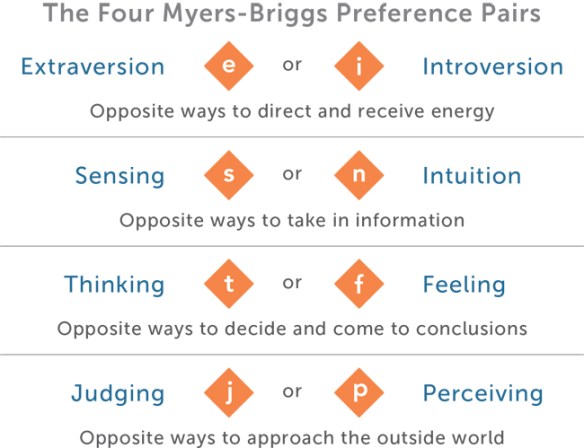
I first came across the Myers-Briggs Type Inventory (MBTI) around 30 years ago. The MBTI was developed by Isabel Myers, a layman, and her mother Katherine Briggs, around the middle of the twentieth century.  They developed a questionnaire  that classified people into 16 types based on Carl Jung’s theory of psychological types, along with their own considerable experience of observing people in action, and some inspirational speculation. Jung’s theory was based on differences in the way that we prefer to use our mental capacities to function in the world – and Myers and Briggs simplified this to identify four dimensions of functioning preferences.  Their questionnaire and most others classify people’s preferences on these four dimensions and assign a letter based to each dimension based on which side of the middle-point you fall. The combinations of these letters result in 16 so-called “personality types”.

The Myers-Briggs Type Inventory (MBTI) has become extremely popular and is a very widely used tool in management training. There are many variants of the questionnaire and of the type classification available for free online, as well as copyrighted versions used by management training companies and others.  It is estimated that since the 1960s, when the test began to be rolled out across the corporate world, more than 50 million people around the world are estimated to have taken it (A).

There are many free online variants of the MBTI, of varying quality. I give links to several that I have found useful.

Continue reading

Skiing from Switzerland to France and back

I have recently been cleaning up old external drives that I’ve used over the years for backups and found a folder of photographs from a 2003 ski trip to Champèry. Champéry lies in a side valley of the Rhone valley under the Dents du Midi (“Teeth of Midday”) mountain range. Some of the photos really capture the beauty of skiing in this region, which is part of the Portes du Soleil (The Doors of the Sun). So I decided to put them up in this post. The Portes du Soleil is one of Europe’s two largest ski areas, around 1000 square kilometres, with 13 interconnected ski resorts and around 650 km of marked pistes, and includes Les Gets where we skied in February this year.

Looking down towards Champéry lying under the Dents du Midi on the other side of the valley

Continuing to head upwards from where the above photo was taken will bring you to the ridgeline which marks the Swiss border with France. Later in the day I skied down the other side into France and ended up in the Morzine valley, where I caught a chairlift back up to the top.

Continue reading

Méribel mountain views

Some photos of the French Alps from the Saulire on the mountain ridge between Méribel and Courcheval. The Saulire is at 2738m and has spectacular views of the surrounding mountains, including Mont Blanc in the distance 63 km away. And then a thousand metre descent which made for great skiiing.

Looking west over the Méribel valley towards Val Torens

Continue reading