Return to Gran Paradiso

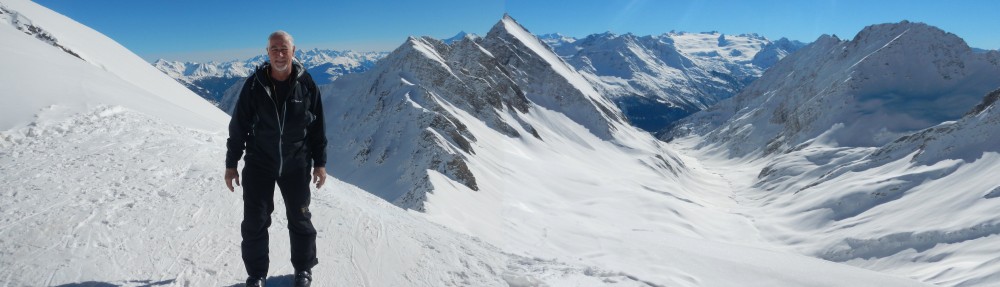
In July 2010, a friend and I set out to climb Gran Paradiso as a training climb before attempting Mont Blanc. Gran Paradiso is the only 4,000 metre peak that is entirely within Italian territory. The Italian-French border runs along the Alps and over the Mont Blanc summit, so there are a number of higher mountains “in Italy”. Unfortunately, my friend had some altitude sickness at around 3,700 metres and, on the advice of our guide, we turned and headed back down. So in the summer of 2014, I decided to complete the climb. Here is a photo, taken from the internet, of the summit ridge of Gran Paradiso (4,061m) in fine weather.

Gran Paradiso summit ridge (4061m)

Gran Paradiso summit ridge (4061m)
Continue reading

My first 4000m peak in the Swiss Alps

On the summit of Weissmeis, my first 4000 m peak in the Swiss Alps.

On the summit of Weissmeis, my first 4000 m peak in the Swiss Alps.

After many years since I had last been climbing on high mountains (Mt Kenya long ago, plus some easy peaks in Britain, Norway and Italy), I decided in 2007 I should do an alpine trip seeing as I was living here in Switzerland. So I contacted a guide and he suggested we climb Weissmies. At  4023 m, Weissmeis is the western-most 4000m peak of its range near Saas Fe (not far from Zermatt).

Continue reading

Other worlds

As a teenager I was fascinated by astronomy and cosmology and read voraciously as well as spending many hours outside at night with my telescope and Norton’s Star Atlas. During my brief years as a physicist in the 1970s, I kept up with the literature and was aware that some astronomers were attempting to detect planets around other stars by detecting the gravitational jiggling of the star around which the planet was orbiting. But these movements were slightly beyond detection by the technology of the day.

Headlines with messages like “First Planet Found Outside Our Solar System” appeared in newspapers dozens of times, at least twice in the New York Times, and once on the front page. But all these announcements were subsequently found to be wrong. And in one notorious incident, it was later found that the astronomer had detected not movements in stars, but movements in the telescope itself. So I was stunned to discover on reading the book “The Stardust Revolution” that new detection methods combined with space-based telescopes had resulted in the proven discovery of nearly 2000 exoplanets.

Continue reading

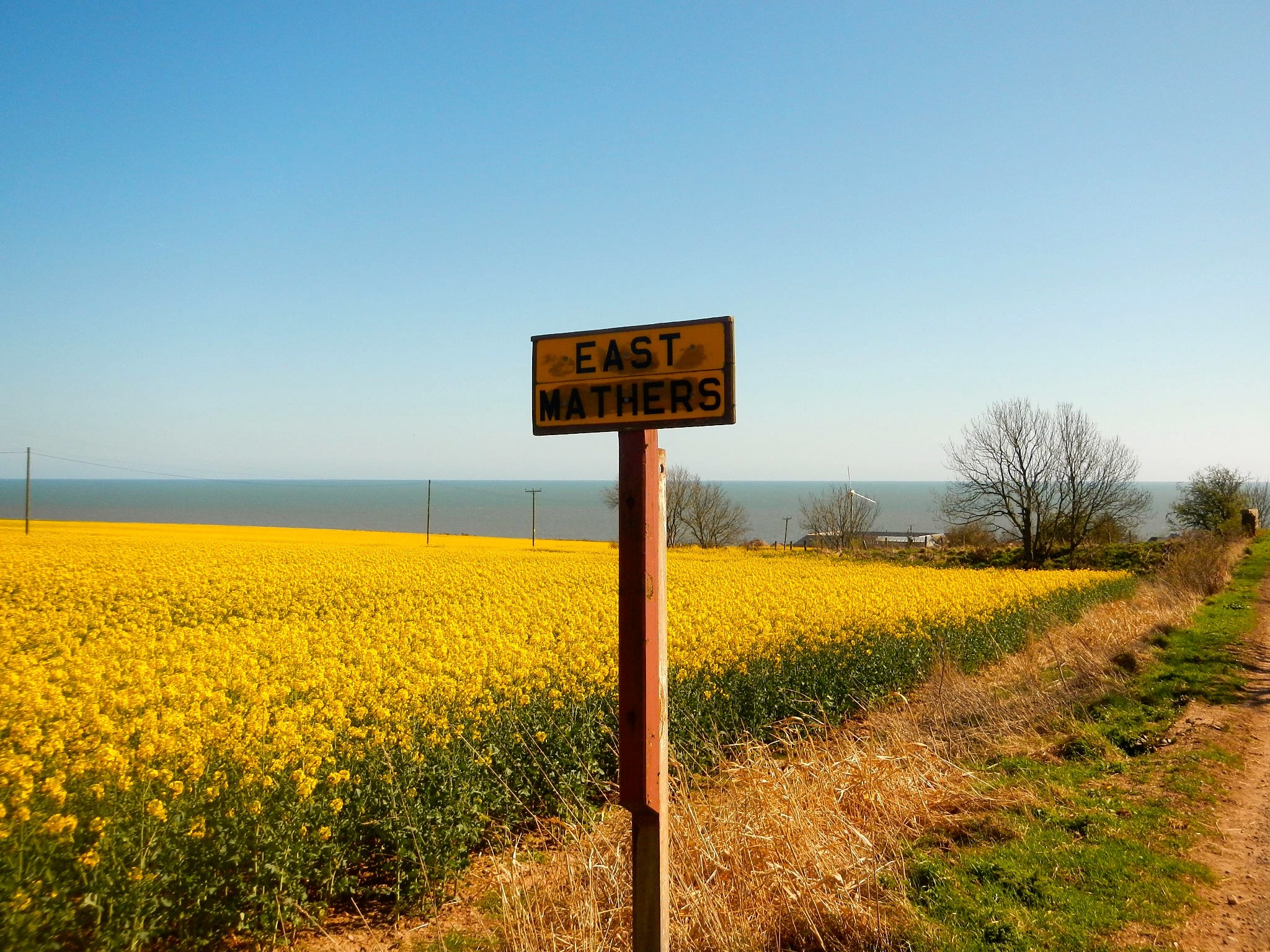
The villages of Mathers – Easter 2014

East Mathers, West Mathers and Milton of Mathers are villages just north of St Cyrus and the Kaim of Mathers (see previous post https://mountainsrivers.com/2014/05/11/a-visit-to-the-mathers-ancestral-castle-in-scotland/). St Cyrus is about 60 km north east of Dundee in Angus and about 50 km south of Aberdeen. St Cyrus lies between the mouths of the South and North Esk Rivers, and developed at a natural harbour that traded in skins, hides and cured salmon in medieval times. It is about 50 km south of Aberdeen. The cliffs and dunes provide a nationally important habitat for flowering plants and insects, and a breeding ground for tern and have been declared a National Nature Reserve.

Continue reading

A visit to the Mathers ancestral castle in Scotland

According to some researchers, the Scottish name Mathers originates from a place name on the east coast of Scotland, a place name associated with the Clan Barclay. The Barclay lairds of Mathers took the title “laird of Mathers” or equivalently “Second of Mathers” etc, and some Mathers claim that this is the origin of the Mathers surname, and by implication, that the Mathers descend from the early Barclays of Mathers. There are certainly quite a number of people called Mathers who lived in this area in the nineteenth century, but its more than likely that they took their name from the place rather than by descent from the Barclays. But I won’t let that stop me from claiming a cannibal laird as an ancestor – see my earlier post https://mountainsrivers.com/2014/01/20/my-cannibal-ancestors/

Heading towards the village of East Mathers on the east coast of Scotland

Heading towards the village of East Mathers on the east coast of Scotland

Continue reading

Cashews

I think cashews have been scientifically proven to be the most addictive substance on earth. I tried to find the studies that must have been published on this hidden epidemic, but instead I found this:

cashews are in the same plant family as poison oak (the sumac family) — that’s why you never see them in shells, handling them would be a bad thing for anyone sensitive to sumacs. You may also have heard of “mango mouth,” a rash that results from contact with mango skin — another member of the sumac family.
I’ve not heard of the sumac connection causing anyone problems from consuming cashews or mangos, but I get poison oak very easily and have been the victim of mango mouth myself, so I stay away from cashews for the most part on general principals.

I was bemused to read this. I have a cashew addiction and my mum had a mango addiction…..until the day she ate a whole box of mangos in one sitting. She developed an allergic reaction to mangos that was so strong she would swell up if she just walked into a room containing a mango.

I checked in Wikipedia and indeed the cashew, mango, poison ivy and pistachios are all members of the same plant family and mango and poison ivy share a common chemical irritant.

Spring skiing at Verbier

Last weekend of March, temperatures definitely spring-like in the valley, around 20 C.  Headed up to Verbier with the boys for some spring skiing. Verbier is one of the higher ski areas, the highest point is Mont Fort at 3300 m, from which it is 1800 vertical descent to Verbier village.

Two boys on the piste at around 2500 m.

Two boys on the piste at around 2500 m.

Continue reading