Watching all 23 Marvel Cinematic Universe movies in timeline order

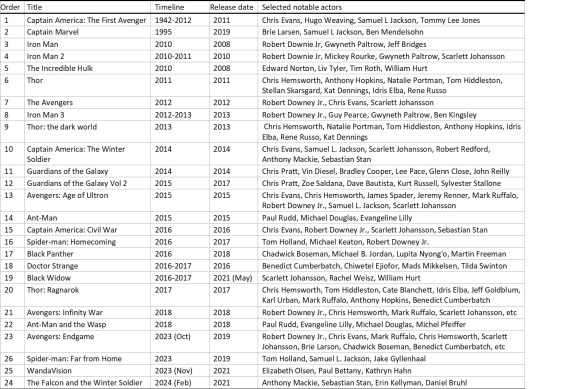
My sons have been fans of the Marvel superhero movies for most of their lives and insisted I watch Marvel’s latest offering, WandaVision, a nine part TV series released weekly on Disney+ from January15th to March 5th this year.  When we got past the first two episodes, I was hooked. But the boys needed to explain quite a few of the characters and Easter Eggs to me and I realized my knowledge of the Marvel Cinematic Universe (MCU) was quite inadequate.

In just over eleven years since Iron Man was released in 2008, Marvel has released 23 movies that are all part of the same universe, the MCU. I saw quite a few of these in cinemas when first released or later on TV, but not all of them. So I decided to watch all 23 in timeline order, the order in which their events occurred in the MCU. WandaVision and the currently running Disney+ series The Falcon and the Winter Soldier are also part of the MCU, as is Black Widow due to be released in May. but I restricted my timeline viewing to the 23 movies in the following Table that were released before this year.

Continue reading

Psychedelics and the health risks of drugs, alcohol and tobacco

In the last decade or so, there has been a renaissance of interest in the therapeutic potential of psychedelics. While natural psychedelic substances have been used by humans for many thousands of years, psychedelics had a massive cultural impact on the West in the 1950s and 1960s. Albert Hoffman, a research scientist working for the Swiss pharmaceutical company Sandoz, accidentally invented LSD (lysergic acid diethylamide) in 1938 and discovered its psychedelic properties five years later. In 1955, a New York banker named Gordon Wasson sampled the psilocybe (magic) mushroom in Mexico and published an article on his experience in Life magazine.

Scientists discovered the role of neurotransmitters in the brain in the 1950s, and psychedelics inspired scientists to search for the neurochemical origins of mental disorders previously thought to be psychological. Psychedelics were also used in psychotherapy to treat various disorders, including alcoholism, anxiety and depression, with some promising results, although these studies generally did not reach modern standards of research design.

However, psychedelics were also embraced by the counterculture and became linked in the mind of authorities with youth counterculture and the anti-Vietnam war protests. By the end of the 1960s, most Western governments had outlawed and forced underground the psychedelic drugs which had been legal in most places previously, and also shut down all scientific research.

In the 1990s small groups of scientists managed to start conducting various trials of the therapeutic uses of psychedelics and this has led to the so-called psychedelic “renaissance” in which larger well-designed trials of psychedelic use for treating a range of mental disorders are being carried out by research groups at institutions such as Imperial College London, Johns Hopkins University and New York University. Just today, it was announced that the Australian government will be providing $15 million funding for clinical trials into the use of psilocybin and other psychedelics for the treatment of mental illnesses, including depression and PTSD. Michael Pollan’s book How to Change Your Mind gives an excellent account of the history of psychedelics, both above ground and underground, and the psychedelic renaissance, and was a best seller. See also this article by Michael Pollan on the “Psychedelic Renaissance”.

As part of my work on the global burden of disease for the World Health Organization (WHO), I carried out several assessments of the direct and indirect health impacts of the use of drugs, alcohol and tobacco. I recently did an approximate update to year 2019 for deaths directly due to drug use disorders (overdoses and directly toxic effects) and indirect deaths from road injury, suicide and infectious diseases attributable to drug use. A proportion of HIV, hepatitis B and hepatitis C deaths can be attributed to injecting drug use with contaminated needles. The great majority of direct and indirect deaths due to drug use are due to the use of opioids, both illicit and pharmaceutical opioids. Very few deaths are associated with psychedelic drug use, but I was curious to get a ballpark estimate for comparison with other drug deaths. I will present a brief summary of the broad estimates of drug-attributable deaths, then review evidence on the likely contribution of psychedelic drugs.

Continue reading

Looking back on 34 years in the martial arts

As a student at the University of Sydney in the early 1970s, I became interested in Zen Buddhism through the writings of Alan Watts and others, but the concept of actual “practice” was completely foreign to me. Then I picked up a second-hand copy of Zen Combat by Jay Gluck (Ballantine 1962) and was absolutely fascinated by its survey of Japanese martial arts and the role of Zen in them. Bruce Lee also sparked a huge surge of Western interest in the Asian martial arts with his 1973 film Enter the Dragon.  The idea of practicing a martial art was something I could relate to, and in 1974 I enrolled in a lunch-time karate class at the University during my 4th year Physics Honors Year. I was so enthusiastic about karate that I remember being puzzled why others were not joining once they knew about the availability of classes. Over the next two or three years I trained in several karate styles including Goju Ryu, Dioshin Lyanbukan and Kei Shin Kan.
Continue reading

Revisiting The Hobbit movie (yes – as one movie not three)

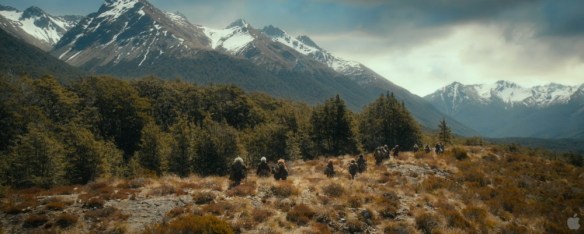
Having recently re-read The Lord of the Rings trilogy (see my earlier post) and realizing that Peter Jackson had changed more in the movie versions than I had realized, I decided to rewatch the three Lord of the Rings (LOTR) movies for the third time, but this time in the Extended Edition, which I’ve never seen. I purchased a copy of that, which has just arrived. But I have been pondering whether to watch the Hobbit movies before watching LOTR.  I really disliked Peter Jackson’s padding out the story with made-up elements that were not in the book, and spinning it out to three overblown movies. There were some aspects I enjoyed, but I just could not bring myself to watch them again, let alone in the extended editions.

Then I stumbled across a “fan edit” of the Hobbit movies to make a single movie (of length just under 4 hours) which is reasonable faithful to the book, removes excess material and the more ridiculous action sequences. This fan edit, called “The Hobbit – The Cardinal Cut” is described here and can be downloaded or watched on Youtube.

Continue reading

My paternal ancestors’ European journey – from the Caspian Steppes to Celtiberia

In a previous post, I used an analysis of my Y chromosome DNA to trace the journey of my paternal ancestors from Y-chromosomal Adam, who lived in West Africa around 275,000 years ago (275 kya), to the founder of the R1b sub-haplogroup R-L23, who was born on the Caspian around 4,400 BC (6.4 kya). In this post, I continue my paternal ancestral journey to the most recently identified haplogroup founder: a Celtiberian living in what is now Portugal around 510 BCE. The sequence of Y SNPs defining my haplotree are shown in the following map. It summarizes this journey from R-L23 (4,400 BCE) to the most recent haplogroup founder (510 BCE), and continues on from the map published in the previous post.

There is an immense amount of recent research on European Bronze Age genetics and migrations and a very considerable unfinished debate on how to interpret the evidence. New evidence is being published almost weekly, as increasing numbers of ancient European remains are analysed and Y haplogroup identified. So this post will only aim to describe the big picture as best I can summarize it, and details and perhaps even some of the big picture will likely change in the future.

Continue reading

How long ago were the events of The Lord of the Rings?

As I discussed in my previous post, Tolkien set out to create a mythology for the English in the Lord of the Rings (LOTR), the Silmarillion and related writings on Middle-earth. He presented himself not as the author of LOTR, but as the translator of various histories written by Bilbo, Frodo and others in the Third and Fourth Age of Middle-earth. This makes Tolkien quite unusual among modern writers of fantasy in presenting it as set in the real worlc albeit in an imagined prehistory. What happened in that period before the Earth’s actual recorded history is otherwise remembered down through the generations as folk myths and legends, especially among the Old English. Tolkien’s life work was an attempt to reconstruct our prehistory, and more specifically the prehistory of the English. Critics Lee and Solopova commented that “Only by understanding this can we fully realize the true scale of his project and comprehend how enormous his achievement was” [1].

Tolkien described the region in which the Hobbits lived as “the North-West of the Old World, east of the Sea” in LOTR, ie. essentially Europe (including Britain). However, as he noted in a letter [2], the geographies do not match, and he did not consciously make them match when he was writing. In another letter [3] he became much more specific, saying “If Hobbiton and Rivendell are taken (as intended) to be at about the latitude of Oxford, then Minas Tirith, 600 miles south, is at about the latitude of Florence. The Mouths of Anduin and the ancient city of Pelargir are at about the latitude of ancient Troy.” In the Prologue to LOTR, Tolkien also notes that “Those days, the Third Age of Middle-earth, are now long past, and the shape of all lands has been changed…”

Fascinated by the detailed chronologies and calendars set out in the Appendices to LOTR and elsewhere, I have naturally wondered how long ago from now the events of LOTR took place. About 15 years ago, I came across an article in the Journal of the Tolkien Society [4¡ which deduced that the Fourth Age began on Wednesday 18 March 3,102 BCE.  The events of LOTR took place during the preceding year.  Despite the bizarre exactness of this, I was quite impressed by the argument, which I summarize here briefly.

Continue reading

On re-reading the Lord of the Rings 50 years later

My first encounter with Middle Earth was when I came across The Hobbit in my first year of high school. The Hobbit gave me the same sense of the numinous and of “Northerness” as earlier had C.S. Lewis’s Chronicles of Narnia. I had borrowed it from the local library, did not remember the name of the author and only several years later as a teenager did I discover the Lord of the Rings (LOTR).  It was originally published in three volumes in 1954 and 1955, 18 years after the Hobbit was published in 1937. The Lord of the Rings became immensely popular in the 1960s with the publication of the Ballantine paperback editions, and in North America, the publication of the Ace pirated edition.  I first read it in 1969, when I purchased the 1968 first edition of the George Allen and Unwin one volume paperback with cover illustrations by Pauline Baynes:

Continue reading

New Year skiing in the Swiss Alps

Switzerland has kept its ski resorts open while all neighbouring countries closed. Hardly surprising that 4,200 British skiers turned up for the Christmas-New Year period just after the new faster spreading covid-19 virus took British new cases through the roof at exponential speed. The Swiss then imposed a retrospective quarantine on the British visitors after they arrived, and almost all of them snuck out during the night and left. Left a lot of anti-British feeling behind.

I and my boys are of like mind that it would be madness to go to one of the major resorts like Verbier, where many British go. Likely the people there are now incubating new infections. But my neighbours packed their car and head up to Verbier today, confident the virus left with the British. I’ve spent a number of New Years at Verbier, particularly back in the noughties (2000-2009) during part of which I rented a studio apartment in Verbier so I could go up for weekends and longer holidays whenever I wanted. Here are some photos from those days.

Two parapenters fly above the mountains at Verbier

View from the top of Mont Fort (3330 m). The three peaks on the horizon from l.to.r are Dent Blanche (4356 m), Matterhorn (4478 m in niddle) and Dent d’Hérens (4171 m)

Continue reading

The Indian Transmission of Zen Buddhism

A previous post examined the Zen tradition of “lineages” of teachers transmitting enlightenment person-to-person and documented the lineages of my Zen teachers down from Bodhidharma, the first Patriarch of Chinese Ch’an (Zen).  In this post, I examine the Zen tradition of an Indian lineage which reaches back from Bodhidharma through 27 ancestors to the the historical Buddha, Shakyamuni. Shakyamuni Buddha’s birth and death dates are somewhat contested, but 563-483 BCE seem to be the most generally accepted dates.

Continue reading

Christmas skiing in the Swiss Alps

Switzerland has angered neighboring countries by keeping the ski slopes open this winter, despite the risks associated with skiing and the coronavirus pandemic. However, national and cantonal restrictions apply, and Les Portes du Soleil where the boys and I have often skied has set a quota for the numbers of skiers allowed on the slopes. I’ve decided to avoid the ski resorts this winter, at least until the covid situation improves or we have been vaccinated.

Its snowing here on Christmas Day in Geneva, though not quite enough to ski on. I’ve  been skiing around the Christmas-New Year period quite a few of the years I’ve been in Geneva. Here are a few photos from two Christmas’s spent at Arosa in northeast Switzerland in 2001, 2005 and 2007. Good times.

Below left: looking down the Hörnli Express to the village of Arosa. Right: Hörnli 2511m.


Enjoying the winter sun on the piste in December 2001

Lamp post in the forest near our hotel. I think I must have gone out through the wardrobe.

View from the summit of Weisshorn (2653 m).

Continue reading