Myers-Briggs Personality Types

The US housewife and writer Katharine Cook Briggs with her daughter Isabel, the eventual creator of the test, c1905

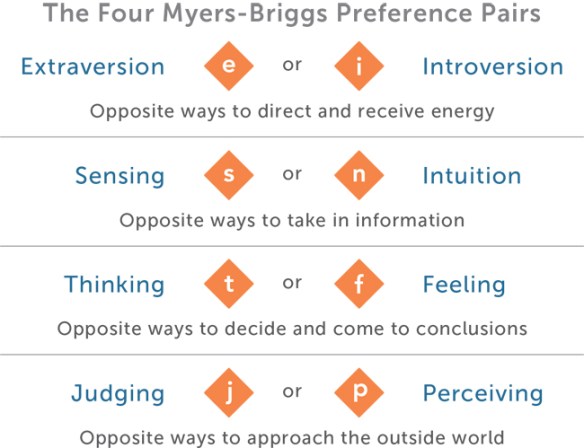
I first came across the Myers-Briggs Type Inventory (MBTI) around 30 years ago. The MBTI was developed by Isabel Myers, a layman, and her mother Katherine Briggs, around the middle of the twentieth century.  They developed a questionnaire  that classified people into 16 types based on Carl Jung’s theory of psychological types, along with their own considerable experience of observing people in action, and some inspirational speculation. Jung’s theory was based on differences in the way that we prefer to use our mental capacities to function in the world – and Myers and Briggs simplified this to identify four dimensions of functioning preferences.  Their questionnaire and most others classify people’s preferences on these four dimensions and assign a letter based to each dimension based on which side of the middle-point you fall. The combinations of these letters result in 16 so-called “personality types”.

The Myers-Briggs Type Inventory (MBTI) has become extremely popular and is a very widely used tool in management training. There are many variants of the questionnaire and of the type classification available for free online, as well as copyrighted versions used by management training companies and others.  It is estimated that since the 1960s, when the test began to be rolled out across the corporate world, more than 50 million people around the world are estimated to have taken it (A).

There are many free online variants of the MBTI, of varying quality. I give links to several that I have found useful.

Continue reading

12 Rules for Life (part 2)

This is the second half of my review of “12 Rules for Life” by Jordan Peterson, the controversial Canadian psychologist who has become an internet sensation.  The first half of my review can be found at 12-rules-for-life-jordan-peterson

Rule 7. Pursue what is meaningful (not what is expedient).

Peterson again turns to the Old Testament to the story of Paradise and the Fall as a guide to Being and right action. He prefaced this with a quite good explanation of how myths and legends encode guidance on Being, action and meaning based on human experience and behaviours that have evolved over a long period of time. But why he thinks Bronze Age myths are still our best source of understanding of these things, and ignores the important evolution of human societies and understanding in recent centuries, I don’t know.

Continue reading

Avengers: Endgame

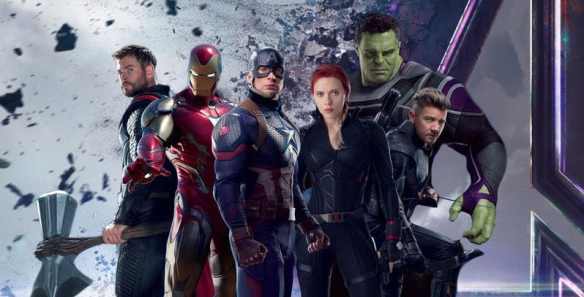
I took my younger son to see Avengers: Endgame on the big IMAX 3D screen the day after it was released. The theatre was almost full, unusual for Geneva. My older son went later in the evening, and he and his friends got the last remaining seats in row A, only two or three metres from the screen.  He claims he enjoyed it and didn’t really notice he was almost in the action.

The movie is long at three hours, but we didn’t notice the passing of time. Lots of emotional scenes, if anything a bit overdone for my taste. But still satisfying, and overall, the movie certainly wraps up the entire arc of the Avengers cycle of movies in a deeply satisfying way. There are lots of good reviews out there and I won’t try to cover the same ground. Rotten Tomatoes has quite a few critics reviews and the Tomatometer has a score of 95% and audience score of 91%. IMDB has a rating of 9 out of 10.

Continue reading

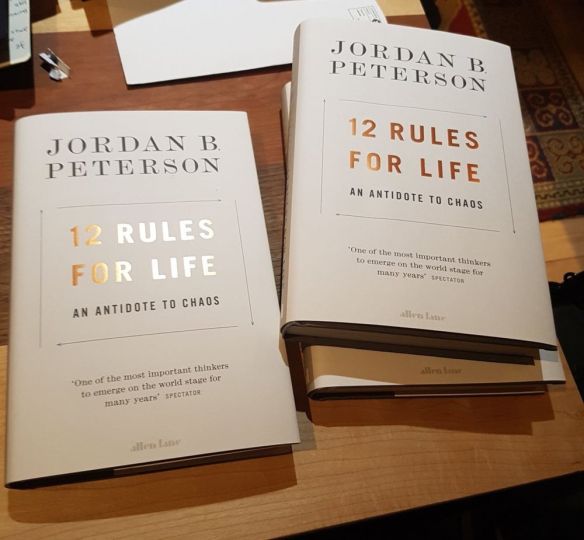
12 Rules for Life – Jordan Peterson (part 1)

In the wake of the New Zealand mosque shootings, one major New Zealand bookshop, Whitcoulls, apparently removed Jordan Peterson’s “12 Rules for Life” from its shelves. This was reported in a range of print and online media, particularly various right-wing sites. For example, the New Zealand Herald on  March, commented in an article mainly about the many positive responses to the massacre that “Contributions to our national wellbeing such as Whitcoulls’ removal of Canadian psychologist Jordan Peterson’s book 12 Rules for Life from its shelves, while Hitler’s Mein Kampf remains on sale, and shutting down debate on the UN’s Immigration Pact are tokenism, and misguided to boot.”

I checked six large New Zealand bookstores (either big chains or online) and indeed Whitcoulls is the only one which does not have 12 Rules for Life available for sale. It does have Mein Kampf, and the Collected Writings of Chairman Mao, as well as some other writings by Peterson. Earlier in February this year, a group called Auckland Peace Action, objected to Peterson’s planned visit to New Zealand, with a “press release” claiming that “Jordan Peterson Threatens Everything of Value in Our Society.”

If you are not aware, Jordan Peterson has become an internet phenomenon, with a massive following, particularly among young men, and there are lots of negative reactions to him from journalists and other commentators. My teenage son has been reading Jordan Peterson’s 12 Rules and also watching various videos of Peterson interviews and lectures, and gave me a copy of “12 Rules for Life” for my birthday. So I am going to read it with interest, to see whether it does indeed threaten everything of value in our society, or should be banned as “extremely disturbing material”. As I make my way through the book, I will add review comments to this blog post, starting with the Introduction below.

s-l1000


Continue reading

Coming unstuck on a free solo

This is my last free solo story. Engraved in my memory like it was yesterday, though I am not sure what year it happened. Was around 1975 I think, though possibly a bit later. In those days, I was hanging around with a bunch of rock climbers and following them up easier climbs. I didn’t think of myself as a rock climber though, because I was content to follow as a second, belaying the lead climber leading the pitches. I occasionally led a pitch if I felt comfortable, particularly if it was a chimney or a good solid crack where I felt pretty comfortable that I could glue myself to the rock. Much less so on slabs where it was all about balance and using friction on tiny ledges and bumps in the rock.

Climbers on Hermes, Booroomba, ACT.

This particular trip was to Booroomba Rocks, not far to the south of Canberra.This has spectacular climbs on granite, and the main cliff line is up to 140 metres high.The photo above shows two friends climbing Hermes (Grade 16, 50 m high), one is visible climbing the crack in the middle of the photo and the other is belaying from a ledge below him. The climb continues up the crack just in the shadow and then towards the right under a big overhang .Someone died around 1971 attempting to free solo Hermes, He fell from near the overhang.

We camped in the valley below the cliffs and walked up to do various climbs. It may have been the trip on which the photo below was taken in 1975.One of the climbers decided to spend a few hours scrambling around on a lower cliff line doing some unroped free climbing. I foolishly decided to go with him.
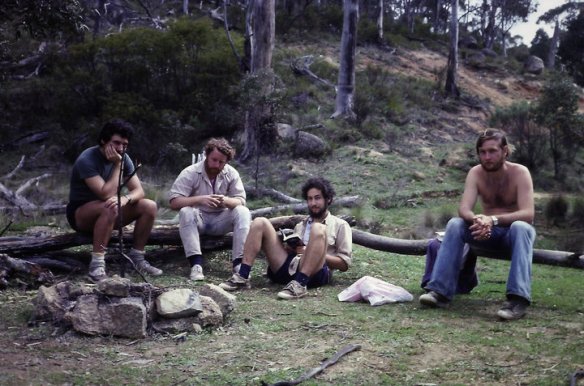
Myself (middle holding book) with friends at Booroomba, 1975

Initially, we were doing little more than scrambling up some steep gullies and small easy climbs. Then we came to a larger face that was probably about 20 metres high with a well defined crack running up it. My friend assured me that it was a very easy climb and within my capabilities, so I followed him up the crack. However, the crack ended a few metres below the top of cliff, and the final stretch was on close to vertical rock with small holds. My friend was just above me, and we were climbing together. I moved up onto the small holds, and realized that I had got out of my depth and  no longer had the strength in my fingers to continue up the last couple of metres, and no possibility to retreat either as my strength was going. So I told my friend and said to him that I was going to come off the wall in the next 30 seconds. He said to hold on, and he moved up a few inches and grabbed a small tree trunk at the top of the cliffline with both hands, and then said “Grab hold of my ankles”. At that moment, I lost my grip on the small holds I had and as I came off the cliff I grabbed his ankles with both hands and swung free below him. I was probaby close to 20 metres from the base of the climb and would have probably died if I fell.  I climbed up his body and over the cliff edge. If this had happened even a metre lower on the climb, where my friend would have had no strong holds to use, I would have fallen. Utter stupidity on my part to attempt to free solo a climb of that height without ever having done it before to know what it involved. One of a few occasions  around that period of my life where pure chance saved me from my own risk taking. In retrospect, I was incredibly lucky.

A “free solo” ascent of Federation Peak

Seeing Free Solo (mountainsrivers.com/free-solo-inspiring-and-disturbing/) reminded me of my “free solo” on Federation Peak years ago. Barely a rock climb, but the exposure was similar to that on El Cap. In Dec 1980- Jan1981, I did a three week traverse of the Eastern and Western Arthur Range in southern Tasmania with my then wife. One of our objectives was to climb Federation Peak (1,224 metres or 4,016 ft), whose spectacular summit rises like a spike in the middle of the Eastern Arthur Range (see photo below).

Looking towards Federation Peak from the Four Peaks.

Continue reading

Free Solo – inspiring and disturbing

Last week I took my boys to see Free Solo. In case you haven’t heard of it, it is a documentary about Alex Honnold’s attempt to become the first person to climb the 3000 foot cliff of El Capitan without any ropes or other protective equipment. One slip or missed hold and he would die. The documentary not only looks at Honnold the climber, his mindset and attitudes, his preparations and the actual climb itself, but also has two other main threads, the process of filming the feat and the moral dilemmas the filmmakers faced, and the very substantial stresses his loved ones have to deal with.

Alex Honnold free soloing El Capitan. Photo credit: National Geographic documentary Free Solo.

I had actually put the DVD in my shopping trolley at Amazon because it did not seem to be screening anywhere in Geneva, when a friend let me know there was a one night showing at Pathe Balexert. So I deleted my draft purchase and took the boys to see it. If you have a chance to see it, I highly recommend it. It is a gripping account of one of the greatest athletic feats of all time, but is also very thought-provoking. It won an Oscar this year for Best Documentary, and has a critics rating of 99% on Rotten Tomatoes.

Continue reading

A sunny day skiing at Verbier

After the day of reasonably heavy snow in Geneva last week, I decided to head up to Verbier to take advantage of the new snow. Verbier is a bit under two hours drive from Geneva and has spectacular scenery and skiing.  In the first few years I was in Geneva, Verbier was my regular ski destination, and for a couple of years I rented a small studio apartment there so I could go up for weekends and longer periods when possible.

From Lausanne onwards, the ground in the Rhone Valley was completely covered in snow, and the trees and mountains were all dusted with fresh powder. I parked in the valley below Verbier and caught the cable car up past Verbier to the mid-level pistes.

Heading up in the cable car

Verbier is part of the “Four Valleys” (“4 Vallées”) ski area, which is the biggest ski domain in Switzerland with extensive off-piste and back country routes.

Grand Combin (4314 m)

Continue reading

Skiing from Switzerland to France and back

I have recently been cleaning up old external drives that I’ve used over the years for backups and found a folder of photographs from a 2003 ski trip to Champèry. Champéry lies in a side valley of the Rhone valley under the Dents du Midi (“Teeth of Midday”) mountain range. Some of the photos really capture the beauty of skiing in this region, which is part of the Portes du Soleil (The Doors of the Sun). So I decided to put them up in this post. The Portes du Soleil is one of Europe’s two largest ski areas, around 1000 square kilometres, with 13 interconnected ski resorts and around 650 km of marked pistes, and includes Les Gets where we skied in February this year.

Looking down towards Champéry lying under the Dents du Midi on the other side of the valley

Continuing to head upwards from where the above photo was taken will bring you to the ridgeline which marks the Swiss border with France. Later in the day I skied down the other side into France and ended up in the Morzine valley, where I caught a chairlift back up to the top.

Continue reading