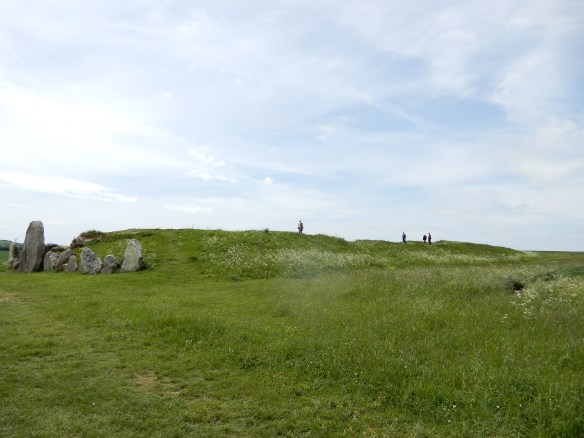
Wayland’s Smithy

After walking from the White Horse across Uffington Castle perched on the hilltop (see previous post  Iron Age hillforts), I walked for about a kilometre to join the Ridgeway track that leads across the Wessex Downs in southern England. I followed this west for about a mile to another Neolithic chambered long barrow known as Wayland’s Smithy. The Smithy is about 100 metres off the Ridgeway nestled in a grove of trees.

The ancient Ridgeway track

Some forest near the Ridgeway

The first version of the barrow was built between 3,590 and 3,555 BC. It was 20m long and the remains of 14 people were buried here in a stone and timber box over a period of less than 15 years. Between 3,460 and 3,400 BC a second larger barrow 56m in length with a stone chamber was constructed over it, and the chambers contained the jumbled remains of several people.
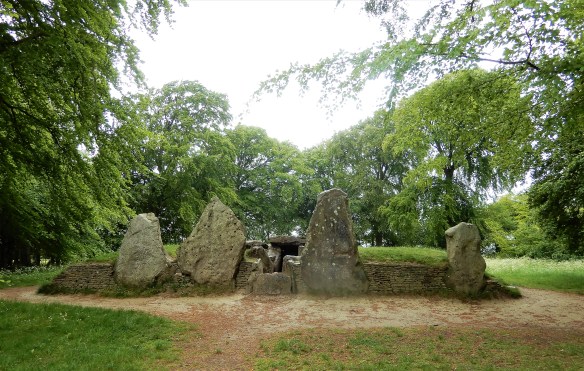
Wayland’s Smithy

Continue reading

There were fortresses on the heights

“They heard of the Great Barrows, and the green mounds, and the stone-rings upon the hills and in the hollows among the hills. Sheep were bleating in flocks. Green walls and white walls rose. There were fortresses on the heights.” [1]

As well as the barrows and stone-circles of my two previous posts, the Wessex Downs have quite a large number of Iron Age fortresses on the hilltops. The closest of these to Avebury, and the first I visited was Barbury Castle, a few miles south of Swindon.

Barbury Castle

Barbury Castle is perhaps the most remarkable of the Ridgeway hill forts. It’s on the edge of the Marlborough Downs with views in all directions, on the Ridgeway, and it’s huge! It is defined by a broadly elliptical double rampart with a ditch in between, which even after two millennia of erosion, remains quite steep and imposing. The fort was built in the 6th century BC as a refuge against warring tribes. At times of attack, people would bring their animals and shelter in huts inside the 12 acre enclosure. The outer bank was reinforced by huge sarsen stones and the inner bank was topped by chalk blocks and a continuous wooden fence.

The fortress is clearly visible in this satellite photo, taken from Google Earth Pro, and also just outside the western entrance can be seen a round barrow which dates from 1,700 BC.

Barbury Castle  (Google Earth Pro)

Continue reading

The Avebury megalithic stone circles

While in Wiltshire earlier this month, I stayed in the village of Avebury, which lies within the world’s largest megalithic stone circle, and is about a mile north of Silbury Hill (see previous post at Exploring-the-barrow-downs-of-wessex

Constructed over several hundred years during the Neolithic period from around 3,000 BC to 2,600 BC, a large henge (a bank and a ditch) with a large outer stone circle encircles part of Avebury village. Two separate smaller stone circles are located closer to the centre of the henge.

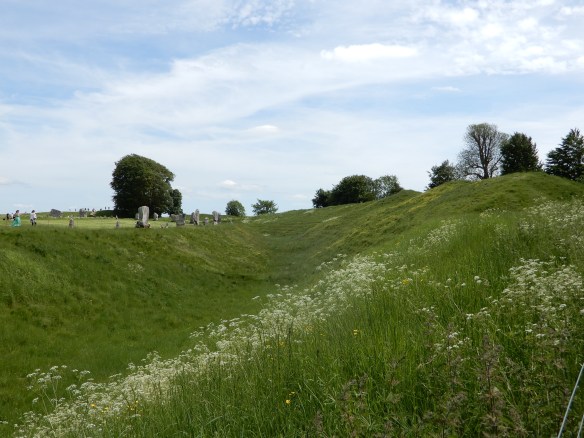
The ditch and mound surrounding the Avebury outer stone circle

The outer stone circle is 332 metres in diameter with a circumference just over 1,000 metres and encloses two smaller stone circles near its centre.[1] The available evidence suggests that in the early Neolithic, Avebury and the surrounding hills were covered in dense oak woodland, and as the Neolithic progressed, the woodland around Avebury and the nearby monuments receded and was replaced by grassland.

Continue reading

Exploring the Barrow Downs of Wessex

I recently had an opportunity to spend a weekend exploring Neolithic, Bronze Age and Iron Age sites on the Wessex Downs. Britain’s “oldest road”, the Ridgeway, runs 87 miles (137 kilometres) across the Wessex Downs eastward to the Berkshire Downs and the River Thames. It has been in use for over 5,000 years and I briefly visited it over 30 years ago.

West Kennet Long Barrow, an early Neolithic grave.

West Kennet Long Barrow

At the western end of the Ridgeway, a couple of miles from Avebury, I visited West Kennet Long Barrow which was built during the early Neolithic period around 3,650 BC. There are five stone burial chambers in the eastern end, and at least 46 people were buried here over a 1,000 year period. The entrance consists of a concave forecourt with a facade made from large slabs of sarsen stones which were placed to seal entry towards the end of its life.

Large sarsen stones guard the entrance to the Barrow

Continue reading

Nine Stanes, Eslie the Greater and Eslie the Lessor

I have had a longstanding interest in megalithic monuments since I was a teenager. In part sparked by my interest in astronomy as a teenager, since the megalithic monuments of Europe show that Neolithic humans had sophisticated astronomical skills. And in part, by my interest in deep ancestry (see previous post https://mountainsrivers.com/2014/03/11/maternal-ancestors-bronze-age-iron-age-roman-britain/). And also by their connection with the barrowdowns of Middle Earth. On my first extended trip to Britain, I visited various megalithic stone circles in England and explored the barrows around the Ridgeway near Oxford.

So on my trip to Eastern Scotland last Easter, I took a look on the internet to see whether there were any megalithic monuments within an easy drive from the area I was staying in near the villages of Mathers (https://mountainsrivers.com/2014/05/20/the-villages-of-mathers-easter-2014/). And discovered there were three stone circles about 45 km north-west of St Cyrus where I was staying. Continue reading

Maternal ancestors: Bronze age, iron age, Roman Britain

This post has been superceded by a new post my-maternal-ancestors-from-eve-via-ice-age-europe-to-victorian-england which contains latest information from a recent more detailed analysis of my mtDNA together with revised and updated dates and locations of haplogroup founders.

This is the last of a series of posts on my deep maternal ancestors, identified through analysis of mitochondrial DNA (mtDNA) which is passed only from the mother to the child and so provides a trail of maternal ancestors identifiable through the mutations accumulated in the mtDNA. In this post I summarize the “recent” maternal ancestors who lived through the beginnings of agriculture in Britain, the British bronze age, the British iron age, the Roman occupation, and post-Roman Britain.

Continue reading

The ice age paintings of the Grotte de Niaux

One of my deep maternal ancestors, Una, probably lived in the Basque region or perhaps a little further north around 12,000 years ago, which would make her my great*780th grandmother (give or take a few generations). She may well have  been part of the Magdalenian culture in the foothills of the Pyrenees who produced the stunning cave paintings at sites such as Roc-de Sers, Lascaux, and Niaux. I have visited the Grotte de Niaux twice, once in 1992 and again in 2011. It is one of the few caves with Paleolithic paintings that can still be visited.

Continue reading

Maternal ancestors: ice age Europe and Britain

This post has been superceded by a new post my-maternal-ancestors-from-eve-via-ice-age-europe-to-victorian-england which contains latest information from a recent more detailed analysis of my mtDNA together with revised and updated dates and locations of haplogroup founders.

In my previous post on my deep maternal ancestors (https://mountainsrivers.com/2014/02/16/deep-maternal-ancestors-out-of-africa-into-ice-age-europe/) I summarized the “grandmothers” who contributed specific mutations to my mtDNA that allow me to trace them (and approximately when and where they lived) all the way back  to Mitochondrial Eve, the most recent common maternal ancestor of all living humans. These women were real and specific individuals, and Sykes and others have given the older ones specific names (usually starting with the letter of the haplogroup they founded).  I have followed this by giving names to the founders of the subgroups to which I belong. In this post, I  give a brief biography of each of these ancestral grandmothers, starting with Mitochondrial Eve, placing them in evolutionary, geographic, and climatic context. Continue reading

Deep maternal ancestors: out of Africa into ice age Europe

This post has been superceded by a new post my-maternal-ancestors-from-eve-via-ice-age-europe-to-victorian-england which contains latest information from a recent more detailed analysis of my mtDNA together with revised and updated dates and locations of haplogroup founders.

I have only been able to trace my maternal ancestors back to my great-great-grandmother, Amelia Buckmaster, who was born in 1809 in Hounslow, Middlesex, England and who died in 1892 in Wallingford, Berkshire, England. I recently had my mitochondrial DNA tested (see an earlier post for more on mtDNA) and the results indicated that my mtDNA haplogroup is U. I did some research on the specific mutations identified in my mtDNA and identified my subgroup more specifically as U5a1a1.This means that I now know quite a lot about specific maternal ancestors and where and when they lived, all the way back to Mitochondrial Eve who lived in Africa 192,400 years ago.

Continue reading

Mitochrondral Eve: the deep maternal ancestor of us all

Mitochondrial Eve is the name given to the matrilineal most recent common ancestor (MRCA) of modern humans. In other words, she was the woman from whom all living humans today descend, on their mother’s side, and through the mothers of those mothers and so on, back until all lines converge on one person. Mitochondrial Eve is estimated to have lived around 192,400 years ago ago in southern Africa (which makes her approximately my great*9,650th grandmother).  Continue reading