Premodern religious values and happiness

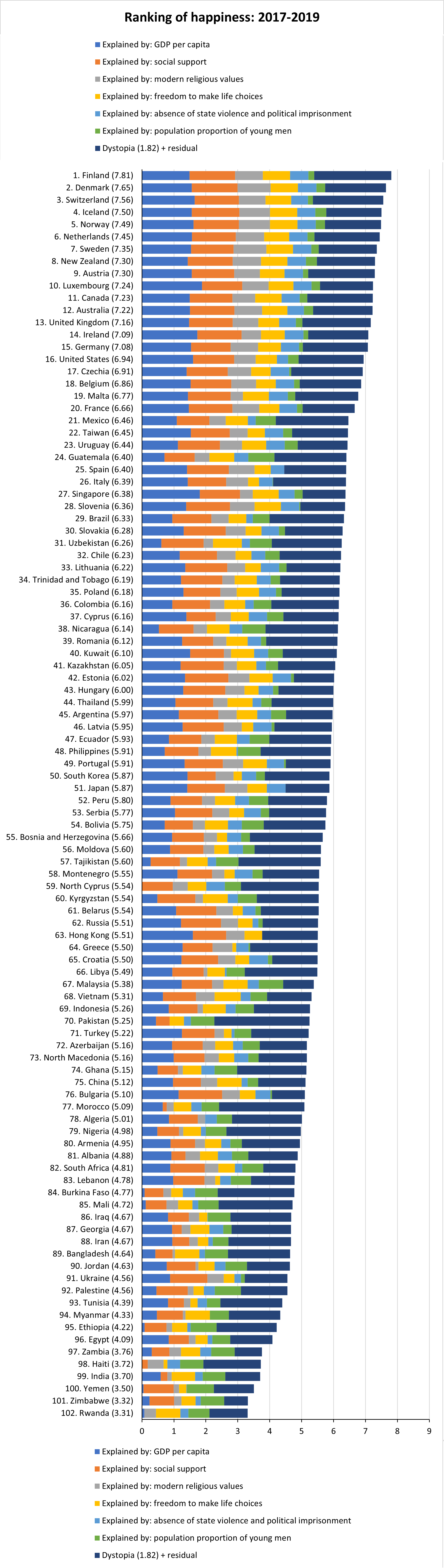
I recently came across a ranking of countries by average reported happiness. This year’s World Happiness Report, released on March 20, uses data from the Gallup World Poll to calculate average reported happiness by country for over 150 countries for years 2005 to 2020. The focus of the report is on the impact of COVID-19 on happiness in 2020 by comparison with years 2017-2019. I was interested to see to what extent modern versus premodern religious values might explain variations in happiness across countries, along with a number of other factors that were examined in the World Happiness Report. I have posted here previously on my analysis of premodern or “fundamentalist” religious values.

The main measure used for happiness in the World Happiness Report is based on the national average response to the question on life evaluation in the Gallup World Poll (GWP). The English wording of the question is  “Please imagine a ladder, with steps numbered from 0 at the bottom to 10 at the top. The top of the ladder represents the best possible life for you and the bottom of the ladder represents the worst possible life for you. On which step of the ladder would you say you personally feel you stand at this time?”

The following graph shows the happiness rankings of 101 countries for which I have both happiness measures and estimates of the modern/premodern religious values index I developed (see here). The happiness scores are averages for years 2017 to 2019.

Continue reading →

Psychedelics and the health risks of drugs, alcohol and tobacco

In the last decade or so, there has been a renaissance of interest in the therapeutic potential of psychedelics. While natural psychedelic substances have been used by humans for many thousands of years, psychedelics had a massive cultural impact on the West in the 1950s and 1960s. Albert Hoffman, a research scientist working for the Swiss pharmaceutical company Sandoz, accidentally invented LSD (lysergic acid diethylamide) in 1938 and discovered its psychedelic properties five years later. In 1955, a New York banker named Gordon Wasson sampled the psilocybe (magic) mushroom in Mexico and published an article on his experience in Life magazine.

Scientists discovered the role of neurotransmitters in the brain in the 1950s, and psychedelics inspired scientists to search for the neurochemical origins of mental disorders previously thought to be psychological. Psychedelics were also used in psychotherapy to treat various disorders, including alcoholism, anxiety and depression, with some promising results, although these studies generally did not reach modern standards of research design.

However, psychedelics were also embraced by the counterculture and became linked in the mind of authorities with youth counterculture and the anti-Vietnam war protests. By the end of the 1960s, most Western governments had outlawed and forced underground the psychedelic drugs which had been legal in most places previously, and also shut down all scientific research.

In the 1990s small groups of scientists managed to start conducting various trials of the therapeutic uses of psychedelics and this has led to the so-called psychedelic “renaissance” in which larger well-designed trials of psychedelic use for treating a range of mental disorders are being carried out by research groups at institutions such as Imperial College London, Johns Hopkins University and New York University. Just today, it was announced that the Australian government will be providing $15 million funding for clinical trials into the use of psilocybin and other psychedelics for the treatment of mental illnesses, including depression and PTSD. Michael Pollan’s book How to Change Your Mind gives an excellent account of the history of psychedelics, both above ground and underground, and the psychedelic renaissance, and was a best seller. See also this article by Michael Pollan on the “Psychedelic Renaissance”.

As part of my work on the global burden of disease for the World Health Organization (WHO), I carried out several assessments of the direct and indirect health impacts of the use of drugs, alcohol and tobacco. I recently did an approximate update to year 2019 for deaths directly due to drug use disorders (overdoses and directly toxic effects) and indirect deaths from road injury, suicide and infectious diseases attributable to drug use. A proportion of HIV, hepatitis B and hepatitis C deaths can be attributed to injecting drug use with contaminated needles. The great majority of direct and indirect deaths due to drug use are due to the use of opioids, both illicit and pharmaceutical opioids. Very few deaths are associated with psychedelic drug use, but I was curious to get a ballpark estimate for comparison with other drug deaths. I will present a brief summary of the broad estimates of drug-attributable deaths, then review evidence on the likely contribution of psychedelic drugs.

Continue reading →

Pre-modern values, religion and culture

Many people outside the USA have watched with astonishment as fundamentalist Christians have aligned themselves with a serial adulterer and sexual assaulter who lost the recent election and is now seeking to undermine democracy in order to stay in power. Since first elected, Trump has worked hard to equate disagreement with treason. He has banished loyal opposition, sacked people for doing their jobs and called for the criminal investigation of ordinary opponents. But this alignment is not as bizarre as it seems on the surface. Fundamentalists share the value of demonizing and seeking to punish those they see as “other”, one of the key characteristics of fascism, as I discussed in my previous post. This applies to Christian fundamentalists and Muslim fundamentalists alike, as evidenced by the recent murders in France and Austria by Muslim terrorists angered by cartoons.

What is fundamentalism?

So I have extended my analysis of the the World Values Survey (WVS) and European Values Study (EVS) (see earlier post here) to see what it has to say about the extent of religious fundamentalism in the world today. Most religions developed in the pre-modern era and their sacred texts and teachings incorporate pre-modern culture and values to varying extents. Peter Herriot has written extensively on fundamentalist religious beliefs, characterized these movements as attempts to return to the pre-modern origins of their faith as prescribed by their sacred books [1]. He identifies five main general characteristics of fundamentalist religious movements:

Continue reading →

Trump’s threat to democracy: an attempted fascist coup?

Over recent months, there has been a steady stream of commentary in the Australian and European media arguing that the Trump program is fascist. Based on a couple of discussions with people who know much more than me about 20th century European fascism, I thought these claims were overblown, and that Trump’s program lacked a defining feature of fascism, the co-opting of industry of industry and the economy for ultra-nationalist goals. I’ve since realized this is too narrow a view of fascism, and that its expression is quite dependent on history, culture and period and may take a different form in different places and times. Mark Twain expressed this well when he said “History doesn’t repeat itself, but it often rhymes”.

Wikipedia has a good summary of the debate around definitions of fascism. But I was most struck by some of its quotations from various historians who have specialized in studying 20th century fascism (Wikipedia gives references):

Continue reading →

Why do people treat others with such inhumanity?

One of the key values of the Western Enlightenment that underlie the rise of science and our understanding of ourselves and the natural world is freedom of speech. Freedom of speech is under attack from the right and the left and from religious extremists. Last week, a French history teacher, Samuel Paty, was beheaded by an Islamic extremist after a lesson about free speech being a fundamental value of the French republic. And other extremists have attacked and killed people in France and Australia in the last week. Police forces and right-wing extremists in the USA have attacked Americans protesting against the extra-judicial murder of black Americans by police. And both the right and left are “cancelling” people whose views they disapprove of and in some cases making sure they lose their job or are boycotted.

Amara Green, a teenage girl who was hit in the face at close range by a deliberately aimed rubber bullet in Minneapolis, is facing months of reconstructive surgery

How can people treat others with such inhumanity?  And its not an insignificant proportionof the population. Despite horrifically cruel actions, such as separating babies and young children from their parents, locking them up, and not keeping any information that would allow the return of these children to their parents, a fairly stable 40% of Americans approve of these actions or simply don’t care all that much about them.  Evidence is now emerging of the extreme and unprovoked violence unleashed by police on peaceful protesters in the USA. There are now a number of documented cases of police vehicles being driven at speed into crowds. The same tactic that has been used with success by Islamic extremists in Europe. And clear evidence that so-called “non-lethal munitions” have been fired at point blank range at people, sometimes causing death, blindness or severe injury.

The same question has been examined in depth and debated at length regarding the role of the German people in the holocaust.  Why did ordinary Germans take part in large numbers in the rounding up and killing of Jews? This has been a question that I’ve thought a lot about, and found three books in particular to be very relevant.  I have been rereading these books over the last couple of months, as they examine these questions in depth and reach somewhat different conclusions from each other.

Continue reading →

Global and country-level prevalence of atheism in 2020

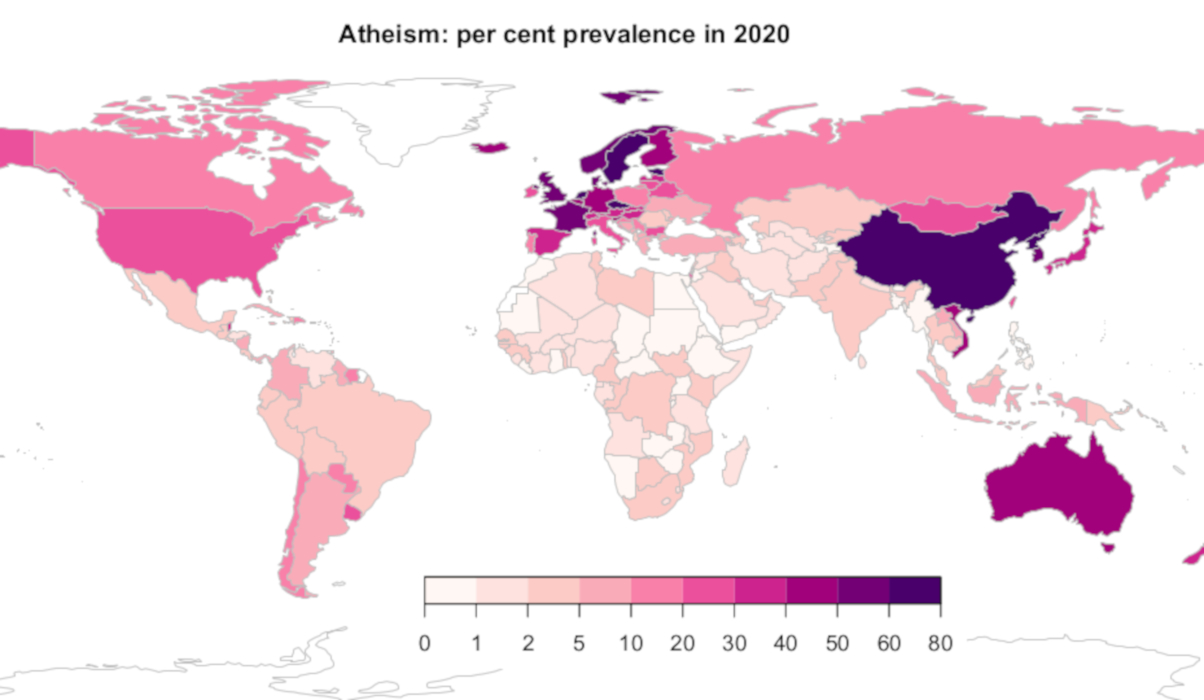
My previous post examined trends in religious belief and irreligion (non-religious and atheism) over the last 40 years using data from the World Values Surveys (WVS) and European Values Study (EVS) [1-4]. There is considerable interest in the prevalence of atheism, particularly from Americans, and a variety of quite different statistics are quoted, and have been written about in various media. In this post, I present my estimates of global prevalence of atheism for the year 2020 and discuss the various other sources of international statistics and the definitional issues. But first, here is my global map based on data from the WVS/EVS (see here for details of analysis).

And here is a closer view of the map for Eurasia. Further below in this post, I have included a more detailed country-level plot of all the religiosity categories (practicing religious, non-practicing religious, non-religious, atheist) for 2020.

Continue reading →

Is religious belief in decline and atheism on the rise?

Ronald Inglehart has recently published an article in Foreign Affairs called “Giving up on God: the global decline of religion” in which he uses data from the most recent wave of the World Values Surveys (WVS) to claim that between 2007 and 2019, the importance of religion has declined in most countries [1]. This is based on a single question on the importance of God in the respondent’s life on a 10-point scale. The average importance declined in 39 countries and increased in only 5.  Apart from the fact that this is based only on a single question on the importance of God, it also does not tell us how regional or global average ratings have changed. Depending on the relative populations and scale shifts in different countries, it could potentially even be consistent with a global average increase.

I’ve taken a closer look at trends in religious belief and practice using data from the World Values Survey and European Values Study [2-5] which have interviewed over 630,000 people in 110 countries in seven waves of the surveys over the period 1981 to 2020. These surveys include a direct question on whether you believe in God (Yes/No/Don’t know), but also “Are you a religious person” (Religious, Non-religious, Confirmed Atheist) and questions on frequency and type of religious practices, and on the importance in your life of religion and God. Of the 105 countries, 76 have data for years in range 2017-2020, and another 17 have data on or later than 2010.

Continue reading →

Anaximander – the first scientist

Recently I discovered Carlo Rovelli, an Italian physicist and best-selling popular science writer and noticed he had written a book on Anaximander, an early Greek philosopher who lived around 150 years before Socrates in the sixth century BC. Though I read some of the Greek philosophers when I was younger, I don’t recall coming across Anaximander. I thoroughly enjoyed reading his book and so here is a review.

Anaximander (c. 610 – c. 546 BC), lived in Miletus, a city of Ionia (in modern-day Turkey) and was a student of Thales. Nothing but a few quotations and descriptions of his work survive in the works of later philosophers, but from this sparse information, Rovelli mounts a persuasive argument that Anaximander was the first true scientist, the first to suggest that order in the world was due to natural forces, not supernatural ones.

Continue reading →

The twin pandemics and the second wave

Today, I took another look at the second wave of the Covid-19 pandemic using data on confirmed new cases per day. The first figure shows four countries where the second wave has peaked and is coming down. Australia is somewhat unique in that its second wave peaked considerably higher than the first. Croatia and likely Spain will join that club.

Continue reading →

Variations and trends in cultural values across 105 countries, 1980 to 2020

I’ve long been interested in the relationship between the stages of development of the individual (whether stages of moral development, psychological development, or consciousness) and the stages of development of human societies and civilizations. With the increasing prominence of fundamentalist religion in some regions of the world, the rise of science denialism and “post-truth” popularist politics, differences in human values are of huge importance and can literally become life and death matters for people. More generally, it seems fairly clear that people’s beliefs play a key role in economic development, the emergence and flourishing of democratic institutions, the rise of gender equality, and the extent to which societies have effective governments.

So I have taken an interest in results from the World Values Survey over the last two decades, and last month learnt that data from its most recent wave was being released in late July. There have now been seven waves of the World Values Survey (WVS), the first in 1980-1982 and the seventh underway since 2017. There have also been five waves of the European Values Study (EVS), which includes many of the same items as the WVS, and whose most recent wave covers the period 2017-2020. With the release of the WVS 7th wave data for 48 countries in July 2020, the WVS plus the EVS now include data for 117 countries or territories and over 638,000 respondents, covering the period 1981-2020.

Data from previous waves of the World Values Survey were used by political scientists Ronald Inglehart and Christian Welzel to identify two major dimensions of cross cultural variation across the world. They refer to these as Traditional values versus Secular-rational values and Survival values versus Emancipative values. Traditional values emphasize the importance of religion, parent-child ties, deference to authority and traditional family values in contrast to secular-rational values. Survival values place emphasis on economic and physical security. It is linked with a relatively ethnocentric outlook and low levels of trust and tolerance. Emancipative values are associated with gender equality, relative acceptance of divorce, abortion, and homosexuality and rising demands for participation in decision-making in economic and political life. Inglehart and Welzel used factor analysis to estimate where each country lies on these two dimensions are constructed what they called a “culture map”.

I set out to replicate this analysis with the full WVS+EVS dataset including the latest wave [1-4]. I decided to use a different statistical approach (item response theory) to estimate the two dimensions. I have posted a more technical summary on my professional website to give details of this analysis. In brief, I used structural equation modelling to estimate two latent variables. The survival-emancipative variable was derived from data for three questions of gender equality (jobs, politics, education) and three questions on acceptance of homosexuality, abortion, and divorce. The traditional-secular values variable was derived from data for three questions on sources of authority (nation pride, government, parents) and three questions on religion (importance, belief, practice. The values for countries with data for years 2005 or later were used to extrapolate values for year 2019. The following “culture map” shows the location of 105 countries based in these two variables.

Continue reading →