
A pandemic out of control

Over the last two days, I’ve been assessing the coronavirus situation across the world. I’ve posted a regional analysis of trends in new cases on my professional site (an-out-of-control-pandemic-in-most-world-regions).

I reproduce a graph of regional trends below. The dramatic difference in trajectories for Western Europe and the Americas is obvious. While levels are lower in most developing regions, this is mostly due to much lower levels of testing. But confirmed new cases in all regions apart from Europe and East Asia and Pacific are rising.

North America has the most out-of-control epidemic, and that is all due to the USA. I plotted trends for blue and red states in the USA. There is a dramatic difference, with most of the recent rise in new cases occurring in red states (that voted for Republican presidents in most of the recent presidential elections). In the week ending July 5, there were an average 226 new cases per 1 million population in red states compared to 88 per million in blue states.

In a second post which-countries-are-succeeding-and-not-succeeding, I have shown country-specific plots for selected examples of three groups of countries: (1) those that are beating Covid-19, (2) those that are nearly there, and  (3) those that need to take action.  The experiences of the first two groups of countries show that (a) it is important to act early, not wait till there a hundreds of deaths in the country, (b) it only takes about 5-7 weeks of strong interventions to get rid of the majority of cases and (c) half measures don’t work.
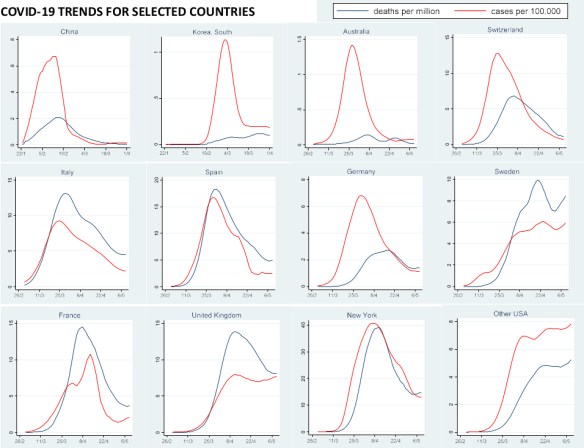
COVID-19: light at the end of the tunnel for some countries

Tomorrow, Switzerland will relax its social distancing regime. Classroom teaching at primary and lower secondary schools will again be permitted. Shops, markets, museums, libraries, gyms and restaurants will be able to reopen under strict compliance with precautionary measures. Switzerland has had the 10th highest death rate per million people but has been one of the few high death rate countries to successfully control the epidemic. See the plot for Switzerland below.

Continue reading →

COVID-19 short-run projections

Its now one month since my earlier post on the coronavirus pandemic    A lot has changed since then. We have gone from 24,392 deaths globally on March 26 to 206,915 on April 26th. And recent analysis of total registered deaths by week in February and March, compared to the same periods in the previous year, suggest that the reported deaths (mostly hospital deaths) are only about 70% of the actual deaths. The proportion of deaths reported in developing countries without good death registration (including most of Africa, and much of Asia) will be even lower.

Continue reading →

COVID-19: the big picture

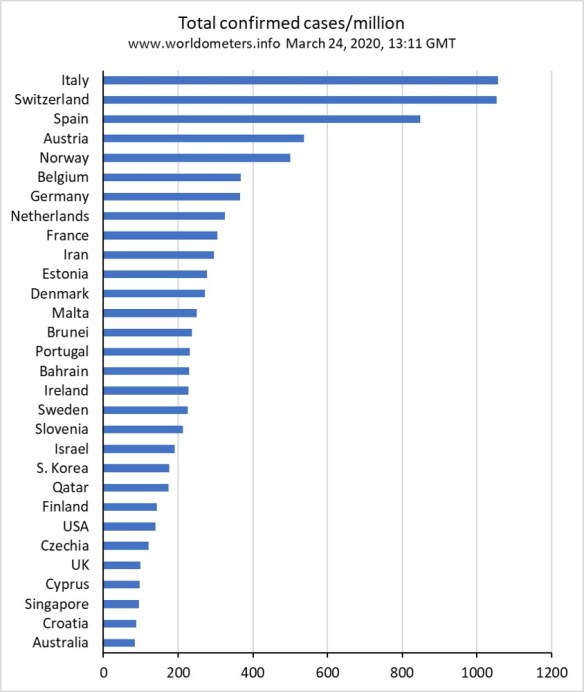
Today Switzerland became the country with the highest rate of confirmed cases of corona virus per million population. Well, that is if you ignore some micro-populations such as the Vatican City, San Marino, Andorra and Faeroe Islands. Why?  It is landlocked with Italy, France and Germany around it. It did not close the border between Ticino and Italy for cross-border workers and many live in Italy were the virus spread rapidly. Also, it was the height of the ski season and alpine resorts were crowded with skiers from all over Europe, Britain and beyond. Here is a graph I did yesterday comparing confirmed cases per million population  for the thirty leading countries (excluding small countries with population less than one million. Data are from worldometers.com at 13.11 GMT on March 24. A this point Switzerland had not yet overtaken Italy.

Continue reading →

Becoming Human Part 1

Our understanding of the evolution of us modern humans has changed dramatically in the last few years as ancient genomes are decoded and we discover that humans, Neanderthals and Denisovans interbred, and also in the remote past interbred with previously unknown “superarchaic” human groups.  Scientists are also discovering new species of extinct hominids, and no doubt will continue to shed further light on our origins. Just to try to sort out the big picture in my own mind and to put these various discoveries in context, I’ve tried to summarize what we think we know, or at least what the evidence available to date suggests. This will no doubt continue to change.

This is the first of two posts and summarizes the evolution of pre-human species from the first monkeys around 35 million years ago (Mya) to the appearance of the first human species around 2 Mya. A following post will summarize the evolution of humans from the appearance of the first human species Homo habilis 2 Mya to the appearance of anatomically modern Homo sapiens sapiens around 250 thousand years ago and  mitochondrial Eve, who lived around 178,000 years ago.

Continue reading →

Is freedom increasing or decreasing?

Last week, Freedom House released its 2020 annual report on global freedom. The report documents trends in every region of the world of declining political and civil freedom: “In every region of the world, democracy is under attack by populist leaders and groups that reject pluralism and demand unchecked power to advance the particular interests of their supporters, usually at the expense of minorities and other perceived foes.”

The report compiles a freedom index for countries based on an average of two indices for political rights and civil liberties, composed of numerical ratings and descriptive texts for each country. The 2020 index adds to a time series for countries that extends back to 1972.  I’m interested to see to what extent the time series upholds the view of Stephen Pinker that there has been sustained long-term improvement in both political rights and human rights globally and this will continue (Enlightenment Now, Chapters 13 and 14).

The graph below shows time trends for the number of countries falling into three broad categories of the freedom index, labelled as Free (green shades), Partly free (orange shades) and Not free (purple shades). The graph includes 185 countries. 11 very small countries with populations less than 90,000 in 2015 are not included.

Trends in numbers of countries by broad freedom category

Continue reading →