Today, I took another look at the second wave of the Covid-19 pandemic using data on confirmed new cases per day. The first figure shows four countries where the second wave has peaked and is coming down. Australia is somewhat unique in that its second wave peaked considerably higher than the first. Croatia and likely Spain will join that club.
Variations and trends in cultural values across 105 countries, 1980 to 2020
I’ve long been interested in the relationship between the stages of development of the individual (whether stages of moral development, psychological development, or consciousness) and the stages of development of human societies and civilizations. With the increasing prominence of fundamentalist religion in some regions of the world, the rise of science denialism and “post-truth” popularist politics, differences in human values are of huge importance and can literally become life and death matters for people. More generally, it seems fairly clear that people’s beliefs play a key role in economic development, the emergence and flourishing of democratic institutions, the rise of gender equality, and the extent to which societies have effective governments.
So I have taken an interest in results from the World Values Survey over the last two decades, and last month learnt that data from its most recent wave was being released in late July. There have now been seven waves of the World Values Survey (WVS), the first in 1980-1982 and the seventh underway since 2017. There have also been five waves of the European Values Study (EVS), which includes many of the same items as the WVS, and whose most recent wave covers the period 2017-2020. With the release of the WVS 7th wave data for 48 countries in July 2020, the WVS plus the EVS now include data for 117 countries or territories and over 638,000 respondents, covering the period 1981-2020.
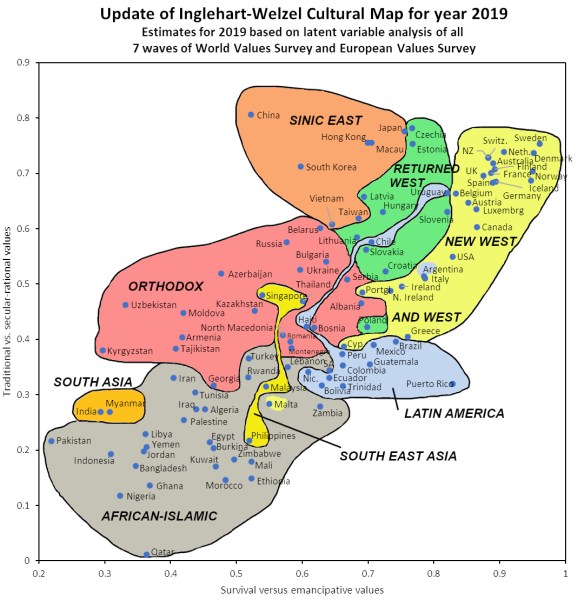
Data from previous waves of the World Values Survey were used by political scientists Ronald Inglehart and Christian Welzel to identify two major dimensions of cross cultural variation across the world. They refer to these as Traditional values versus Secular-rational values and Survival values versus Emancipative values. Traditional values emphasize the importance of religion, parent-child ties, deference to authority and traditional family values in contrast to secular-rational values. Survival values place emphasis on economic and physical security. It is linked with a relatively ethnocentric outlook and low levels of trust and tolerance. Emancipative values are associated with gender equality, relative acceptance of divorce, abortion, and homosexuality and rising demands for participation in decision-making in economic and political life. Inglehart and Welzel used factor analysis to estimate where each country lies on these two dimensions are constructed what they called a “culture map”.
I set out to replicate this analysis with the full WVS+EVS dataset including the latest wave [1-4]. I decided to use a different statistical approach (item response theory) to estimate the two dimensions. I have posted a more technical summary on my professional website to give details of this analysis. In brief, I used structural equation modelling to estimate two latent variables. The survival-emancipative variable was derived from data for three questions of gender equality (jobs, politics, education) and three questions on acceptance of homosexuality, abortion, and divorce. The traditional-secular values variable was derived from data for three questions on sources of authority (nation pride, government, parents) and three questions on religion (importance, belief, practice. The values for countries with data for years 2005 or later were used to extrapolate values for year 2019. The following “culture map” shows the location of 105 countries based in these two variables.
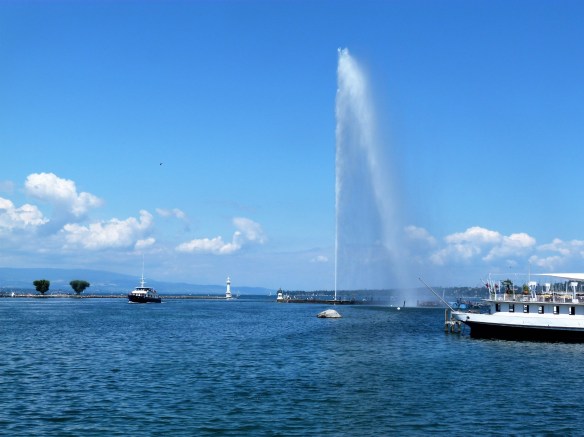
The jet d’eau of Geneva
The jet d’eau (jet of water) is a famous Geneva landmark, situated just off the shore of Lake Leman near the centre of Geneva and its old town. The original jet d’eau was a pressure release mechanism for the Geneva water supply in the 19th century. When engineering improvements made it obsolete, the City of Geneva decided to make the jet a tourist attraction. The current version was installed in 1951 and sends the water plume to a height of 140 m (460 feet). Its two pumps expel 500 litres of water per second at a speed of 200 km/hour.

My paternal ancestors – from Adam via ice age Siberia to the steppes of Europe
In earlier posts, I discussed how I have used an analysis of my Y chromosome DNA to identify my paternal ancestors all the way back to Y-chromosomal Adam, the most recent common ancestor of all men alive today. The following map summarizes my Y haplogroup ancestors from Y-chromosomal Adam down to those who left Africa around 70 thousand years ago (70 kya) and headed east through India and South East Asia and then up through China into ice age Siberia and then across to the Ukrainian steppeland north of the Black Sea.
I was originally going to continue this story all the way across Europe to the Iberian Peninsula and up to Ireland and Scotland, but I will keep that for a later post. I have discovered that there is an immense amount of recent research on European Bronze Age genetics and migrations and a very considerable unfinished debate on how to interpret the evidence. So it may take me a little while to come to grips with it. (A follow-up post is now available at my-paternal-ancestors-european-journey-the-caspian-steppes-to-celtiberia)

Breathwork and sensed energy
In an earlier post, I described my experience with transformational breathwork and the Wim Hof method. I’ve continued to practice these, and to do some online sessions with the breathwork instructor from the retreat I attended late last year. In looking around for more information on breathwork, I came across a book by David Lee called “Life force: Sensed Energy in Breathwork, Psychedelia and Chaos Magic” (Norwich: The Universe Machine, 2018).
Lee gives an overview of and simple instructions for ten types of breathwork, as well as
discussing their various purposes and effects, and the relationships between them. This is interesting enough, but his approach to understanding breathwork completely changed my experience of it. He describes the book as an exploration of “sensed energy” and schemes of belief that work best for experiencing, cultivating and manipulating these subtle sensations. In particular, he frames breathwork in terms of the arousal and relaxation of sensed energy.

Transformational breathing produces within minutes a tingling within the hands and feet and a sense of energy surging around the body. Lee advises to simply witness this energy as it circulates and coalesces into definite sensations and emotions. Layers of unresolved emotion may surface and the high level of sensed energy helps them to resolve. So breathwork may untangle pain and discomfort from the past. Lee describes how to modulate the intensity of the breathwork to hover in the space between suppression of this unresolved material and its too intense activation, allowing a process of resolution to occur, rather than repression or re-traumatizing. I certainly experience intense emotions at times during breathwork, and the periods of “tantrum” and application of pressure to particular points on the body enable you to intensify and experience or release these intense emotions.
A pandemic out of control
Over the last two days, I’ve been assessing the coronavirus situation across the world. I’ve posted a regional analysis of trends in new cases on my professional site (an-out-of-control-pandemic-in-most-world-regions).
I reproduce a graph of regional trends below. The dramatic difference in trajectories for Western Europe and the Americas is obvious. While levels are lower in most developing regions, this is mostly due to much lower levels of testing. But confirmed new cases in all regions apart from Europe and East Asia and Pacific are rising.

North America has the most out-of-control epidemic, and that is all due to the USA. I plotted trends for blue and red states in the USA. There is a dramatic difference, with most of the recent rise in new cases occurring in red states (that voted for Republican presidents in most of the recent presidential elections). In the week ending July 5, there were an average 226 new cases per 1 million population in red states compared to 88 per million in blue states.
In a second post which-countries-are-succeeding-and-not-succeeding, I have shown country-specific plots for selected examples of three groups of countries: (1) those that are beating Covid-19, (2) those that are nearly there, and (3) those that need to take action. The experiences of the first two groups of countries show that (a) it is important to act early, not wait till there a hundreds of deaths in the country, (b) it only takes about 5-7 weeks of strong interventions to get rid of the majority of cases and (c) half measures don’t work.
Lake sunset
Sitting by the lake at sunset.
Thoughts drop away as the light of the sun drops away,
the stillness of mind and the stillness of the lake here-now

Looking south across Lake Leman from Montreux, Switzerland.


Geneva hidden in a golden glow

Sunset behind the Intra-coastal water way, Ocean Isle, North Carolina

Swans on Lake Garda, northern Italy

Sunset reflected in a farm dam, Gloucester, New South Wales
.
Tracing my paternal ancestors through Y DNA
The human Y chromosome is a male-specific sex chromosome. When mutations (errors in the copying process) arise in the Y chromosome, they are passed down directly from father to son in a direct male line of descent and define a tree of Y “haplogroups”. The mutations on the Y chromosome can thus be used to trace our paternal ancestors all the way back to the most recent common paternal ancestor of all men alive today, Y chromosomal Adam.
When I first got interested in genetic genealogy around 2010, I had my DNA tested by the National Genographic Project, funded by the National Geographic to collect over a million DNA samples to map the patterns of human migration across the world. This project measured mutations known as short tandem repeats (STRs) at 12 sites, and gave a statistical prediction of my Y-haplogroup, R1b (M343) and subclade R-M269. A year later I upgraded my Y-DNA analysis to 44 STRs with Ancestry.com. At the time, I decided that I would wait for the technology to improve and the cost to drop and do a more comprehensive test which would definitively determine my Y haplogroup.
And so last year I did the Big Y-700 test with FamilyTreeDNA which examines 700 short tandem repeats, and over 200,000 single-nucleotide polymorphisms(SNPs) identifying known haplogroups as well as millions of locations where there may be new branch markers on the Y chromosome. This company claims to have the world’s largest genealogical YDNA database with over 2 million people included.
Y chromosomal Adam
Y-chromosomal Adam is the name given to the patrilineal most recent common ancestor (MRCA) of modern humans. In other words, he was the man from whom all living humans today descend, on their father’s side, and through the fathers of those fathers and so on, back until all lines converge on one person. He is the male counterpart of Mitochondrial Eve, who,lived in north-western Botwsana around 177,000 years ago (confidence interval ± 11,300 years).
When I did my first Y-DNA test in 2012 with the National Geographic’s National Genographic Project, it gave a date of 60,000 years ago (60 kya) for Y-chromosomal Adam. This was already outdated, as other recent estimates around that time gave dates ranging from 120 to 160 kya. By definition, it is not necessary and highly unlikely that Y-chromosomal Adam and Mitochondrial Eve lived at the same time or in the same location.

However, in 2013 scientists announced the discovery of an extremely ancient Y DNA haplogroup from a sample submitted for an African-American man in the USA. Y-chromosomal haplogroups are defined by mutations in the non-recombing portions of DNA from the Y chromosome. These mutations accumulate at the rate of roughly two per generation. The accumulation of mutations in the descendants of Y-chromosomal Adam allow us to map out the major branches of the family tree in terms of Y-haplogroups. This discovery adds a completely new branch to the Y-DNA family tree and pushes back the age of Y-chromosomal Adam to around 250 to 300 kya.
COVID-19: light at the end of the tunnel for some countries
Tomorrow, Switzerland will relax its social distancing regime. Classroom teaching at primary and lower secondary schools will again be permitted. Shops, markets, museums, libraries, gyms and restaurants will be able to reopen under strict compliance with precautionary measures. Switzerland has had the 10th highest death rate per million people but has been one of the few high death rate countries to successfully control the epidemic. See the plot for Switzerland below.