Ancestral tales: a theosophist, a thief and an Indian Princess

My father had three uncles and an aunt on his father’s side and they were an important part of his formative years. I met them all as a young child, and my father told me many stories about them. In particular, I remember Aunt Boodie, the wife of his uncle Robert, as an eccentric old lady. She continued to send birthday and Christmas presents to me and my sister until we were in our teens, but they were things suitable for very young children. My father certainly thought she was very eccentric, particularly because she was a theosophist.

So in the internet age, I used the power of the internet to research her background, and to contact people who knew about some of her ancestors. And what stories I discovered. A famous poet who committed suicide, a bank robber, and an Indian princess among other things. If I had been researching in the pre-internet days (as recently as early 1990s), there is no way I would ever have discovered some of these stories or contacted descendents with some knowledge of them. Continue reading

Ascent of Mont Blanc, September 2010

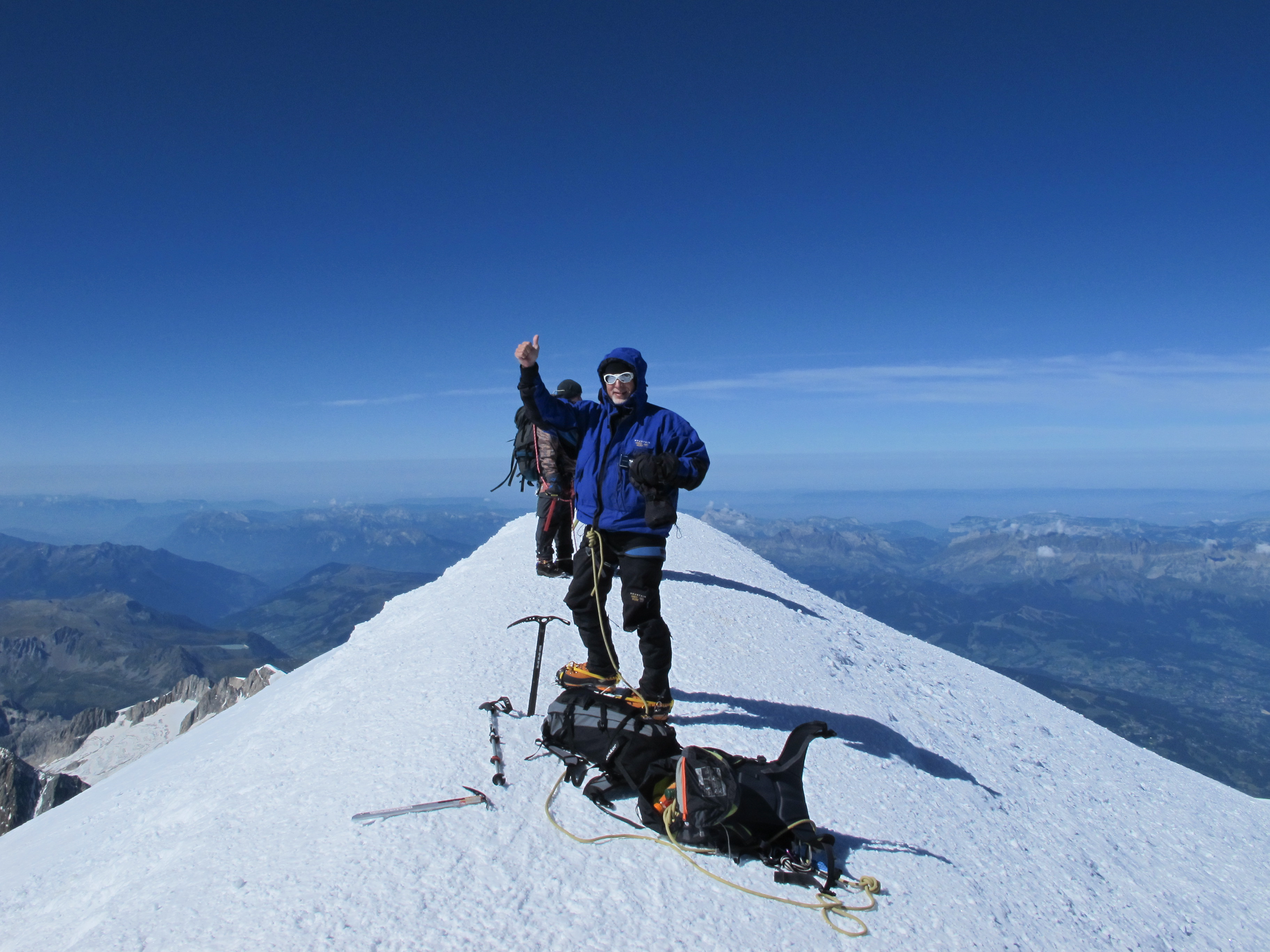
On a clear day, I can see Mont Blanc on the skyline from my office window, and many is the day in winter where I watch the sun rise almost directly over the summit. Mont Blanc looms over the skyline in many places around Geneva and the “frontalier” France to the west. So I had long had an ambition to climb Mont Blanc, the highest peak in (Western) Europe at 4808m, and succeeded on my first attempt in September 2010.

On the summit of Mont Blanc (4808 m), Sunday morning at 11.30 am. And somewhat surprised I made it!

On the summit of Mont Blanc (4808 m), Sunday morning at 11.30 am. And somewhat surprised I made it!

Continue reading

Books by Colin Mathers

A comprehensive list of publications relating to my professional work is available at www.colinmathers.com

Colin Mathers. A Baker Family History. Thomas and Mary Baker,  their Australian descendants and European ancestors . Lulu.com, Australia, 2024 (143 pages). (In press).

Colin Mathers. James Cook and the discovery of Queensland: The Australian descendants and English ancestors of James Cook and Anne Cobb. Lulu.com, Australia, 2023 (98 pages).

Colin Mathers. A Baker Family History. The family and ancestors of Audrey May Baker: from England and Ireland to Australia. Lulu.com, Australia, 2023 (253 pages).

Colin Mathers and Irene Waters. Audrey’s Family: a Daughter, Mother and Grandmother. Pixxibook, November 2021 (148 pages).

Colin Mathers. Shall I try Australia? A history of the Mathers family in Ireland, Scotland and Australia from the 17th to the 21st century. Lulu.com, Australia, 2010 (148 pages).

DSCN4793My great-grandfather, James Mathers, was born in Armagh, Ireland, in 1852 and moved to Scotland in the 1860s where he married Margaret Melrose. They migrated to Australia with their six surviving children in 1897. This book documents the history of the family in Australia, and traces the Mathers and Melrose ancestors in Ireland and Scotland back to the 1700s and earlier. The previous generation, born around the 1820s, were almost all illiterate labourers and coalminers. The subsequent history of the Mathers family encapsulates the dramatic changes in the educational, cultural and economic opportunities brought by the Industrial Revolution in Britain.

This edition of the book was available only to Mathers family members, and a second edition is planned. The second edition will include substantial additions and new information, not least because it has recently been discovered that James Mathers had an older sister, who migrated to Australia earlier, and whose existence was unknown to his descendents. Continue reading

Origin of the name Mathers

The names Mather and Mathers are not uncommon in Ireland and are thought to derive from two separate sources. The name MATHER (also MATHUR) originated in Yorkshire, England, as an occupational surname originally denoting a mower (from the Old English: Maedere ‘mower, reaper’)1. The earliest recorded instance of this surname dates from 1249 in Nottingham. This name is fairly common in England and Ireland, though in Ulster for instance it has become MATHERS. Mather is the more numerous in the other provinces and it is on record in Dublin since the first half of the seventeenth century. By the end of that century it was well established in Co. Armaugh2 where my Scottish Mathers ancestors migrated in the 1700s. Mathers has to some extent been changed to Mathews in Co. Down.

However, the Scottish name Mathers, of separate origin, was also brought to Ireland by Scottish migrants. Scotland, during the 16th, 17th, and 18th centuries, was ravaged by religious conflict and many Scots migrated to Australia and Ireland. Families migrated from Scotland to Ireland with promises of cheap Irish land, and many settled in Armagh, including my Scottish ancestors (probably around the mid-1700s). There is always much debate about the pronunciation of the surname Mathers, by other people. It is accepted by all members of the Scottish Mathers that Mathers is pronounced as if there was a Y in it, MA(Y)THERS.

1. Reaney PH. A Dictionary of English Surnames. Oxford: Oxford University Press; 1997.

2. Edward MacLysaght. The Surnames of Ireland. Dublin: Irish Academic Press; 1980.

Brainwave entrainment

The basic idea of brainwave entrainment is to use an external periodic stimulus to cause wave1brainwave frequencies to fall into step with it at a frequency corresponding to the intended brain-state (for example, to induce sleep or meditative states). There is good evidence that the human brain has a tendency to change its dominant EEG frequency towards the frequency of a dominant external stimulus. Such a stimulus may be aural, as in the case of binaural or monaural beats and isochronic tones,or light (visual), or a combination of the two with a mind machine.

Continue reading

Priceless advice

The next time you lose heart and you can’t bear to experience what you’re feeling, you might recall this instruction: change the way you see it and lean in. Instead of blaming our discomfort on outer circumstances or on our own weakness, we can choose to stay present and awake to our experience, not rejecting it, not grasping it, not buying the stories that we relentlessly tell ourselves. This is priceless advice that addresses the true cause of suffering—yours, mine, and that of all living beings.

Taking the Leap by Pema Chödrön, page 55

This is how things are; what is to be done about them?

It is not profitable to spend time on such questions as whether there was ever a beginning to the succession of universes that have been arising and reaching their end for innumerable aeons, or why sentient beings must revolve endlessly from life to life in this sad realm of samsara. What is needed is to direct one’s attention to the present, thinking: “This is how things are; what is to be done about them?

Bodhisattva of Compassion: The Mystical Tradition of Kuan Yin by John Blofeld, page 88

Surfing at Noosa


This Easter, the boys and I went to Noosa on the Sunshine Coast of Queensland, Australia to visit relatives. Apart from heavy rain storms the first couple of days it was hot and sunny just like mid-summer. We went to the beach every day and the boys had some surfing lessons (boards). I also did a jet ski trip with each of them out to the open ocean to jump waves at speed.

Nine Stanes, Eslie the Greater and Eslie the Lessor

I have had a longstanding interest in megalithic monuments since I was a teenager. In part sparked by my interest in astronomy as a teenager, since the megalithic monuments of Europe show that Neolithic humans had sophisticated astronomical skills. And in part, by my interest in deep ancestry (see previous post https://mountainsrivers.com/2014/03/11/maternal-ancestors-bronze-age-iron-age-roman-britain/). And also by their connection with the barrowdowns of Middle Earth. On my first extended trip to Britain, I visited various megalithic stone circles in England and explored the barrows around the Ridgeway near Oxford.

So on my trip to Eastern Scotland last Easter, I took a look on the internet to see whether there were any megalithic monuments within an easy drive from the area I was staying in near the villages of Mathers (https://mountainsrivers.com/2014/05/20/the-villages-of-mathers-easter-2014/). And discovered there were three stone circles about 45 km north-west of St Cyrus where I was staying. Continue reading