Ulysses and book burning in Australia

Today the 16th June is Bloomsday, a celebration of the life and work of the Irish writer James Joyce. Joyce’s epic novel Ulysses is set on that day in 1904, the day of his first date with his wife-to-be, Nora Barnacle.

This lengthy novel has been highly controversial, and has been banned in various countries. It is written using a stream-of-consciousness technique, with careful structuring based on Homer’s Odyssey. Its revolutionary technique and experimental prose as well as its rich characterisation and broad humour, have led it to be regarded as one of the greatest literary works in history.

I read Ulysses as an undergraduate during my daily commutes by train to and from Sydney University. I was particularly taken with the final chapter of Ulysses in which Molly Bloom is lying in bed next to Leopold and her thoughts are reported as a stream-of-consciousness 42 pages in length. I think I read a paperback edition that belonged to my father. I remember him during that period quoting to me the following passage highlighting Leopold Bloom’s adoration for his wife Molly, because he loved the sound of the words:

“He kissed the plump mellow yellow smellow melons of her rump, on each plump melonous hemisphere, in their mellow yellow furrow, with obscure prolonged provocative melonsmelonous osculation.”
                James Joyce, Ulysses, Episode 17 “Ithaca”.
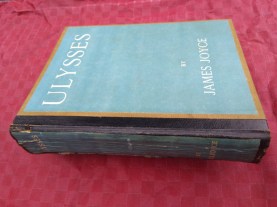
My father and before him my great-Uncle John (1895-1975) were book collectors and I have kept some of their books, including a copy of the first edition of Ulysses published by Shakespeare and Company in Paris. After the initial printing of 1000 numbered copies in 1922, my great-uncle acquired a copy in 1927 from the 8th print run of May 1926.

Title page

A publishing history of Ulysses can be found at antwerpjamesjoycecenter.com

I knew that Ulysses had been banned in Australia for some time and looked up the dates. it was not banned until 1929, then released in 1937, only to be restricted again in 1941 after pressure from Catholic organizations. This ban was lifted in 1953 after it was considered ineffectual considering how many copies were already in circulation.

Continue reading

12 Rules for Life (part 2)

This is the second half of my review of “12 Rules for Life” by Jordan Peterson, the controversial Canadian psychologist who has become an internet sensation.  The first half of my review can be found at 12-rules-for-life-jordan-peterson

Rule 7. Pursue what is meaningful (not what is expedient).

Peterson again turns to the Old Testament to the story of Paradise and the Fall as a guide to Being and right action. He prefaced this with a quite good explanation of how myths and legends encode guidance on Being, action and meaning based on human experience and behaviours that have evolved over a long period of time. But why he thinks Bronze Age myths are still our best source of understanding of these things, and ignores the important evolution of human societies and understanding in recent centuries, I don’t know.

Continue reading

Avengers: Endgame

I took my younger son to see Avengers: Endgame on the big IMAX 3D screen the day after it was released. The theatre was almost full, unusual for Geneva. My older son went later in the evening, and he and his friends got the last remaining seats in row A, only two or three metres from the screen.  He claims he enjoyed it and didn’t really notice he was almost in the action.

The movie is long at three hours, but we didn’t notice the passing of time. Lots of emotional scenes, if anything a bit overdone for my taste. But still satisfying, and overall, the movie certainly wraps up the entire arc of the Avengers cycle of movies in a deeply satisfying way. There are lots of good reviews out there and I won’t try to cover the same ground. Rotten Tomatoes has quite a few critics reviews and the Tomatometer has a score of 95% and audience score of 91%. IMDB has a rating of 9 out of 10.

Continue reading

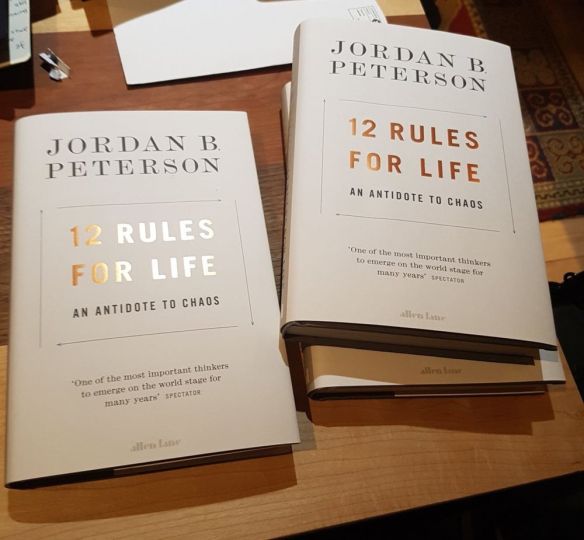
12 Rules for Life – Jordan Peterson (part 1)

In the wake of the New Zealand mosque shootings, one major New Zealand bookshop, Whitcoulls, apparently removed Jordan Peterson’s “12 Rules for Life” from its shelves. This was reported in a range of print and online media, particularly various right-wing sites. For example, the New Zealand Herald on  March, commented in an article mainly about the many positive responses to the massacre that “Contributions to our national wellbeing such as Whitcoulls’ removal of Canadian psychologist Jordan Peterson’s book 12 Rules for Life from its shelves, while Hitler’s Mein Kampf remains on sale, and shutting down debate on the UN’s Immigration Pact are tokenism, and misguided to boot.”

I checked six large New Zealand bookstores (either big chains or online) and indeed Whitcoulls is the only one which does not have 12 Rules for Life available for sale. It does have Mein Kampf, and the Collected Writings of Chairman Mao, as well as some other writings by Peterson. Earlier in February this year, a group called Auckland Peace Action, objected to Peterson’s planned visit to New Zealand, with a “press release” claiming that “Jordan Peterson Threatens Everything of Value in Our Society.”

If you are not aware, Jordan Peterson has become an internet phenomenon, with a massive following, particularly among young men, and there are lots of negative reactions to him from journalists and other commentators. My teenage son has been reading Jordan Peterson’s 12 Rules and also watching various videos of Peterson interviews and lectures, and gave me a copy of “12 Rules for Life” for my birthday. So I am going to read it with interest, to see whether it does indeed threaten everything of value in our society, or should be banned as “extremely disturbing material”. As I make my way through the book, I will add review comments to this blog post, starting with the Introduction below.

s-l1000


Continue reading

Free Solo – inspiring and disturbing

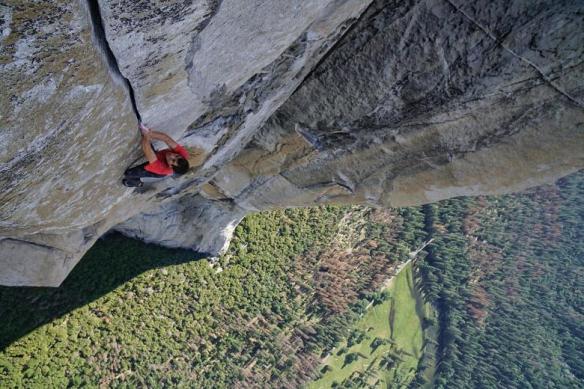
Last week I took my boys to see Free Solo. In case you haven’t heard of it, it is a documentary about Alex Honnold’s attempt to become the first person to climb the 3000 foot cliff of El Capitan without any ropes or other protective equipment. One slip or missed hold and he would die. The documentary not only looks at Honnold the climber, his mindset and attitudes, his preparations and the actual climb itself, but also has two other main threads, the process of filming the feat and the moral dilemmas the filmmakers faced, and the very substantial stresses his loved ones have to deal with.

Alex Honnold free soloing El Capitan. Photo credit: National Geographic documentary Free Solo.

I had actually put the DVD in my shopping trolley at Amazon because it did not seem to be screening anywhere in Geneva, when a friend let me know there was a one night showing at Pathe Balexert. So I deleted my draft purchase and took the boys to see it. If you have a chance to see it, I highly recommend it. It is a gripping account of one of the greatest athletic feats of all time, but is also very thought-provoking. It won an Oscar this year for Best Documentary, and has a critics rating of 99% on Rotten Tomatoes.

Continue reading

Barcroft Boake (1866-1892): Australian bush poet

In an earlier post https://mountainsrivers.com/2015/10/26/ancestral-tales-a-theosophist-a-thief-and-an-indian-princess/ I wrote about my great-aunt Boodie (Florence Teasdale Smith) who was a theosophist, whose father was a bank robber and she was also descended from an Indian princess.  I mentioned in passing that her uncle was a famous Australian poet who committed suicide but did not give any details. So this post is about Barcroft Boake, an Australian bush poet, who committed suicide at the age of 26.

Continue reading

Books by Colin Mathers

A comprehensive list of publications relating to my professional work is available at www.colinmathers.com

Colin Mathers. A Baker Family History. Thomas and Mary Baker,  their Australian descendants and European ancestors . Lulu.com, Australia, 2024 (143 pages). (In press).

Colin Mathers. James Cook and the discovery of Queensland: The Australian descendants and English ancestors of James Cook and Anne Cobb. Lulu.com, Australia, 2023 (98 pages).

Colin Mathers. A Baker Family History. The family and ancestors of Audrey May Baker: from England and Ireland to Australia. Lulu.com, Australia, 2023 (253 pages).

Colin Mathers and Irene Waters. Audrey’s Family: a Daughter, Mother and Grandmother. Pixxibook, November 2021 (148 pages).

Colin Mathers. Shall I try Australia? A history of the Mathers family in Ireland, Scotland and Australia from the 17th to the 21st century. Lulu.com, Australia, 2010 (148 pages).

DSCN4793My great-grandfather, James Mathers, was born in Armagh, Ireland, in 1852 and moved to Scotland in the 1860s where he married Margaret Melrose. They migrated to Australia with their six surviving children in 1897. This book documents the history of the family in Australia, and traces the Mathers and Melrose ancestors in Ireland and Scotland back to the 1700s and earlier. The previous generation, born around the 1820s, were almost all illiterate labourers and coalminers. The subsequent history of the Mathers family encapsulates the dramatic changes in the educational, cultural and economic opportunities brought by the Industrial Revolution in Britain.

This edition of the book was available only to Mathers family members, and a second edition is planned. The second edition will include substantial additions and new information, not least because it has recently been discovered that James Mathers had an older sister, who migrated to Australia earlier, and whose existence was unknown to his descendents. Continue reading