My son has been reading the existentialists, starting with Camus (of course, The Plague is quite relevant for more than one reason now). He recently moved on to Kierkegaard, who
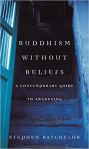
took a form of Christianity as a solution to existential angst. I was reminded of a book I read probably 15 years ago, by Stephen Batchelor: Buddhism Without Beliefs (London: Bloomsbury 1997) which argued that the Buddha was concerned with addressing the existential issue of suffering not with metaphysics and beliefs. I couldn’t find my copy of this, and bought another, which I enjoyed reading even more than the first time.
Category Archives: The big picture
COVID-19: the big picture
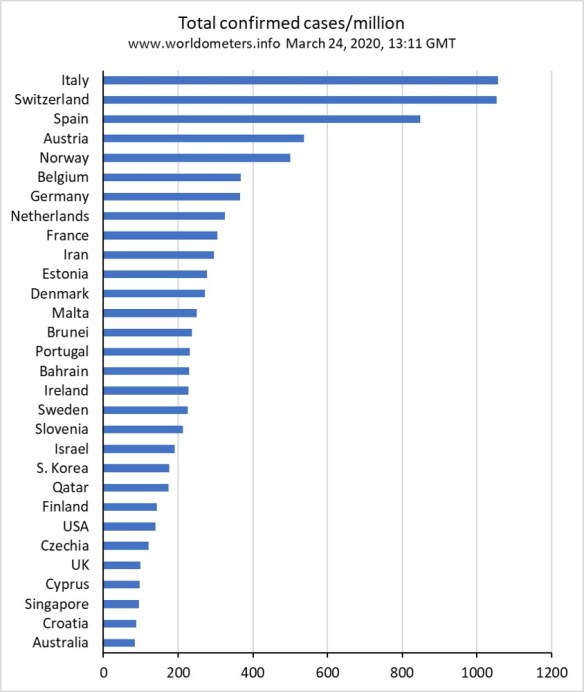
Today Switzerland became the country with the highest rate of confirmed cases of corona virus per million population. Well, that is if you ignore some micro-populations such as the Vatican City, San Marino, Andorra and Faeroe Islands. Why? It is landlocked with Italy, France and Germany around it. It did not close the border between Ticino and Italy for cross-border workers and many live in Italy were the virus spread rapidly. Also, it was the height of the ski season and alpine resorts were crowded with skiers from all over Europe, Britain and beyond. Here is a graph I did yesterday comparing confirmed cases per million population for the thirty leading countries (excluding small countries with population less than one million. Data are from worldometers.com at 13.11 GMT on March 24. A this point Switzerland had not yet overtaken Italy.

Becoming Human Part 1
Our understanding of the evolution of us modern humans has changed dramatically in the last few years as ancient genomes are decoded and we discover that humans, Neanderthals and Denisovans interbred, and also in the remote past interbred with previously unknown “superarchaic” human groups. Scientists are also discovering new species of extinct hominids, and no doubt will continue to shed further light on our origins. Just to try to sort out the big picture in my own mind and to put these various discoveries in context, I’ve tried to summarize what we think we know, or at least what the evidence available to date suggests. This will no doubt continue to change.
This is the first of two posts and summarizes the evolution of pre-human species from the first monkeys around 35 million years ago (Mya) to the appearance of the first human species around 2 Mya. A following post will summarize the evolution of humans from the appearance of the first human species Homo habilis 2 Mya to the appearance of anatomically modern Homo sapiens sapiens around 250 thousand years ago and mitochondrial Eve, who lived around 178,000 years ago.
Is freedom increasing or decreasing?
Last week, Freedom House released its 2020 annual report on global freedom. The report documents trends in every region of the world of declining political and civil freedom: “In every region of the world, democracy is under attack by populist leaders and groups that reject pluralism and demand unchecked power to advance the particular interests of their supporters, usually at the expense of minorities and other perceived foes.”
The report compiles a freedom index for countries based on an average of two indices for political rights and civil liberties, composed of numerical ratings and descriptive texts for each country. The 2020 index adds to a time series for countries that extends back to 1972. I’m interested to see to what extent the time series upholds the view of Stephen Pinker that there has been sustained long-term improvement in both political rights and human rights globally and this will continue (Enlightenment Now, Chapters 13 and 14).
The graph below shows time trends for the number of countries falling into three broad categories of the freedom index, labelled as Free (green shades), Partly free (orange shades) and Not free (purple shades). The graph includes 185 countries. 11 very small countries with populations less than 90,000 in 2015 are not included.

Trends in numbers of countries by broad freedom category
Australia appears to be committing climate suicide
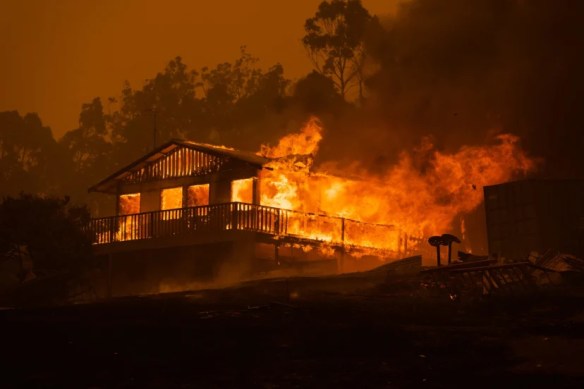
Media across the world have been publishing articles and photos on the catastrophic bushfires in Australia. Richard Flanagan, a well-known Australian author, published an opinion piece in the New York Times two days ago, which fairly accurately summarized the impact of the fires and the complete inadequacy of the government and political response (Australia Is Committing Climate Suicide).

Mogo, a town on the NSW south coast has been devastated by bushfires. One Mogo resident watched his 92 year old father’s house burning next door. At the time of taking this photo, he wasn’t sure where his father was. Credit: James Brickwood
Here are some quotes from the article:
“Australia today is ground zero for the climate catastrophe. Its glorious Great Barrier Reef is dying, its world-heritage rain forests are burning, its giant kelp forests have largely vanished, numerous towns have run out of water or are about to, and now the vast continent is burning on a scale never before seen. …….
“The fires have already burned about 14.5 million acres — an area almost as large as West Virginia, more than triple the area destroyed by the 2018 fires in California and six times the size of the 2019 fires in Amazonia. Canberra’s air on New Year’s Day was the most polluted in the world partly because of a plume of fire smoke as wide as Europe.
“Scientists estimate that close to half a billion native animals have been killed and fear that some species of animals and plants may have been wiped out completely. Surviving animals are abandoning their young in what is described as mass “starvation events.” At least 18 people are dead and grave fears are held about many more. …..”
A deceased horse on a property on the outskirts of Cobargo, a town on the NSW south coast that was devastated by bushfires at New Year. Credit: James Brickwood
Ad Astra
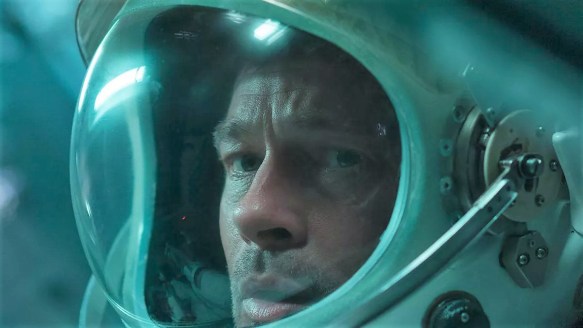
Having just seen a standout performance by Brad Pitt in Once Upon a Time in Hollywood, I was keen to see his latest film Ad Astra. I saw some rave reviews by film critics that perhaps raised my expectations a little too much, because while I enjoyed the film I had some problems with it also. Here is a quote from one review: “In a mesmerizing, minimalist performance, Pitt forms the gravitational center of a film that takes its place in the firmament of science fiction films by fearlessly quoting classics of the genre (as well as those outside it)”.

It pays homage to many classic science fiction and other films, and the central journey to Uranus is very reminiscent of 2001 A Space Odyssey. Brad does give a great “minimalist” performance as the icily competent, pathologically controlled astronaut, Roy McBride, whose heart rate never rises above 80 beats per minute, even in the opening sequence when he is falling from near space out of control, after an accident on the world’s tallest antenna.
The 10 greatest athletic feats of the 21st century – transcending perceived limits of mind and body
I have been following Eliud Kichoge’s bid to be the first human to run a marathon in less than 2 hours. He succeeded on Saturday with a time of 1 hour 59 mins and 40 seconds. This is an absolutely extraordinary achievement. It was not an official world record, because of the use of rotating pacemakers and because Kipchoge was handed his drinks from a bike, but it is still the fastest marathon ever run. After he finished, Kipchoge said that he had wanted to send a message to the world that no human is limited.
This made me think about a number of extraordinary feats that I’ve seen achieved in recent years and I decided to make a list of my top 10 most extraordinary human achievements in the realm of extreme feats that broke barriers and went beyond perceived limits of mind and body. Quite a few of these feats involve non-ordinary states of consciousness that need total engagement in the here-now, unity of mind and body, and transcendence of distracting thoughts and emotions. States known as “being in the zone” or “flow” to athletes, as “immovable mind” to the samurai and as samadhi to Zen practitioners.
I also decided arbitrarily to restrict my list to feats achieved in the last 20 years, or in other words, in the 21st century (counting the year 2000 as part of this century). This is an idiosyncratic list that reflects my interests and the level of amazement and awe that watching (or in one case reading an account of) the event inspired in me. You may well have a very different list, though I think at least the ones towards the top should be on most lists.
Climate change and the undermining of science
Greta Thunberg and Extinction Rebellion have been raising awareness of the urgent need to stop talking and start acting on global warming. The evidence that global warming is real and that it is human-caused is now overwhelming, but the public debate is regularly swamped by science deniers who in most cases clearly simply ignore or are ignorant of the evidence, and often are clearly clueless about how to assess evidence, or even what constitutes evidence.
The first illustration below, from a recent Economist issue, summarises the rise in average temperature across the earth’s surface in 2018 compared to the average for 1951-1980.

Many deniers claim that the current rising temperature is natural, resulting from ice age cycles or orbital variations of the earth. The graph below shows how current CO2 levels are dramatically higher and rising faster than in any interglacial period over the last half million years. And our best climate models predict temperature rises associated with CO2 levels which match measured temperatures over the last 40 years. If the impact of CO2 is excluded from the models, it is not possible to explain the observed rise in temperature (see graph below).
The Manson murders and Once Upon a Time in Hollywood
After watching Tarantino’s latest film, which I reviewed in my last post (once-upon-a-time-in-hollywood), I got out Helter-Skelter to read again. This is the absolutely riveting story of the Manson murders in Hollywood in 1969, the police investigation that followed, the trial and outcomes, written by the prosecutor Vincent Bugliosi, who meticulously investigated and prosecuted Manson and three female followers.
Warning: this post contains spoilers about the movie “Once Upon a Time in Hollywood”.Don’t read further if you haven’t seen the movie and intend to.
Once Upon A Time in Hollywood
I wanted to see Tarantino’s latest film, Once Upon a Time in Hollywood, which takes place in a loving recreation of late-’60s Los Angeles. I knew that it starred one of my favorite actors, Brad Pitt, along with Leonardo DiCaprio and Margot Robbie and was set in 1969 at the time of the Manson murders. But that was all. I asked my older son if he was interested to see it and he came along. I was a teenager in last years of high school in 1969 and very clearly remember the Manson murders, as well as later reading a book by the prosecutor who got Manson and his followers convicted and sentenced to death. So I was quite interested to see what Tarantino would make of this material and era. We both thoroughly enjoyed the film, of which more below, but in our discussion after the movie ended, I discovered that we had had two extremely different experiences, as if we were watching two different movies.

Once Upon a Time in Hollywood Cast
Warning: this post will contain major spoilers about the movie “Once Upon a Time in Hollywood”. I strongly recommend that you don’t read further if you haven’t seen the movie and intend to. It really will be a much more satisfying movie if you don’t already know the plot.