COVID-19: the big picture

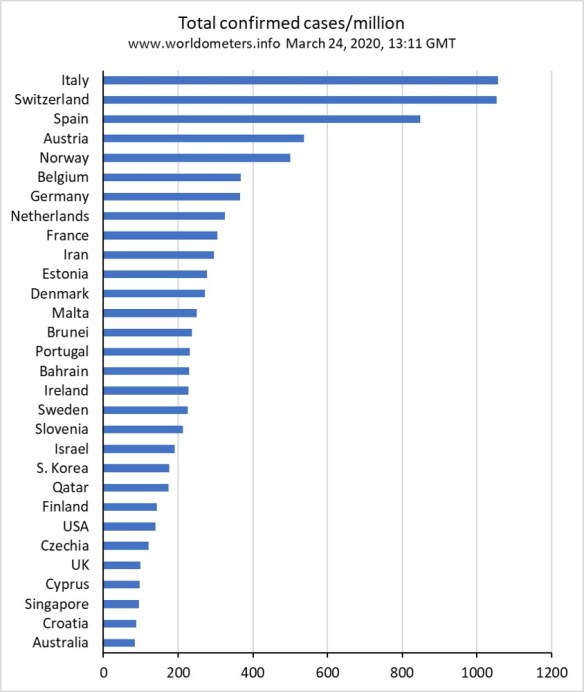
Today Switzerland became the country with the highest rate of confirmed cases of corona virus per million population. Well, that is if you ignore some micro-populations such as the Vatican City, San Marino, Andorra and Faeroe Islands. Why?  It is landlocked with Italy, France and Germany around it. It did not close the border between Ticino and Italy for cross-border workers and many live in Italy were the virus spread rapidly. Also, it was the height of the ski season and alpine resorts were crowded with skiers from all over Europe, Britain and beyond. Here is a graph I did yesterday comparing confirmed cases per million population  for the thirty leading countries (excluding small countries with population less than one million. Data are from worldometers.com at 13.11 GMT on March 24. A this point Switzerland had not yet overtaken Italy.

Continue reading

Becoming Human Part 1

Our understanding of the evolution of us modern humans has changed dramatically in the last few years as ancient genomes are decoded and we discover that humans, Neanderthals and Denisovans interbred, and also in the remote past interbred with previously unknown “superarchaic” human groups.  Scientists are also discovering new species of extinct hominids, and no doubt will continue to shed further light on our origins. Just to try to sort out the big picture in my own mind and to put these various discoveries in context, I’ve tried to summarize what we think we know, or at least what the evidence available to date suggests. This will no doubt continue to change.

This is the first of two posts and summarizes the evolution of pre-human species from the first monkeys around 35 million years ago (Mya) to the appearance of the first human species around 2 Mya. A following post will summarize the evolution of humans from the appearance of the first human species Homo habilis 2 Mya to the appearance of anatomically modern Homo sapiens sapiens around 250 thousand years ago and  mitochondrial Eve, who lived around 178,000 years ago.

Continue reading

James Mathers and the plague outbreak of 1900

The coronavirus epidemic has now spread to most parts of the world, and Switzerland is in the top 12 countries for confirmed cases, which may not reflect the reality of cases in countries with little or no testing.  This time of social distancing and self-quarantine brought to mind my great-grandfather who lived through an epidemic of bubonic plague in Sydney in 1900, the first and largest plague outbreak in Australia. In this post, I take a look at this outbreak and his experience of it through the window of the detailed journal that he kept at the time.

Continue reading

Is freedom increasing or decreasing?

Last week, Freedom House released its 2020 annual report on global freedom. The report documents trends in every region of the world of declining political and civil freedom: “In every region of the world, democracy is under attack by populist leaders and groups that reject pluralism and demand unchecked power to advance the particular interests of their supporters, usually at the expense of minorities and other perceived foes.”

The report compiles a freedom index for countries based on an average of two indices for political rights and civil liberties, composed of numerical ratings and descriptive texts for each country. The 2020 index adds to a time series for countries that extends back to 1972.  I’m interested to see to what extent the time series upholds the view of Stephen Pinker that there has been sustained long-term improvement in both political rights and human rights globally and this will continue (Enlightenment Now, Chapters 13 and 14).

The graph below shows time trends for the number of countries falling into three broad categories of the freedom index, labelled as Free (green shades), Partly free (orange shades) and Not free (purple shades). The graph includes 185 countries. 11 very small countries with populations less than 90,000 in 2015 are not included.

Trends in numbers of countries by broad freedom category

Continue reading

My maternal ancestors – from Eve via ice age Europe to Victorian England

In an early post on this blog, I summarized my maternal-line ancestors and where and when they lived. In the last 6 years, there have been substantial revisions to estimates of the dates associated with these mitochondrial DNA (mtDNA) haplogroup founders, and revisions to the mtDNA haplogroup tree (deep-maternal-ancestry-and-mtdna) and this post provides an update. I am a member of mtDNA haplogroup U5, which is one of nine native European haplogroups stemming from haplogroup U which most likely arose in the Near East, and spread into Europe in a very early expansion. The presence of haplogroup U5 in Europe pre-dates the last ice age and the expansion of agriculture in Europe. Today, about 11% of modern Europeans are the direct maternal descendants of the founder U5 woman. They are particularly well represented in western Britain and Scandinavia. My more recent maternal ancestors were part of the population that tracked the retreat of ice sheets from Europe at the end of the last ice age and re-colonized Britain about 12,000 years ago.

The mtDNA sequence at the root of each haplogroup arose from one or more mutations in the mtDNA of just one woman, and the age of the associated haplogroup gives the time in the past when this specific woman lived. To emphasise that the maternal clan founders were real individuals, I have used the names given to them by Sykes [1] and Oppenheimer [2] and given my own names to the more recent subgroup founders. The Table below summarizes these founders, dates and locations and is followed by brief biographies. The haplogroups are identified by the labels used in Build 17 of the ISOGG mtDNA tree which can be accessed at http://phylotree.org/ [3]. Dates in the table below have been updated using most recent available dating estimates as described in my previous post deep-maternal-ancestry-and-mtdna.

The migration path out of Africa into Europe of the “grandmothers” linking mitochondrial Eve through to Ursula (U5) is shown on a map in my previous post deep-maternal-ancestry-and-mtdna. The subsequent migration from Europe to Britain is shown in the map below.
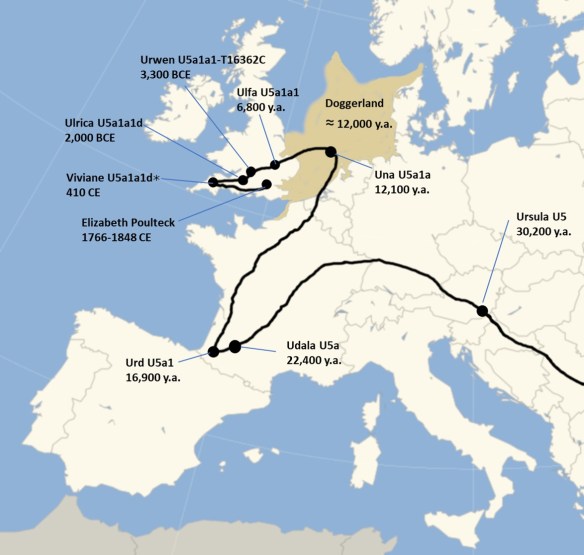
Figure 1. Migration path of my maternal ancestors from Ursula (U5) to Viviane (410 CE). A map of the earlier migration from mitochondrial Eve to U5 is included in an earlier post.

Updated biographies of my maternal haplogroup great* grandmothers follow below.

Continue reading

Skiing in the French Alps

I have just spent a week skiing in the French Alps with my younger son. We stayed in a chalet above the village of Les Gets in Les Portes du Soleil ski doman (the Gates of the Sun). Normally the snow is down to the village, but this February is the warmest I have experienced since I have lived in Geneva and the snow did not extend much lower than our chalet. Fortunately it snowed quite a bit after we arrived, and there was plenty of fresh powder for skiing. And enough to ski back to our chalet at the end of the day.

View from our chalet

Continue reading

Our Asgardian ancestors

I grew up reading northern European myths and legends, including tales of Odin, Thor, and the other gods of Asgard. I was largely unaware of the Marvel comics appropriation of Thor and other Asgardians as superheros until the Marvel cinematic universe started to hit the big screens in the last 12 years.

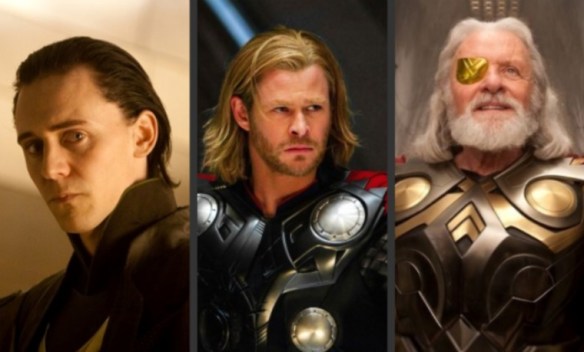
Loki, Thor and Odin (from the Marvel Cinematic Universe)

I have only recently come across the growing evidence that an Asgardian was one of our ancestors, way back near the beginning of the evolution of life, when the first eukaryotic cell appeared. Eukaryotes are organisms whose cells contain membrane-wrapped internal structures, such as a nucleus, unlike prokaryotes (Bacteria and Archaea), which have no membrane-bound internal structures.

Continue reading

Powerlifting

Approaching retirement from full-time work, the last thing I would have foreseen doing was to take up powerlifting and get involved in competitions. I had plans to spend more time walking and climbing in the Alps, but increasing knee problems (osteoarthritis) around 2014-2015 put that on hold. I stopped doing Crossfit classes in 2015 and instead started to focus on weight training apart from squats.

I had also been reading various books and research relating to exercise and ageing, and became convinced that to maximise my health and functioning into older age I needed to maintain and improve my strength, and that this was probably more important than the endurance cardiovascular training that I had been doing for many years.

I found that I really enjoyed training with heavy weights and low repetitions (usually in range 3-6) and that my knees felt a lot better after a workout. With some coaching on good technique, I was able to substantially increase the weight and volume I was working with and would often leave the gym with an endorphin high and pain-free knees. Occasional lower back pain (related to an old injury during jujutsu training) also became rarer.

Continue reading

Deep maternal ancestry and mtDNA

In February 2014, I did a series of posts on my deep maternal ancestors, identified through a test of mutations on my mitochondrial DNA (mtDNA) which is inherited only from the mother. This test was carried out by Ancestry.com, who have since discontinued tests of mtDNA and Y-chromosome DNA. Costs of DNA tests have dropped dramatically since then, and late last year I ordered an mtDNA test from FamilyTreeDNA (www.familytreedna.com) which carried out a full sequencing of the mitochondrial DNA.

As well as the DNA that makes up the chromosomes in the nuclei of our cells, we also have another type of DNA called mitochondrial DNA (mtDNA). The mitochondria are organs located outside the cell nucleus which convert sugars into energy.  Mitochondria have a small circular loop of DNA, containing only approximately 16,569 base pairs in humans. The circular mtDNA is similar to the DNA of bacteria, and it is thought that mitochondia evolved from symbiotic bacteria that were once free living.

Continue reading

Australia appears to be committing climate suicide

Media across the world have been publishing articles and photos on the catastrophic bushfires in Australia. Richard Flanagan, a well-known Australian author, published an opinion piece in the New York Times two days ago, which fairly accurately summarized the impact of the fires and the complete inadequacy of the government and political response (Australia Is Committing Climate Suicide).

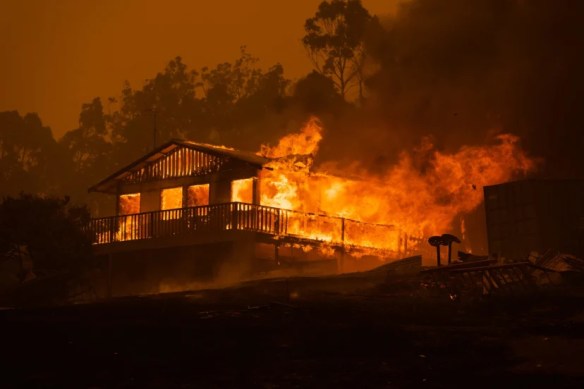
Mogo, a town on the NSW south coast has been devastated by bushfires. One Mogo resident watched his 92 year old father’s house burning next door. At the time of taking this photo, he wasn’t sure where his father was. Credit: James Brickwood

Here are some quotes from the article:

“Australia today is ground zero for the climate catastrophe. Its glorious Great Barrier Reef is dying, its world-heritage rain forests are burning, its giant kelp forests have largely vanished, numerous towns have run out of water or are about to, and now the vast continent is burning on a scale never before seen.       …….

“The fires have already burned about 14.5 million acres — an area almost as large as West Virginia, more than triple the area destroyed by the 2018 fires in California and six times the size of the 2019 fires in Amazonia. Canberra’s air on New Year’s Day was the most polluted in the world partly because of a plume of fire smoke as wide as Europe.

“Scientists estimate that close to half a billion native animals have been killed and fear that some species of animals and plants may have been wiped out completely. Surviving animals are abandoning their young in what is described as mass “starvation events.” At least 18 people are dead and grave fears are held about many more. …..”

A deceased horse on a property on the outskirts of Cobargo, a town on the NSW south coast that was devastated by bushfires at New Year. Credit: James Brickwood

Continue reading