Skiing in the French Alps

Schools in Geneva have a one-week mid-term break in February, and the ski slopes are normally crowded. I took my boys for a week skiing in the French Alps at Les Gets, which is a little over 60 kilometres from Geneva, in the direction of Chamonix. The slopes were even more crowded as usual, as it was also the British mid-term break, and Les Gets is a popular destination.
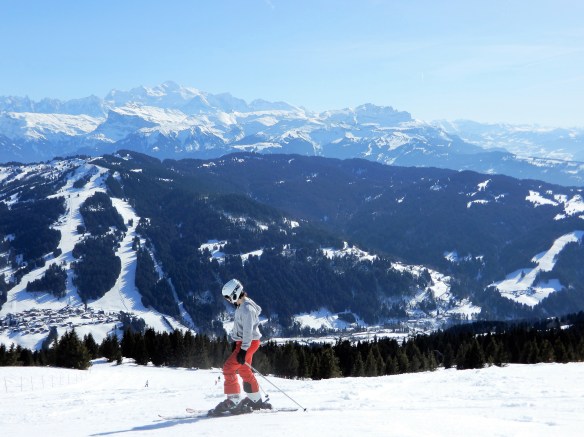
Looking towards Mont Blanc from Mont Chéry.

The village of Les Gets, visible in the valley below my younger son in the photo above, is relatively low at 1,170m above sea level, and the highest points accessible on ski are at around 2000 m. The photo above was taken near the summit of Mont Chéry at around 1,800 m. In the distance to the south-east Mont Blanc (4,810 m) is visible on the horizon. I stood on its summit in 2010 (Mont Blanc), 3000 metres higher than where I and my son are now standing. Below is another photo taken using the zoom lens.
Continue reading

Alexandria Bay

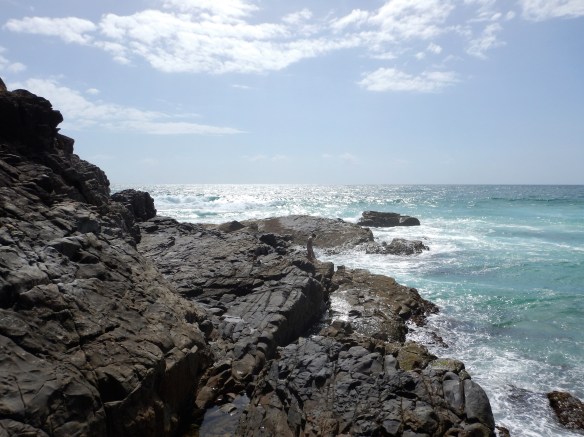
I returned to Noosa in Queensland, Australia for Christmas with my sister and mother. While there I walked from the southern end of Noosa National Park along the coastal track to Alexandria Bay where I had a swim with the jellyfish and enjoyed the relative solitude of a beautiful beach on the Pacific Ocean.

Northern end of Sunshine Beach

Continue reading

Glacial Erratic Blocks in the Rhone Valley

Continuing our glacial explorations (see also The-pyramids-of-euseigne), we visited a number of enormous glacial erratic blocks in the wooded slopes above the town of Monthey in the Rhone Valley. These blocks played a pivotal role in the realization that there had been great Ice Ages in the past. There are eight blocks along a trail about 5km long between Monthey and Collombey. ( MT_Blocs_Erratiques_Web.pdf). The first and largest of these blocks, “La Pierre des Marmettes”, is now in the middle of the parking lot of the Monthey Hospital.

La Pierre des Marmettes

Continue reading

The Pyramids of Euseigne

The Pyramids of Euseigne are one of the more bizarre geological features created by the last ice age. They are in the Val d’Hérens, one of the southern side valleys off the Rhône valley of Switzerland. The entire Rhone valley and its side valleys were under glaciers at the height of the last ice age around 23,000 years ago. An old university friend who is a geologist visited Switzerland at the beginning of the year and invited me to join him for an exploration of some of the landscape features created by the glaciers of the last ice age.

In the photo below, my friend is looking south towards the junction of the Val d’Hérens and Val d’Hérémence where two glaciers met and continued down towards us. The pyramids are located on the ridge separating the two valleys, We are standing on the remnants of a glacial lake delta formed by the damming of the melt waters of the joined glaciers. The glaciers retreated about 11,000 years ago when humans expanded north back into Northern Europe and Britain again.

The Pyramids are the remnants of a ground moraine created from finely ground silt and sand with embedded larger boulders. Some of the boulders protected the underlying compacted silt from erosion, forming protective caps.

Continue reading

Canoeing in the Noosa Everglades

While visiting Noosa in July, I took my two boys on a kayak trip into the Noosa Everglades.  Located in the Great Sandy National Park, the upper reaches of the Noosa River are a network of waterways, rivers, lakes and marshes and are best explored by kayak or canoe. The Everglades are situated in the Noosa Biosphere, which is one of Australia’s most diverse ecosystems and includes more than 40 per cent of the country’s bird species.

We drove about 20 km from Noosa to Booreen Point on Lake Cootharaba and crossed the lake in a larger boat to the mouth of the Upper Noosa River, where we changed to canoes, and continued into the Everglades by canoe. Lake Cootharaba is one of three large lakes connected to the Noosa River, the others are Lake Cooroibah and Lake Weyba.

Lake Cootharaba

The banks of the river are a mix of swampy grassland and subtropical forest, with patches of rainforest. There are lots of banksia trees and tea-trees. The tea-trees stain the water a deep brown colour from the tannin in their leaves. The Tea Tree, Melaleuca alternifolia, is an Australian native plant, and its leaves are also used to produce tea-tree oil, prized for its it’s anti-bacterial and anti-fungal prowess.

Upper Noosa River

Continue reading

WW1 Diaries of Tom Mathers – extracts on the Battle of the Somme 1916

Just over 100 years ago my grandfather Will Mathers and his brother Tom, both in the 8th Australian Field Ambulance, took part in the Battle of the Somme, on the front line from 18 September 1916 to 8 November.

The Battle of the Somme, also known as the Somme Offensive, was fought by the armies of the British and French empires against the German Empire. It took place between 1 July and 18 November 1916 on both sides of upper reaches of the River Somme in France. It was the largest battle of the First World War on the Western Front; more than one million men were wounded or killed, making it one of the bloodiest battles in human history. Tom kept a diary throughout the war [see Endnote 1] and his diary account provides a terse but graphic account of the experience of being a stretcher bearer on the front lines.

Continue reading

Barcroft Boake (1866-1892): Australian bush poet

In an earlier post https://mountainsrivers.com/2015/10/26/ancestral-tales-a-theosophist-a-thief-and-an-indian-princess/ I wrote about my great-aunt Boodie (Florence Teasdale Smith) who was a theosophist, whose father was a bank robber and she was also descended from an Indian princess.  I mentioned in passing that her uncle was a famous Australian poet who committed suicide but did not give any details. So this post is about Barcroft Boake, an Australian bush poet, who committed suicide at the age of 26.

Continue reading