Variations and trends in cultural values across 105 countries, 1980 to 2020

I’ve long been interested in the relationship between the stages of development of the individual (whether stages of moral development, psychological development, or consciousness) and the stages of development of human societies and civilizations. With the increasing prominence of fundamentalist religion in some regions of the world, the rise of science denialism and “post-truth” popularist politics, differences in human values are of huge importance and can literally become life and death matters for people. More generally, it seems fairly clear that people’s beliefs play a key role in economic development, the emergence and flourishing of democratic institutions, the rise of gender equality, and the extent to which societies have effective governments.

So I have taken an interest in results from the World Values Survey over the last two decades, and last month learnt that data from its most recent wave was being released in late July. There have now been seven waves of the World Values Survey (WVS), the first in 1980-1982 and the seventh underway since 2017. There have also been five waves of the European Values Study (EVS), which includes many of the same items as the WVS, and whose most recent wave covers the period 2017-2020. With the release of the WVS 7th wave data for 48 countries in July 2020, the WVS plus the EVS now include data for 117 countries or territories and over 638,000 respondents, covering the period 1981-2020.

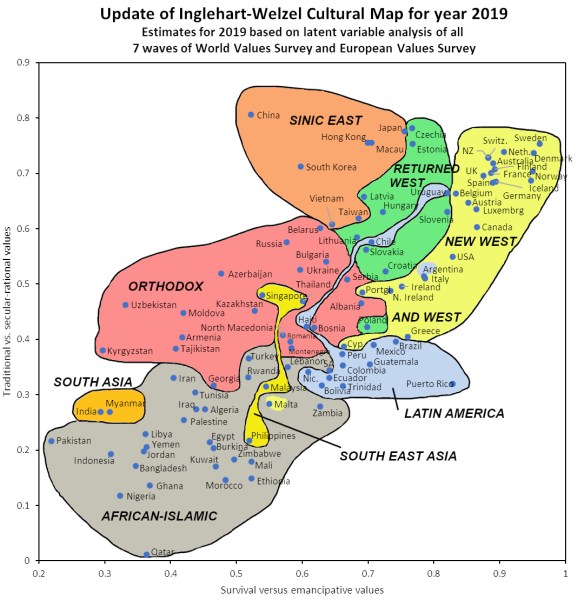
Data from previous waves of the World Values Survey were used by political scientists Ronald Inglehart and Christian Welzel to identify two major dimensions of cross cultural variation across the world. They refer to these as Traditional values versus Secular-rational values and Survival values versus Emancipative values. Traditional values emphasize the importance of religion, parent-child ties, deference to authority and traditional family values in contrast to secular-rational values. Survival values place emphasis on economic and physical security. It is linked with a relatively ethnocentric outlook and low levels of trust and tolerance. Emancipative values are associated with gender equality, relative acceptance of divorce, abortion, and homosexuality and rising demands for participation in decision-making in economic and political life. Inglehart and Welzel used factor analysis to estimate where each country lies on these two dimensions are constructed what they called a “culture map”.

I set out to replicate this analysis with the full WVS+EVS dataset including the latest wave [1-4]. I decided to use a different statistical approach (item response theory) to estimate the two dimensions. I have posted a more technical summary on my professional website to give details of this analysis. In brief, I used structural equation modelling to estimate two latent variables. The survival-emancipative variable was derived from data for three questions of gender equality (jobs, politics, education) and three questions on acceptance of homosexuality, abortion, and divorce. The traditional-secular values variable was derived from data for three questions on sources of authority (nation pride, government, parents) and three questions on religion (importance, belief, practice. The values for countries with data for years 2005 or later were used to extrapolate values for year 2019. The following “culture map” shows the location of 105 countries based in these two variables.
Continue reading →

Breathwork and sensed energy

In an earlier post, I described my experience with transformational breathwork and the Wim Hof method. I’ve continued to practice these, and to do some online sessions with the breathwork instructor from the retreat I attended late last year. In looking around for more information on breathwork, I came across a book by David Lee called “Life force: Sensed Energy in Breathwork, Psychedelia and Chaos Magic” (Norwich: The Universe Machine, 2018).

Lee gives an overview of and simple instructions for ten types of breathwork, as well as discussing their various purposes and effects, and the relationships between them. This is interesting enough, but his approach to understanding breathwork completely changed my experience of it. He describes the book as an exploration of “sensed energy” and schemes of belief that work best for experiencing, cultivating and manipulating these subtle sensations. In particular, he frames breathwork in terms of the arousal and relaxation of sensed energy.
Transformational breathing produces within minutes a tingling within the hands and feet and a sense of energy surging around the body. Lee advises to simply witness this energy as it circulates and coalesces into definite sensations and emotions. Layers of unresolved emotion may surface and the high level of sensed energy helps them to resolve. So breathwork may untangle pain and discomfort from the past. Lee describes how to modulate the intensity of the breathwork to hover in the space between suppression of this unresolved material and its too intense activation, allowing a process of resolution to occur, rather than repression or re-traumatizing. I certainly experience intense emotions at times during breathwork, and the periods of “tantrum” and application of pressure to particular points on the body enable you to intensify and experience or release these intense emotions.

Continue reading →

A pandemic out of control

Over the last two days, I’ve been assessing the coronavirus situation across the world. I’ve posted a regional analysis of trends in new cases on my professional site (an-out-of-control-pandemic-in-most-world-regions).

I reproduce a graph of regional trends below. The dramatic difference in trajectories for Western Europe and the Americas is obvious. While levels are lower in most developing regions, this is mostly due to much lower levels of testing. But confirmed new cases in all regions apart from Europe and East Asia and Pacific are rising.

North America has the most out-of-control epidemic, and that is all due to the USA. I plotted trends for blue and red states in the USA. There is a dramatic difference, with most of the recent rise in new cases occurring in red states (that voted for Republican presidents in most of the recent presidential elections). In the week ending July 5, there were an average 226 new cases per 1 million population in red states compared to 88 per million in blue states.

In a second post which-countries-are-succeeding-and-not-succeeding, I have shown country-specific plots for selected examples of three groups of countries: (1) those that are beating Covid-19, (2) those that are nearly there, and  (3) those that need to take action.  The experiences of the first two groups of countries show that (a) it is important to act early, not wait till there a hundreds of deaths in the country, (b) it only takes about 5-7 weeks of strong interventions to get rid of the majority of cases and (c) half measures don’t work.

COVID-19: light at the end of the tunnel for some countries

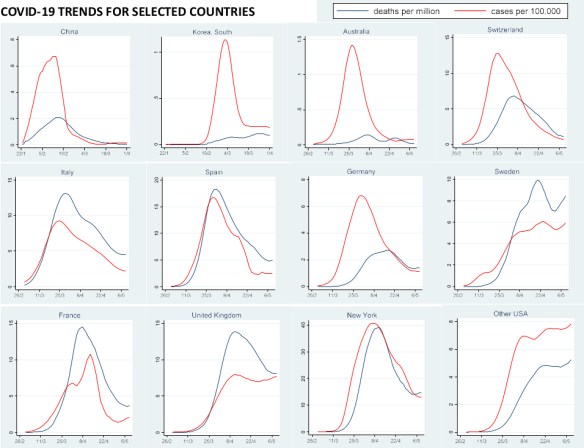
Tomorrow, Switzerland will relax its social distancing regime. Classroom teaching at primary and lower secondary schools will again be permitted. Shops, markets, museums, libraries, gyms and restaurants will be able to reopen under strict compliance with precautionary measures. Switzerland has had the 10th highest death rate per million people but has been one of the few high death rate countries to successfully control the epidemic. See the plot for Switzerland below.

Continue reading →

COVID-19 short-run projections

Its now one month since my earlier post on the coronavirus pandemic    A lot has changed since then. We have gone from 24,392 deaths globally on March 26 to 206,915 on April 26th. And recent analysis of total registered deaths by week in February and March, compared to the same periods in the previous year, suggest that the reported deaths (mostly hospital deaths) are only about 70% of the actual deaths. The proportion of deaths reported in developing countries without good death registration (including most of Africa, and much of Asia) will be even lower.

Continue reading →

Buddhism without beliefs

My son has been reading the existentialists, starting with Camus (of course, The Plague is quite relevant for more than one reason now). He recently moved on to Kierkegaard, who took a form of Christianity as a solution to existential angst. I was reminded of a book I read probably 15 years ago, by Stephen Batchelor: Buddhism Without Beliefs (London: Bloomsbury 1997) which argued that the Buddha was concerned with addressing the existential issue of suffering not with metaphysics and beliefs.  I couldn’t find my copy of this, and bought another, which I enjoyed reading even more than the first time.
Continue reading →

COVID-19: the big picture

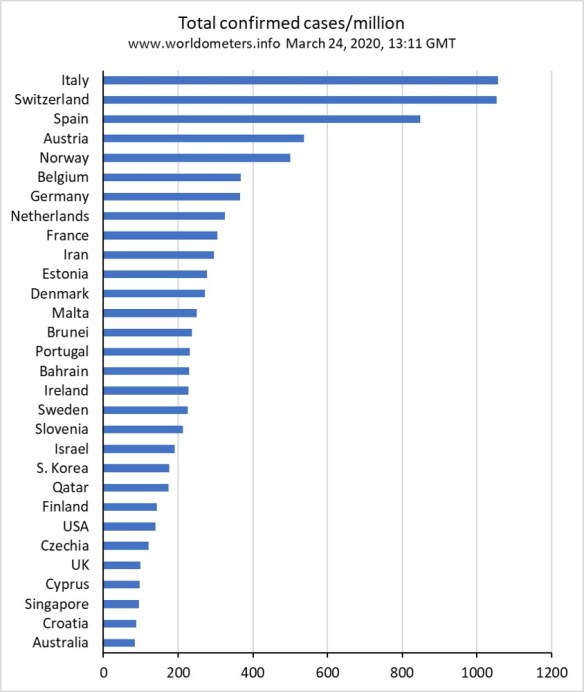
Today Switzerland became the country with the highest rate of confirmed cases of corona virus per million population. Well, that is if you ignore some micro-populations such as the Vatican City, San Marino, Andorra and Faeroe Islands. Why?  It is landlocked with Italy, France and Germany around it. It did not close the border between Ticino and Italy for cross-border workers and many live in Italy were the virus spread rapidly. Also, it was the height of the ski season and alpine resorts were crowded with skiers from all over Europe, Britain and beyond. Here is a graph I did yesterday comparing confirmed cases per million population  for the thirty leading countries (excluding small countries with population less than one million. Data are from worldometers.com at 13.11 GMT on March 24. A this point Switzerland had not yet overtaken Italy.

Continue reading →

Becoming Human Part 1

Our understanding of the evolution of us modern humans has changed dramatically in the last few years as ancient genomes are decoded and we discover that humans, Neanderthals and Denisovans interbred, and also in the remote past interbred with previously unknown “superarchaic” human groups.  Scientists are also discovering new species of extinct hominids, and no doubt will continue to shed further light on our origins. Just to try to sort out the big picture in my own mind and to put these various discoveries in context, I’ve tried to summarize what we think we know, or at least what the evidence available to date suggests. This will no doubt continue to change.

This is the first of two posts and summarizes the evolution of pre-human species from the first monkeys around 35 million years ago (Mya) to the appearance of the first human species around 2 Mya. A following post will summarize the evolution of humans from the appearance of the first human species Homo habilis 2 Mya to the appearance of anatomically modern Homo sapiens sapiens around 250 thousand years ago and  mitochondrial Eve, who lived around 178,000 years ago.

Continue reading →

Is freedom increasing or decreasing?

Last week, Freedom House released its 2020 annual report on global freedom. The report documents trends in every region of the world of declining political and civil freedom: “In every region of the world, democracy is under attack by populist leaders and groups that reject pluralism and demand unchecked power to advance the particular interests of their supporters, usually at the expense of minorities and other perceived foes.”

The report compiles a freedom index for countries based on an average of two indices for political rights and civil liberties, composed of numerical ratings and descriptive texts for each country. The 2020 index adds to a time series for countries that extends back to 1972.  I’m interested to see to what extent the time series upholds the view of Stephen Pinker that there has been sustained long-term improvement in both political rights and human rights globally and this will continue (Enlightenment Now, Chapters 13 and 14).

The graph below shows time trends for the number of countries falling into three broad categories of the freedom index, labelled as Free (green shades), Partly free (orange shades) and Not free (purple shades). The graph includes 185 countries. 11 very small countries with populations less than 90,000 in 2015 are not included.

Trends in numbers of countries by broad freedom category

Continue reading →

Australia appears to be committing climate suicide

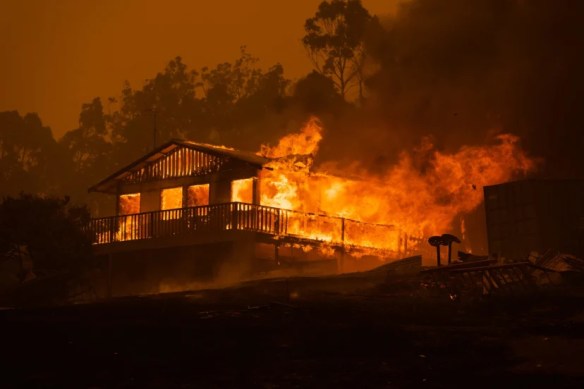
Media across the world have been publishing articles and photos on the catastrophic bushfires in Australia. Richard Flanagan, a well-known Australian author, published an opinion piece in the New York Times two days ago, which fairly accurately summarized the impact of the fires and the complete inadequacy of the government and political response (Australia Is Committing Climate Suicide).

Mogo, a town on the NSW south coast has been devastated by bushfires. One Mogo resident watched his 92 year old father’s house burning next door. At the time of taking this photo, he wasn’t sure where his father was. Credit: James Brickwood

Here are some quotes from the article:

“Australia today is ground zero for the climate catastrophe. Its glorious Great Barrier Reef is dying, its world-heritage rain forests are burning, its giant kelp forests have largely vanished, numerous towns have run out of water or are about to, and now the vast continent is burning on a scale never before seen.       …….

“The fires have already burned about 14.5 million acres — an area almost as large as West Virginia, more than triple the area destroyed by the 2018 fires in California and six times the size of the 2019 fires in Amazonia. Canberra’s air on New Year’s Day was the most polluted in the world partly because of a plume of fire smoke as wide as Europe.

“Scientists estimate that close to half a billion native animals have been killed and fear that some species of animals and plants may have been wiped out completely. Surviving animals are abandoning their young in what is described as mass “starvation events.” At least 18 people are dead and grave fears are held about many more. …..”

A deceased horse on a property on the outskirts of Cobargo, a town on the NSW south coast that was devastated by bushfires at New Year. Credit: James Brickwood

Continue reading →